

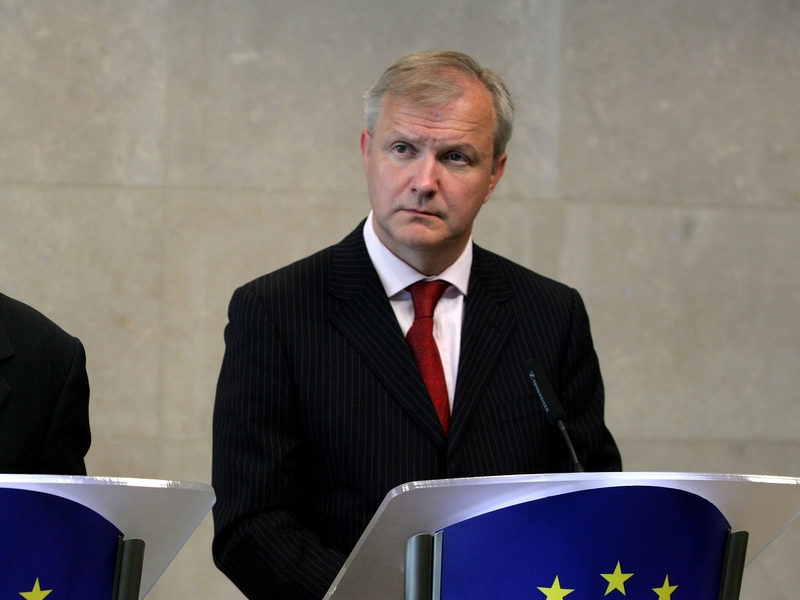
The European Commission is set to float proposals to create a 'European IMF' tomorrow. An official said the body could rescue debt-hit countries such as Greece.
Economic and Monetary Affairs Commissioner Olli Rehn will 'inform' the full commission tomorrow of continuing talks on the issue, his spokesman said.
The International Monetary Fund gives out emergency loans to countries with troubled finances but strict conditions are usually attached.
Plans to 'reinforce economic co-ordination across Europe will be centred on the 16 euro zone members, as the euro area has come under pressure as a result of the Greek budget crisis.
Spokesman Amadeu Altafaj Tardio said the commission was 'ready to propose such a European instrument', and gave a tentative deadline of the end of June for full details on how and by whom it would be funded.
Rehn earlier told the Financial Times Deutschland newspaper that the monetary fund 'would have the support of euro zone members' and that such financial aid would be linked to 'strict conditions'.
The Greek deficit crisis has triggered intense debate over how the euro countries deal with problems in one member state, reviving arguments first aired - and rejected by Germany - at the birth of the currency a decade ago.
German Finance Minister Wolfgang Schauble is in the forefront of the moves to beef up the bloc's economic toolkit, telling the weekend Welt am Sonntag newspaper that 'for the internal stability of the euro zone, we need an institution that has the experience and power of the IMF'.
There has been mixed reaction to the 'EMF' proposal, with German Chancellor Angela Merkel saying today that she backs the idea in principle, although a number of details would have to be cleared up before anything was agreed.
She told reporters issues such as who would contribute and how independent such an organisation would be still had to be looked at.
But the European Central Bank's head economist has criticised the proposal. 'Such a mechanism would not be consistent with the founding principles of the monetary union,' Jurgen Stark told the financial newspaper Handelsblatt in comments to appear on Tuesday but released in advance.
The Greek debt crisis has highlighted differences in the 27-nation EU between the euro countries and those that have retained their own national currencies, giving the latter greater leeway in managing their finances as they can devalue their money if they so wish to help balance their books.
Central bankers optimistic on growth
Leading central bankers believe economic growth is advancing on a 'very positive' path, allowing them to unwind stimulus measures. This is according to European Central Bank chief Jean-Claude Trichet, who was speaking after they met this morning.
'At the global level, the sentiment is that growth continues to be very positive, and with a number of corrections,' he told reporters in Basel after the group of central bankers held their regular meeting at the Bank for International Settlements. Trichet said global economic growth was regarded as robust with a revival in international trade.
Portugal plans spending cuts
Meanwhile, Portugal became the latest euro zone country to announce austerity measures to rein in a ballooning budget deficit as bond markets eased pressure on debt-stricken Greece today after a French pledge of EU help.
Portugal unveiled plans to cut its deficit to 2.8% of gross domestic product in 2013 from 8.3% this year by trimming spending on civil servants and public investment, and raising taxes on high incomes and stock market gains.
The programme is seen as the key to convincing markets that Portugal will tackle its high deficit and debt after coming under scrutiny by investors fearing it may be next in line to have Greek-style fiscal problems.
Under the plan, Portugal's public debt would peak at 90.1% of GDP in 2012 and fall thereafter. Greece's debt is set to reach 125% of GDP this year.
Greece's borrowing costs and the price of insuring Greek debt against default both fell after French President Nicolas Sarkozy gave the clearest indication so far that firm plans to help Athens were ready if needed.
