


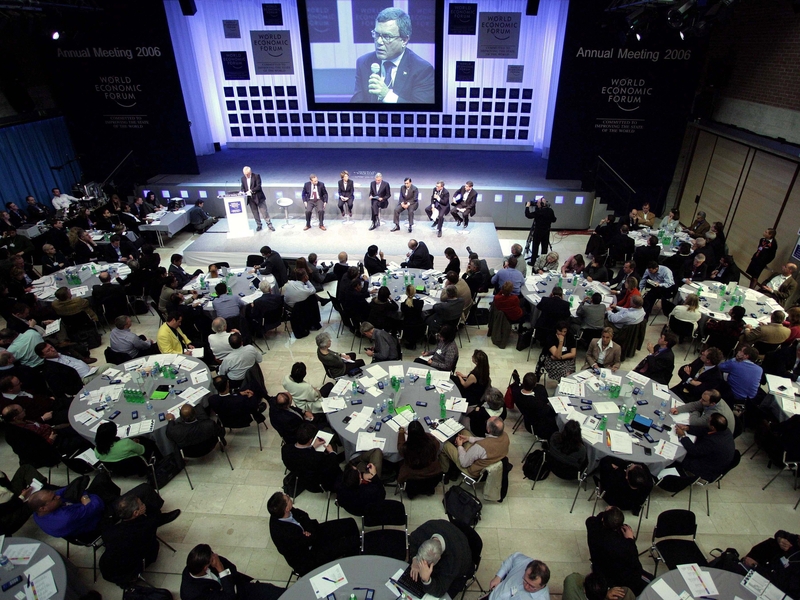
The World Economic Forum took place in the Swiss ski resort of Davos from 28 January to 1 February.
Watch extensive coverage of the sessions at RTÉ.ie/Live
Click here for a full schedule and list of podcasts
Read about Friday's speeches by Gordon Brown and Angela Merkel calling for more regulation of the global economy, plus a call from HSBC for lower salaries for bankers. Click here
Brian Cowen gives his reaction to comments by the European Commission President, President José Manuel Borosso who compared Ireland and Iceland here
Listen here to ECB President Jean-Claude Trichet telling delegates at Davos that no country will be asked to leave the euro zone.
Listen to David McWilliams' preview of the meeting on Morning Ireland
Read about Brian Cowen's visit to Davos, and Thursday's focus on international security
In his address at the World Economic Forum China's premier Wen Jiabao criticises the policies pursued by the US - read it here.
Participate in the discussion on the Davos YouTube page
Crisis summit signals era of big government
The world is entering an era of big government with only state muscle powerful enough to fight the economic crisis, top leaders signalled at the Davos summit.
News of mass job losses and fears of social unrest and protectionism reverberated around the gloomy halls of the World Economic Forum in Switzerland.
But the absence of any senior member of President Barack Obama's US administration in the Swiss resort and nationalist rumblings in Washington left doubts about how closely the major powers will take up the battle together.
The 'go-go years' are over, admitted HSBCchairman Stephen Green talking for beleaguered bankers at the elite gathering. And Europe's main leaders made it clear that they want a greater grip on the international financial system.
German Chancellor Angela Merkel proposed a UN economy council on the lines of the Security Council that kept squabbling nations apart after World War II.
'Freedom is a necessary precondition for market forces to operate,' she said in a speech which condemned 'unfettered markets'. 'Individual freedom needs to be limited if it takes freedom away from others,' she added.
Britain's Prime Minister Gordon Brown called for a 'global regulatory system' with a toughened up International Monetary Fund and World Bank. Governments have already spent $1 trillion bailing out banks, he reasoned.
The government does not want to be a shareholder in banks but 'you cannot leave everything to the market,' Brown declared.
Police fought anti-forum demonstrators in Geneva and Bern and kept other protesters at bay in Davos, as Brazil's Foreign Minister Celso Amorim warned: 'For more vulnerable nations there is the threat of instability and social unrest with all its dire consequences.'
French Finance Minister Christine Lagarde said 'social unrest and protectionism are the two major risks of the world economic crisis. I think it's a risk in Europe, it's a risk elsewhere as well.'
Nearly every prime minister and minister present vowed to fight protectionism. But with alarm bells ringing over a US Congress measure proposing that only US steel be bought with US stimulus package money, World Trade Organisation director general Pascal Lamy said there are already protectionist spots on the radar.
'The more governments get involved in the market, the more probable that protectionist measures will come about and that is a vicious circle,' said South Korea's Trade Minister Kim Jong-Hoon.
The world is now waiting for a Group of 20 summit in April and world trade talks to send important signals about the intent of governments to work together to ease the pain of the crisis.
The French finance minister said the world was working against the clock to get proposals ready for the G20 summit in London.
For most ministers the attitude of the US will be crucial. China's Premier Wen Jiabao and Russian Prime Minister Vladimir Putin both took Davos pot shots at the US role in the causes of the crisis and the dominance of the dollar.
There was no high ranking American in Davos to reply and little is known about what Obama thinks about the global regulation advocates.
