
Minister for Foreign Affairs, Trade and Defence Helen McEntee has said that she wants to bring Ireland's new maritime strategy "to the fore" during Ireland’s upcoming presidency of the Council of the European Union, which begins on 1 July.
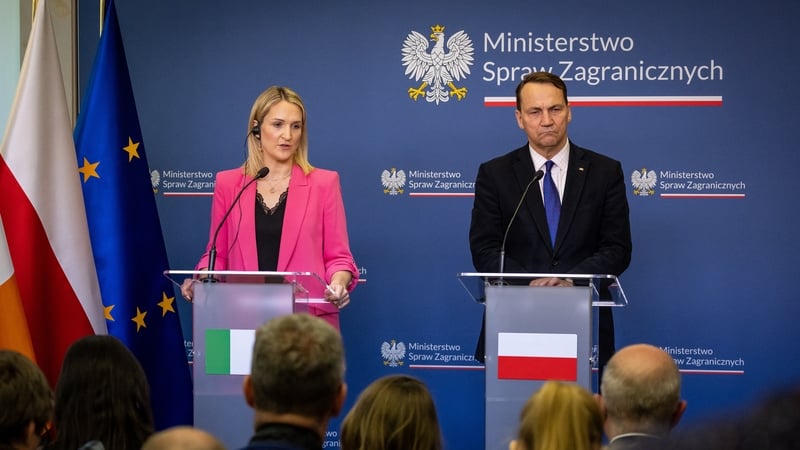
Ms McEntee was speaking in Warsaw after holding bilateral meetings with Polish foreign minister Radosław Sikorski and Polish defence minister Władysław Kosiniak-Kamysz, both of whom also hold roles as deputy prime ministers of Poland.
The meetings focused on Ireland’s priorities for the upcoming EU presidency, namely, EU core values, security and European competitiveness.
"I've published just this year a new maritime security strategy, which I wanted to bring to the fore during the presidency, making sure that countries that are very much affected by maritime security or maritime threats, be it above sea or below, with our significant critical infrastructure underwater, that we're working more closely together," Minister McEntee said.
She also said that the strategy would involve information sharing to protect maritime infrastructure and to develop capabilities to "respond where threats emerge".
In February, Minister Entee launched Ireland’s first National Maritime Security Strategy, aimed at safeguarding Irish sovereignty through enhanced protection of Ireland’s critical maritime infrastructure, including subsea cables.
Watch: Govt 'ambitious' with Defence Forces investment, says McEntee
The strategy also envisages closer naval co-operation with France and the UK.
Poland prioritised European security during its EU presidency for the first six months of 2025 and is projected to spend close to 5% of its annual GDP on defence this year, the largest share per capita in the bloc.
By contrast, Ireland’s defence budget is one of the smallest in the bloc, slightly more than 0.2% of GDP.
However, the Government allocated a record €1.5bn for defence expenditure this year, marking a 35% increase since 2022, the year Russia launched its full-scale invasion of Ukraine.
"We are increasing our capital funding for defence spending by 55% so we are very focused on investing more," Ms McEntee said.
The minister also said the Government was focused on investing more on radar and sonar capabilities, as well as counter-drone technology, specifically for Ireland's naval service.
Minister McEntee said she also discussed support for Ukraine during her meetings with Mr Sikorski and Mr Kosiniak-Kamysz.
"Defending Ukraine is the same as defending Europe, and it's really important that we continue to support Ukraine, that we continue to put pressure on Russia, be it through sanctions or other means.
"It is essential that Europe, that the EU, is around the table for any future negotiation for any agreement that's reached between Ukraine and Russia," she added.
During their joint press conference, Mr Sikorski said he welcomed that security was "once again one of the priorities" of the EU presidency and that Ireland and Poland were "united by a strong Polish diaspora, which has found a second home in Ireland".
Read more
Ireland in 'absolutely critical position' amid tensions with Russia