


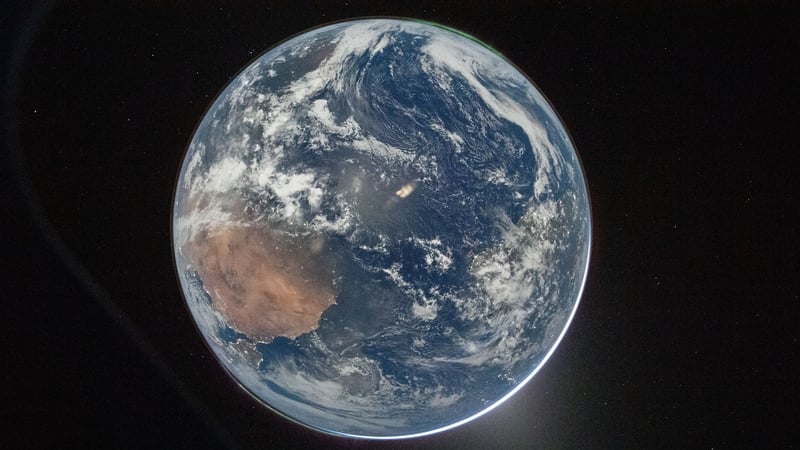
Astronauts aboard NASA's Artemis II Orion capsule have said the Moon is "definitely getting bigger," marking the third day of their high-stakes mission around the lunar surface, aiming to return humans to the Moon later this decade.
The four Artemis astronauts have passed the halfway point between Earth and the Moon on the way to their planned lunar flyby, NASA said.
"We're halfway there," the space agency posted on social media.
NASA's online dashboard showed the Orion spacecraft carrying the astronauts is now more than 256,000 kilometres from Earth.
NASA also released initial images taken from inside the Orion spacecraft, including a full portrait of Earth featuring its deep blue oceans and billowing clouds.
The astronauts fired up their spacecraft's engine to break away from Earth's orbit towards the Moon yesterday.
Watch: 'The moon is definitely getting bigger', says Artemis astronaut
The burn lasting just under six minutes propelled them on their three-day voyage towards Earth's natural satellite, the first since 1972.
The orange-and-white Space Launch System (SLS) rocket carrying the Orion capsule blasted off from Kennedy Space Center in Florida for the long-anticipated journey.
The astronauts - Americans Reid Wiseman, Victor Glover and Christina Koch and Canadian Jeremy Hansen - spent their first hours in space performing checks and troubleshooting minor problems on the spacecraft that has never carried humans before, including a communications issue and a malfunctioning toilet.
"On our first day in space, we just saw some extraordinary things, the Earth up close, and then by the time we had a bit of a nap and got up, the Earth was just so far away again," Mr Hansen said.
Mr Hansen said he felt like he was "falling out of the sky" as his spacecraft followed its complex flight path to the Moon.
"It just felt like we were falling out of the sky back to Earth, and I said to Reid, 'It feels like we're gonna hit it,'" Mr Hansen said.
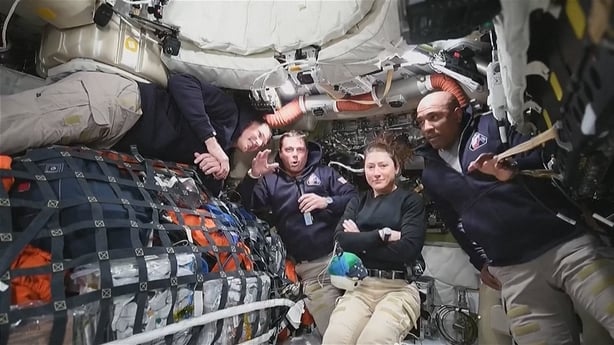
"It's amazing that we're actually gonna go around and miss this thing. It was just so close and so to take all of that in was really phenomenal."
Mission pilot Victor Glover described being able to see features of the Moon as the mission continued on its journey.
"We took some pictures earlier today, and then after putting them on the computer to look closer, we found a feature, you know, the 'Grand Canyon' of the Moon, it's called Orientale Basin, and we were able to see the entire thing,"
"And yes, the Earth is quite small and the Moon is definitely getting bigger."
The ten-day Artemis II mission is aimed at paving the way for a Moon landing in 2028.
The mission marks a series of historic accomplishments: sending the first person of colour, the first woman and the first non-American on a lunar mission.
If all proceeds smoothly, the astronauts will set a record by venturing farther from Earth than any human before - more than 402,000km.
Lock in, we're Moonbound.
— NASA (@NASA) April 4, 2026
Artemis II astronauts are more than halfway to their destination, and preparations for lunar flyby are underway. During their trip around the far side of the Moon, they will capture imagery to share with scientists (and you, too!). pic.twitter.com/T2z4W2XLCt
NASA praises photographs taken by astronauts
NASA official Lakiesha Hawkins praised the photographs taken by commander Wiseman, calling them "amazing" during a briefing yesterday.
"We continue to learn all about our spacecraft as we operate it in deep space with crew for the first time," Ms Hawkins said.
"It's important to remind ourselves of that as we learn a little bit more day by day," she added.
It is also the inaugural crewed flight of SLS, NASA's new lunar rocket.
SLS is designed to allow the United States to repeatedly return to the Moon with the goal of establishing a permanent base that will offer a platform for further exploration.
It was meant to take off as early as February after years of delays and massive cost overruns.
But repeated setbacks stalled it and even necessitated rolling the rocket back to its hangar for repairs.
Watch: NASA rocket launches from Florida for Artemis II mission
The current era of American lunar investment has frequently been portrayed as an effort to compete with China, which aims to land humans on the Moon by 2030.
The Artemis programme has come under pressure from US President Donald Trump, who has pushed its pace with the hope that boots will hit the lunar surface before his second term ends in early 2029.
But the projected date of 2028 for a landing has raised eyebrows among some experts, in part because Washington is relying heavily on the private sector's technological headway.
