


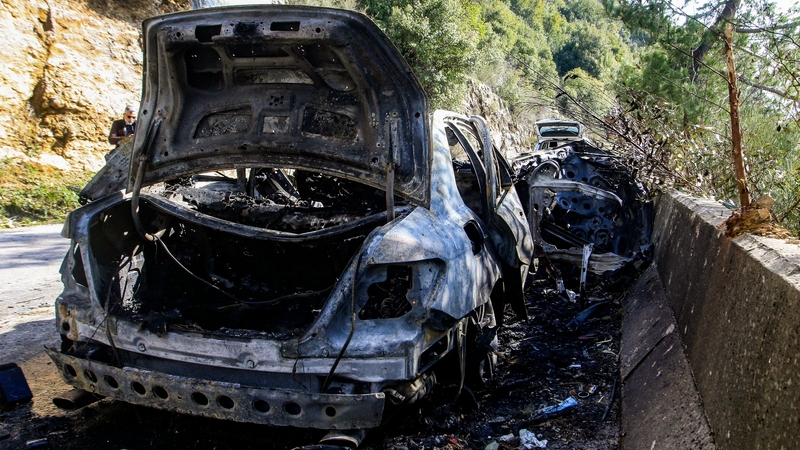
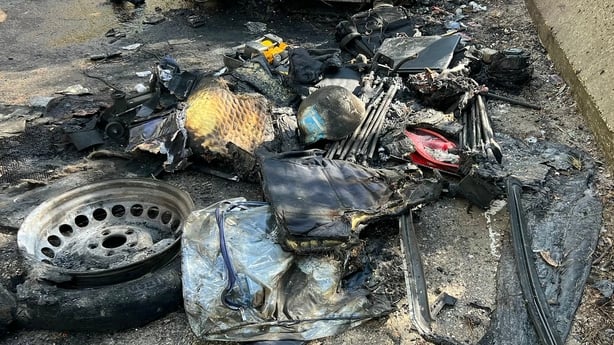
Israeli forces killed three Lebanese journalists in southern Lebanon in an airstrike that Israel's military said had targeted one of them.
Lebanese television news channel Al Manar said its reporter Ali Shaib and reporter Fatima Ftouni, from Lebanese pan-Arab broadcaster Al Mayadeen, were killed when their vehicle was hit.
Lebanon's information minister, Paul Morcis, later said Ms Ftouni's brother, Mohammed, a cameraman, had also been killed.
Israel's military said in a statement it had killed Mr Shaib, whom it called a "terrorist", in a targeted strike, accusing him of being part of a Hezbollah intelligence unit, and said he had reported on locations of Israeli soldiers in Lebanon.
The statement, which also accused Mr Shaib of "incitement "against Israeli soldiers and civilians, did not mention the other journalists or provide evidence to support its assertion that Mr Shaib was a member of a Hezbollah intelligence unit.
Hezbollah, which controls Al Manar, denied Mr Shaib was part of one of its intelligence units.
"The enemy's false claims are nothing but an expression of its weakness and fragility, and a desperate attempt to evade responsibility for this crime," it said in a statement.
Lebanese President Joseph Aoun described the journalists as "civilians doing their professional duty."
"It is a brazen crime that violates all treaties and norms through which journalists enjoy international protection in war," he said in a statement on X.
Al Manar described Mr Shaib as an "icon of resistance reporting."
Al Mayadeen, which is widely perceived as editorially aligned with Hezbollah, and Iran's allies and supporters in the region, said Fatima Ftouni had been distinguished by her brave and objective reporting.
In response to the killings, Reporters Without Borders said it had been raising the alarm for weeks about the growing risks facing media professionals.
Yemen's Houthis strike at Israel
Yemen's Iran-aligned Houthis launched missiles at Israel, their first such attack since the start of the Iran war, heightening the risk that a conflict now in its fifth week could expand further across the region.
Speaking before the strike, Secretary of State Marco Rubio said the United States expected to conclude military operations within weeks, but the Houthis said they would continue their operations until the "aggression" on all fronts ended.
We need your consent to load this rte-player contentWe use rte-player to manage extra content that can set cookies on your device and collect data about your activity. Please review their details and accept them to load the content.Manage Preferences
There is no sign of an immediate diplomatic breakthrough and the war, launched with US and Israelistrikes on Iran on 28 February, has spread across the Middle East, killing thousands and hitting the world economy with the biggest-ever disruption to global energy supplies.
Israel said it had carried out a wave of attacks on Tehran, targeting what the military said were infrastructure sites belonging to Iran's government.
Pakistan will host talks next week
Pakistan will host talks next week with Saudi Arabia, Egypt and Turkey on the war in the Middle East, a senior foreign ministry official told AFP.
"We will host a quadrilateral meeting on Monday," the official said on condition of anonymity, adding that the exact representation was not yet confirmed.
Delegations are expected to arrive in Pakistan by tomorrow evening, the official added.
Pakistan has emerged as a key facilitator between Iran and the United States as the conflict drags on, serving as an intermediary for messages between the two sides.
Islamabad has longstanding links with Tehran and close contacts in the Gulf, while Prime Minister Shehbaz Sharif and army chief Field Marshal Amin Munir have struck up a personal rapport with US President Donald Trump.
Ankara's Foreign Minister Hakan Fidan told the private A Haber broadcaster that the meeting was initially planned to be held in Turkey.
"However, since our Pakistani counterparts are required to remain in their country, we moved the meeting to Pakistan," he said late yesterday.
"It is possible that we will meet there this weekend," he added.
Mr Fidan had said the talks would involve the foreign ministers of the four Muslim-majority countries.
Earlier yesterday, Germany's Foreign Minister Johann Wadephul said he expected a direct US-Iran meeting in Pakistan "very soon", without revealing his source.
While Tehran has refused to admit to holding official talks with Washington, Iran has passed a response to Mr Trump's 15-point plan to end the war via Islamabad, according to an anonymous source cited by the Iranian Tasnim press agency.
Mr Trump has appeared anxious to wind down the unpopular war, and on Thursday he extended a deadline by ten days for Iran to reopen the blockaded Strait of Hormuz or face attacks against its civilian energy grid.
His special envoy Steve Witkoff said there were clear red lines for the US, including no uranium enrichment by Iran and the country giving up what he said was 10,000 kilograms of enriched stockpiled material.
The US expects its military operations against Iran to conclude within weeks, not months, and Washington can meet all its objectives without using ground troops, US Secretary of State Marco Rubio said yesterday.
Mr Rubio discussed with G7 foreign ministers the possibility that Iran, even after the conflict ends, could try to impose shipping tolls through the Strait of Hormuz.
He said European and Asian countries that benefit from trade through the waterway should contribute to efforts to secure free passage, downplaying US dependence on the trade.
Ukraine says Iran lying about destroying anti-drone depot in UAE
Ukraine has said Iran was lying about having struck a depot housing Ukrainian anti-drone systems in the UAE, after Tehran said it destroyed a facility used to aid US forces.
Foreign ministry spokesman Georgiy Tykhy said "this is a lie, we officially refute this information", saying Tehran "often conducts such disinformation operations".
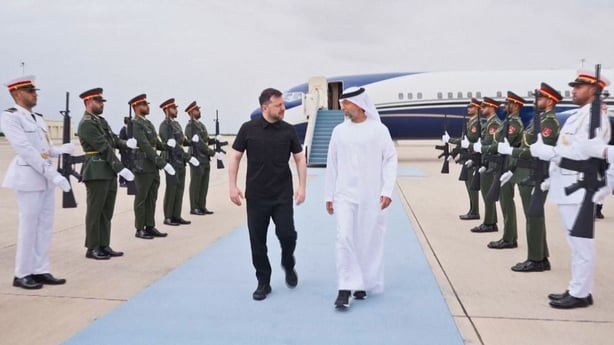
Ukraine has moved rapidly to provide anti-drone expertise, developed while fending off Iranian-designed drones launched by Russia, to the Gulf countries as they come under fire from Iran.
Tykhy was speaking after Iran's central military command Khatam Al-Anbiya said in a statement carried by state TV that it had destroyed a depot in the United Arab Emirates.
Earlier today, Ukrainian President Volodymyr Zelensky said on an unannounced tour of the Gulf that Kyiv and Abu Dhabi had agreed to cooperate on defence. Qatar also announced its own deal with Ukraine.
Ukraine and Saudi Arabia also signed an air defence agreement during Mr Zelensky's visit to the kingdom, two senior officials said yesterday.
Read more:
MAGA backs Trump on Iran, but how strong is support?
'We do not intend to negotiate', says Iranian foreign minister
Mapped: Military activity in the Irish AOR in southern Lebanon
