


Elon Musk's platform X has announced measures to prevent its AI chatbot Grok from undressing images of real people, following global backlash over its generation of sexualised images of women and children.
X said it will "geoblock the ability" of all Grok and X users to create images of people in "bikinis, underwear, and similar attire" in those jurisdictions where such actions are deemed illegal.
"We have implemented technological measures to prevent the Grok account from allowing the editing of images of real people in revealing clothing such as bikinis," X's safety team said in a statement.
"This restriction applies to all users, including paid subscribers," they added.
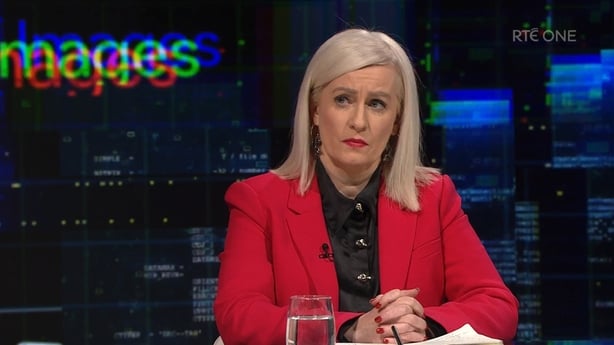
Minister with responsibility for Artificial Intelligence Niamh Smyth said that she welcomes the "corrective action" taken by X.
The minister also confirmed that she would meet X tomorrow.
She accused X of showing "total disregard" to the Irish Govenment and to "many European states".
"I will making it very clear to X tomorrow that until that Grok app is disabled they are breaking the law," she said.
Minister Smyth held a meeting with the Attorney General this afternoon.
Speaking on Six One, she said the purpose of her meeting with the AG was to "give myself and the Government absolute confidence in the fact that the laws that we have in place here in Ireland do protect our citizens in every way possible".
"And I am still very concrete in my own mind and absolute in the fact that we have very robust legislation and laws here in Ireland that prohibits the technology that Grok has been providing people to enable them to misuse imagery," she said.
"Coming out from the Attorney General's meeting, I am confident that that is the position we have here in Ireland today," she added.
It comes just hours after California's attorney general launched an investigation into Mr Musk's xAI - the developer of Grok - over the generation of "non-consensual, sexually explicit material" in recent weeks.
International pressure had been building on xAI to rein in Grok after a feature allowed users to create sexualised deepfakes of women and children.
Watch: Work and Technology Correspondent Brian O'Donovan says it is unclear how the Grok announcement will impact Ireland
Minister Smyth said that it was her "understanding" that an X subscriber in Ireland "cannot" unddress an image of a real person.
"It is illegal in this country, I do believe we've very robust laws here in Ireland, to deal with what has been happening over the last number of days and possibly weeks.
"Because, in my mind, the laws that we have in place, it is illegal to have child sexual abuse images online.
"It is illegal to have the possession of those images, it is illegal to disseminate those images, and it's illegal to share those images."
Minister Smyth said that as well as users of the offending technology, platforms should "absolutely" be held to account.
"The platforms are the enablers and giving users the opportunity to create this abhorrent type of imagery," she said.
"And they [platforms] are my focus over the next number of weeks ensuring that the enforcement of the laws here in Ireland are actually enforced, and entites like X or any other platform that would continue to make that readily available to the public will face the full rigours of the law."
Yesterday, Gardaí said there are 200 active investigations into child sexual abuse-related images generated by Grok.
The head of the Garda National Cyber Crime Bureau, Detective Chief Superintendent Barry Walsh, confirmed there is an ongoing investigation in relation to Grok.
Government ministers are to meet next week to decide how best to combat AI-generated and child sexual abuse-related content.
The matter was discussed at a meeting between the Taoiseach and Minister Smyth yesterday. A round table meeting will take place next week.
Minister Smyth has said Grok should be banned in Ireland if X fails to abide by Irish law regarding the creation of sexualised images of both children and adults.
Speaking on RTÉ's Prime Time, the minister said laws are in place regarding the creation and dissemination of AI-generated sexual imagery and that enforcement is needed.
X invited to appear before committee
Labour TD and Chair of the Oireachtas Media Committee Alan Kelly said X has been invited to appear before the committee on 4 February, adding that it would be "unacceptable" if they did not attend.
"I expect them to turn up, I expect them to address these issues. I think it will be unacceptable if they don't," he said.
"Collectively, and this goes beyond any politics inside here in Leinster House, we as a parliament, this Government and everybody else needs to put in place the legislative basis to ensure that platforms cannot, in any way, shape or form, continue to sexualise or nudify children."
Speaking on RTÉ's Morning Ireland, Mr Kelly said that in relation to the generation of sexually explicit content by AI, "moderation does not work".
"These AI tools should not be allowed to do this, it's as simple as that, and it is up to the platforms to deal with this," he said, adding that it was up to Ireland to tackle the issue if Europe is moving too slowly on it.
Mr Kelly said that it was up to Ireland to tackle the issue, if Europe was moving too slowly on it.
"We have robust laws ... We need to ensure that those laws, which are quite good and strong, are complete in relation to how we can deal with this.
"We need to protect our citizens, protect our children. The issue here is expanded to how these AI tools are actually sexualising and nudifying not just children, but also adults, and make sure that everybody is protected cross-platform."
'Could have been foreseen by X'
CEO of Irish Internet Hotline Hotline.ie Michael Moran has said that while the changes are welcome, the potential misuse of Grok should have been foreseen.
"You have to welcome any change, but I think the way it has happened over the last month really needs to be looked at," he said.
"All of this was and could have been foreseen by the X organisation. To suggest that they are now bringing in safety and that they're to be lauded for it is just not acceptable."
Also speaking on Morning Ireland, Mr Moran said "functionality was key" in addressing the unregulated use of AI.
"This is going to happen again and again and again, as new functionality is brought out. We're left with a situation where we know that AI can produce nudification apps, we know that AI can produce CSAM (Child Sexual Abuse Material)," he said.
"What we're going to be left with is, yes, certainly the Groks and Geminis and ChatGPTs of the world will moderate. They are the big companies, they will moderate.
"But in the meantime, in the background, there are any number of AI engines that have no regulation, that have nobody doing it. So the functionality is really the key at the end of the day."
Mr Moran described X's changes as "a win for the regulators".
"I think it's a win for Coimisiún na Meán. I think it's a win for the united front that Coimisiún na Meán and all the regulators across Europe showed in the early days of this," he said.
The sharing of images of people in a state of undress in Ireland is illegal, but the generation of such content is not.
Mr Moran said apps that produce those images should be banned, or also made illegal.
"And while we're at it, make it illegal for AI to produce CSAM in the first place," he added.
"We've seen how successful moderation has been in the last 30 years. It hasn't been. Let's see that it is actually removed as an actual possibility. That would be my ask."
Britain's Ofcom media regulator said it was opening a probe into whether X failed to comply with UK law over the sexual images.
France's commissioner for children Sarah El Hairy said she had referred Grok's generated images to French prosecutors, the Arcom media regulator and the European Union.
Indonesia became the first country to block access to Grok entirely, with neighbouring Malaysia following.
India said that X had removed thousands of posts and hundreds of user accounts in response to its complaints.
We need your consent to load this rte-player contentWe use rte-player to manage extra content that can set cookies on your device and collect data about your activity. Please review their details and accept them to load the content.Manage Preferences
