

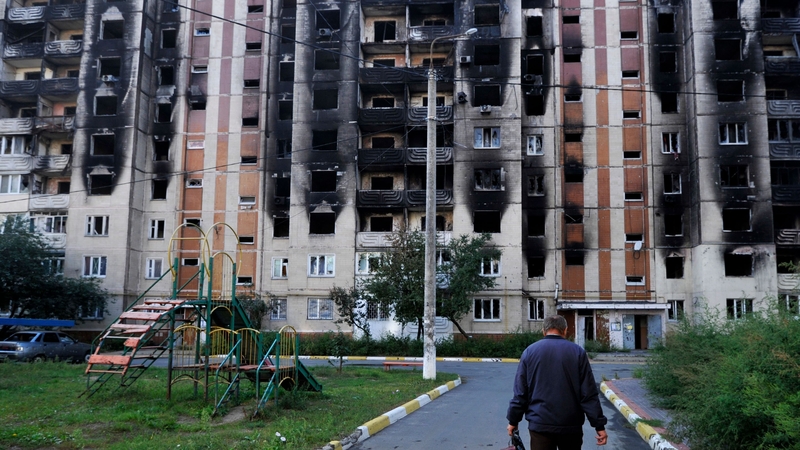
Ukraine has vowed to liberate all of its territory after driving back Russian forces in the northeast of the country.
Kyiv has also called on the West to speed up deliveries of weapons to back its advance.
Since Moscow abandoned its main bastion in northeastern Ukraine on Saturday, marking its worst defeat since the early days of the war, Ukrainian troops have recaptured dozens of towns in a stunning shift in battleground momentum.
Speaking in the central square of Balakliia, a crucial military supply hub taken by Ukrainian forces late last week, Ukraine's Deputy Defence Minister Hanna Malyar said 150,000 people had been liberated from Russian rule in the area.
Ukrainian flags had been raised and a large crowd gathered to receive bundles of humanitarian aid. A shopping centre had been destroyed but many buildings remained intact, with shops closed and boarded up.
We need your consent to load this rte-player contentWe use rte-player to manage extra content that can set cookies on your device and collect data about your activity. Please review their details and accept them to load the content.Manage Preferences
Fighting was continuing elsewhere in the northeastern Kharkiv region, Malyar earlier told Reuters, saying Ukraine's forces were making good progress because they were highly motivated and their operation well planned.
"The aim is to liberate the Kharkiv region and beyond - all the territories occupied by the Russian Federation," she said on the road to Balakliia, which lies 74 km southeast of Kharkiv, Ukraine's second largest city.
In Verbivka, a village northwest of Balakliia, Nadia Khvostok, 76, described the traumatic occupation and the arrival of Ukrainian troops.
"(We greeted them) with tears in our eyes. We could not have been happier. My grandchildren spent two and a half months in the cellar. When the corner of the house was torn off, the children began to shudder and stutter," she said, adding that they and her daughter had left - she did not know where.
The village school, where the Russians were based, was destroyed and trees on the road to the village and a cement factory showed battle scars. Elsewhere were abandoned Russian vehicles, including a military truck with a smashed windscreen. Ukrainians distributed aid in Verbivka on Monday, locals said.
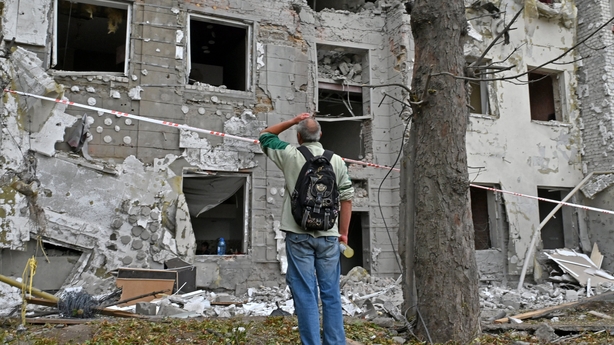
In a video address, Ukraine's President Volodymyr Zelensky said the West must speed up deliveries of weapons systems, calling on Ukraine's allies to "strengthen cooperation to defeat Russian terror".
His foreign ministry singled out Germany, saying in unusually blunt language that it was disappointing that Berlin had not provided Leopard tanks and Marder infantry fighting vehicles.
On Monday, German Defence Minister Christine Lambrecht rejected sending tanks "unilaterally". Some saw the remarks as leaving open the possibility that Berlin could do so as part of a pan-European consortium. The German foreign ministry did not immediately respond to a request for comment.
Since Russia's invasion, Washington and its allies have provided Ukraine with billions of dollars in weapons that Kyiv says have helped limit Moscow's gains. Russian forces control around a fifth of the country in the south and east. Ukraine is now on the offensive in both areas.
Malyar said Ukrainian forces were consolidating their gains by checking for sabotage groups. The military said Russian forces were shelling parts of Kharkiv region retaken by Ukraine and attacking further south in Donetsk region, which Moscow is trying to seize for separatist proxies.
Reuters could not immediately verify the battlefield reports.
A senior US military official said earlier that Russia had largely ceded territory near Kharkiv in the northeast and pulled many of its troops back over the border.
A video issued by Ukraine's border guards service showed what it said were Ukrainian troops liberating the town of Vovchansk near the country's border with Russia, burning down flags and tearing down a poster saying "We are one with Russia".
Read more:
Latest Ukraine stories
Is Ukraine's eastern offensive a turning point in war?
Latest Defence Intelligence update on the situation in Ukraine - 13 September 2022
— Ministry of Defence 🇬🇧 (@DefenceHQ) September 13, 2022
Find out more about the UK government's response: https://t.co/BYZhjLmtmf
🇺🇦 #StandWithUkraine 🇺🇦 pic.twitter.com/r0Cf3z3wab
Luhansk next?
A Moscow-based diplomat said the advance in Kharkiv region was encouraging but expressed caution over the next steps.
"We shouldn't get ahead of ourselves," the diplomat said on condition of anonymity. Key questions were whether Ukrainian forces would be able to move into Luhansk region next to Kharkiv and the impact on Russian morale in the south, where Ukraine's advance had so far been slow, the diplomat said.
Serhiy Gaidai, Ukrainian governor of the Luhansk region, which Moscow has seized, said he expected a major Ukrainian offensive there. He later said the town of Lyman had been captured.
US Secretary of State Antony Blinken said on Monday that Ukrainian forces made "significant progress" with Western support to ensure it has the equipment it needs.
President Zelensky said Ukraine had recaptured roughly 6,000 square km of territory, double what officials had cited on Sunday. A sliver of Ukraine's land mass of around 600,000 square km, it is approximately equivalent to the combined area of the West Bank and Gaza.
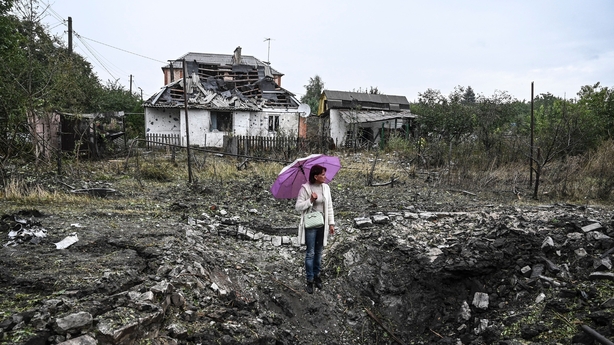
Mr Zelensky's advisor, Mykhailo Podolyak, spelled out why Ukraine needed more weapons, saying that firstly, it needed air defence to protect its civilians and critical infrastructure.
"Second, Luhansk/Donetsk liberation will cause domino effect, collapse ru-frontline and lead to political destabilization. It is possible. Weapons required," he wrote on Twitter.
First, Russia fights against civilians, so critical infrastructure facilities protection with air defense is obligatory. Second, Luhansk/Donetsk liberation will cause domino effect, collapse ru-frontline and lead to political destabilization. It is possible. Weapons required.
— Михайло Подоляк (@Podolyak_M) September 13, 2022
Another ex-Soviet conflict
Fighting broke out between two other former Soviet republics on Monday, raising fears of another conflict. Azerbaijan, which is backed by Turkey, and Armenia, an ally of Russia, blamed each other for the border clashes, with both reporting losses.
It was not clear if there was any link between the fighting and the conflict in Ukraine. The Kremlin said Putin was trying to end the clashes, emphasising his influence in the Armenian-Azeri conflict, which dates back to the 1990s.
Kremlin spokesman Dmitry Peskov also said there was no discussion of a nationwide mobilisation within Russia to bolster the operation in Ukraine, which he has said will continue until it achieves its goals.
Criticism of Russia's leadership from online nationalist commentators demanding mobilisation was an example of "pluralism", Peskov told reporters, adding that Russians as a whole continue to support Putin.
Ukrainian officials say Russia has responded to Kyiv's battlefield successes by shelling power stations and other key infrastructure, causing blackouts in Kharkiv and elsewhere.
Russia has blamed Ukraine for the blackouts.
Shelling around the Russian-held Zaporizhzhia nuclear powerplant has sparked grave concerns about the risk of radioactive catastrophe.
The UN atomic watchdog has proposed the creation of a protection zone around the nuclear plant, Europe's largest, and both sides are interested, IAEA chief said.
"We are playing with fire," Rafael Grossi told reporters.
"We can not continue in a situation where we are one step away from a nuclear accident. The safety of the Zaporizhzhia powerplant is hanging by a thread."
