


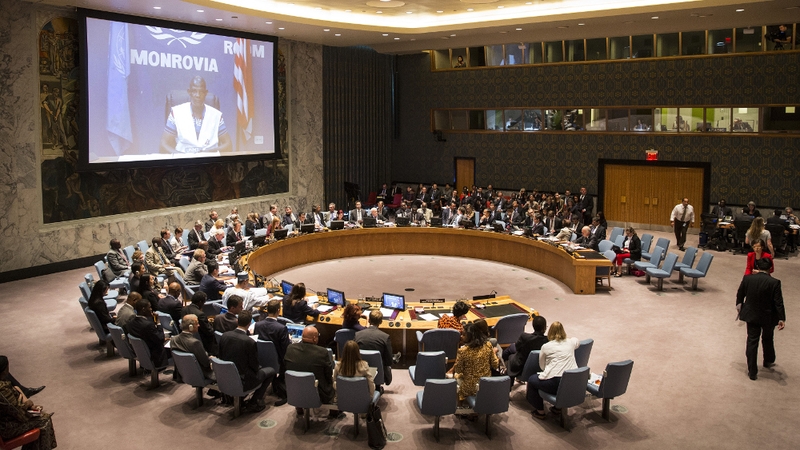
The UN Security Council has declared the Ebola outbreak in Africa a "threat to international peace and security" and called on all states to provide urgent resources and assistance to help tackle the crisis.
The 15-member body unanimously adopted a resolution that also calls on states "to lift general travel and border restrictions, imposed as a result of the Ebola outbreak, and that contribute to the further isolation of the affected countries and undermine their efforts to respond."
The UN unveiled plans for a special mission to combat what is the worst Ebola epidemic on record in West Africa.
It comes as the death toll hit 2,630 and France became the latest Western nation to step up its support.
In a letter circulated to the Security Council, UN Secretary-General Ban Ki-moon said he would appoint a special envoy to head the UN Mission for Ebola Emergency Response (UNMEER), based in the region.
"The strategic priorities of the mission will be to stop the spread of the disease, treat the infected, ensure essential services, preserve stability and prevent the spread to countries currently unaffected," Mr Ban wrote.
French President Francois Hollande today announced the deployment of a military hospital to remote Forest Region of south-eastern Guinea, where the outbreak was first detected in March.
Since then the virus has infected at least 5,357 people, according to World Health Organization (WHO), mostly in Guinea, neighbouring Sierra Leone and Liberia. It has also spread to Senegal and Nigeria.
With fragile West African healthcare systems overrun by the outbreak, Mr Hollande said France's response would not be limited to contributing to €150m in aid promised by EU nations.
"We must save lives," he told a news conference. "I have asked the defence minister to coordinate this action and to include military doctors and the civil protection agency plus air support."
US President Barack Obama, calling the disease a threat to global security, promised this week the deployment of 3,000 US troops to help contain the epidemic.
Britain also announced yesterday it would help to provide a further 700 treatment beds in Sierra Leone, its former colony.
One of the most deadly diseases, there is no known cure for the hemorrhagic fever, though development of several treatments and vaccines is being fast-tracked.
Seven people who were part of a team sent to educate villagers in south-eastern Guinea about Ebola have been found dead after they were attacked by angry locals, the government said today.
The bodies were recovered from the septic tank of a primary school in the village of Wome, government spokesman Albert Damantang Camara told AFP.
"It's very sad and hard to believe but they were killed in cold blood by the villagers," he said, adding that he would do everything in his power to bring the perpetrators to justice.
The victims, said to include local health officials and journalists, had been missing ever since their delegation was pelted with stones during an outreach visit on Tuesday.
At least 21 people were wounded during the unrest, according to local police.
It was not immediately clear what prompted the violence, but the spread of Ebola has been accompanied by fear and paranoia by villagers who feel the government and international community cannot be trusted.
Many Guineans believe local and foreign health care workers are part of a conspiracy which either deliberately introduced the outbreak, or invented it as a means of luring Africans to clinics to harvest their blood and organs.
"The villagers violently attacked the delegation led by the governor, Lancei Conde, with stones and sticks," police lieutenant Richard Haba told AFP earlier on Thursday.
