


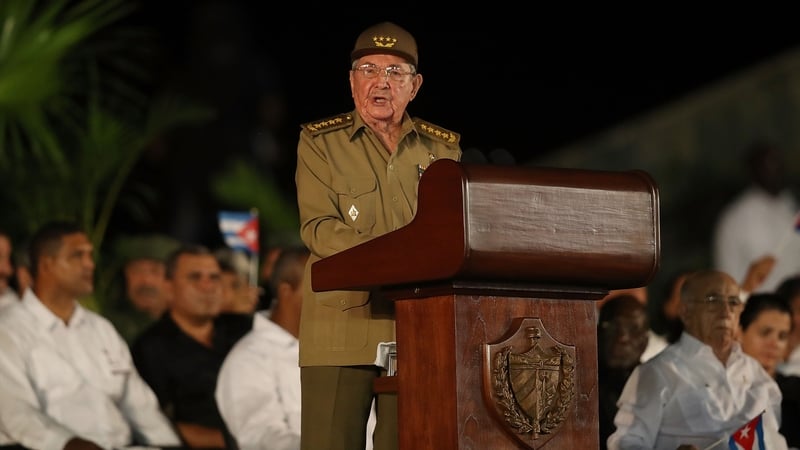
Former Cuban president Raúl Castro has been charged in the United States with murder in a major escalation of Washington's pressure campaign against the island's communist government.
The indictment was filed in a federal court in Miami, Florida, on 23 April.
The 94-year-old is charged with one count of conspiracy to kill US nationals, four counts of murder, and two counts of destruction of aircraft, according to the documents.
Five other people are also named as defendants in the case.
The charges stem from 1996 when Cuban jets shot down planes operated by a group of Cuban exiles, US acting Attorney General Todd Blanche said at an event in Miami today to honour the victims.
"My message today is clear: The United States and President Trump does not and will not forget its citizens," Mr Blanche said to applause in a packed auditorium of government officials and Cuban Americans.
Cuba's foreign ministry did not immediately respond to a request for comment.
Raúl Castro last appeared in public in Cuba earlier this month, and there is no evidence that he has left or that the government would allow him to be extradited.
The indictment comes as US President Donald Trump pushes for regime change on the Caribbean island, where communists have been in charge since his late brother Fidel Castro led a revolution in 1959.
Earlier today, he described Cuba as a "rogue state harbouring hostile foreign military" and said his administration's actions were part of a broader effort to expand US influence in the Western Hemisphere.
"From the shores of Havana to the banks of the Panama Canal, we will drive out the forces of lawlessness and crime and foreign encroachment," Mr Trump said at a Coast Guard Academy event in New London, Connecticut.
On Monday, Cuba's President Miguel Diaz-Canel said that the island did not represent a threat.
The indictment marks a new low in relations between the longtime Cold War rivals.
After taking power, Fidel Castro struck an alliance with the Soviet Union and seized US-owned businesses and properties.
Since then, Washington has maintained an economic embargo on Cuba, a country with a population of about 10 million.
The two sides have talked intermittently over the years. Diplomatic relations briefly improved during the second term of former president Barack Obama, a Democrat, but President Trump, a Republican, has taken a harder line.
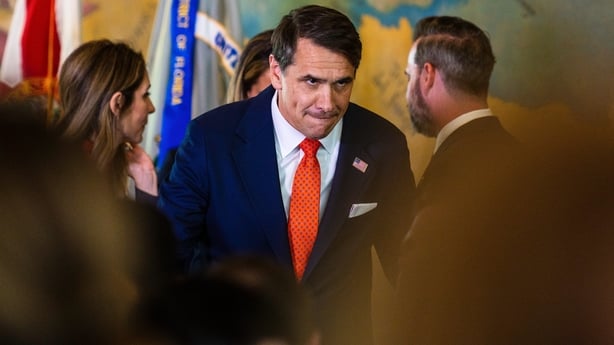
Members of Miami's large Cuban American community gathered outside the city's Freedom Tower ahead of the ceremony to the victims of the 1996 incident.
The event took place on the anniversary of the end of a four-year US military occupation of Cuba on 20 May 1902, which itself followed centuries of Spanish colonial rule.
Cuba's government does not consider the date to mark the country's independence day, arguing that it remained subservient to Washington until the 1959 revolution.
In a post on social media, President Diaz-Canel said that, in Cuban history, 20 May signified "intervention, interference, dispossession, frustration".
Under Mr Trump, the US has effectively imposed a blockade on the island by threatening sanctions on countries supplying it with fuel, triggering power outages and exacerbating its worst crisis in decades.
US Secretary of State Marco Rubio offered $100 million (€86m) in aid to Cuba and blamed its leaders for shortages of electricity, food and fuel.
The island's foreign minister Bruno Rodriguez described the move as cynical, citing the "devastating effect" of the economic blockade.
Trump warned that Cuba was 'next'
Born in 1931, Raúl Castro was a key figure alongside his older brother in the guerrilla war that toppled US-backed dictator Fulgencio Batista.
He helped defeat the Bay of Pigs invasion in 1961, and served as defence minister for decades.
Raúl succeeded his brother as president in 2008 and stepped down in 2018, but remains a powerful behind-the-scenes figure in Cuban politics.
He was defence minister at the time of the 1996 incident.
The two small planes that were shot down were being flown by Brothers to the Rescue, a group of Miami-based Cuban exile pilots who said their mission was to search for Cuban rafters fleeing the island.
All four men aboard were killed. Portraits of them were displayed behind Mr Blanche as he spoke in Miami's Freedom Tower, which served as a refugee centre for Cubans in the 1960s.
The Cuban government has argued the strike was a legitimate response to the planes intruding on its airspace.
Fidel Castro said the island's military had acted on "standing orders" to down planes entering the airspace.
He said that Raúl Castro did not give a specific order to shoot the planes.
The US condemned the attack and imposed sanctions.
The Department of Justice charged three Cuban military officers in 2003 but they were never extradited.
The International Civil Aviation Organization later concluded that the incident took place over international waters.
The filing of the criminal case against a US adversary like Raúl Castro recalls the earlier drug-trafficking indictment of imprisoned former Venezuelan president Nicolas Maduro, an ally of Cuba.
The Trump administration cited that indictment as a justification for the 3 January raid on Caracas by the US military in which Mr Maduro was captured and brought to New York to face the charges.
He has pleaded not guilty.
In March, President Trump threatened that Cuba was "next" after Venezuela.
President Diaz-Canel said on Monday that any US military action against Cuba would lead to a "bloodbath".
