There has been criticism of the European Union's Digital Services Act at a committee hearing in the United States.
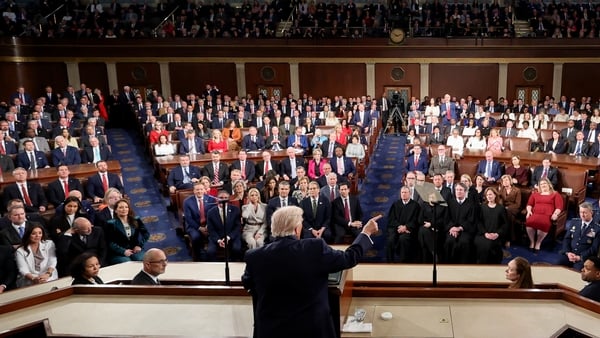
The meeting, of the US House Judiciary Committee in Washington, came after a report claimed the legislation amounted to censorship and electoral interference.
The act regulates companies such as X, TikTok and Meta - the operators of Facebook, Instagram and WhatsApp.
Witnesses included Irish human rights Irish lawyer, Lorcan Price, who said: "There can be no doubt that the European Digital Services Act is the tip of a massive censorship industrial complex.
"The enormous fines levied on X corporations by the European Commission since the last hearing has proved, beyond all doubt, that the EC [European Commission] means to strangle free speech by a systemic assault on US companies," he added.
Comedic writer Graham Linehan, who co-created Father Ted and was arrested at Heathrow Airport in London last year under British hate speech laws, called for the US to put pressure on the Irish Government.
"In 2015, while the Irish were celebrating their vote for marriage equality, the Gender Recognition Act was quietly passed.
"No public consultation, no referendum, no women's rights organisations consulted," he said, adding that Ireland's "women and girls deserve the debate that they were denied".
The leading Democrat on the committee, Jamie Raskin, said the US faced a much bigger threat to free speech from the immigration clampdown in Minneapolis.
"We're having another hearing about the imaginary threat to the transphobic material of Irish comedians against the European Union and we can't seem to have a hearing about ICE agents shooting Americans in the face for exercising their first amendment rights."
We need your consent to load this rte-player contentWe use rte-player to manage extra content that can set cookies on your device and collect data about your activity. Please review their details and accept them to load the content.Manage Preferences
Mr Price appeared to largely agree with this viewpoint, and that of Republican Congressman Russell Fry, who said that unelected European bureaucrats were attempting to set the global laws on what constitutes hate speech.
Speaking to RTÉ News after the hearing, Mr Linehan said he felt he had no other option but to ask the US Congress to put pressure on Ireland to re-examine the Gender Identity Act.
"At the moment self-ID in Ireland is law of the land, which means that men are in women's prisons: a man who was released (from prison) recently, an extremely violent misogynist, is free to enter any women-only space in Ireland and I don't think Irish people are fully aware of it," he said.
"So I think it's very important to go back on such a huge social change and say, actually, let's make sure the Irish know what they're voting for when they vote," Mr Linehan added.
He criticised RTÉ and other media in Ireland, claiming they do not accommodate all viewpoints.
"RTÉ has not interviewed me for nearly a decade, not even when there's a celebration of Father Ted," Mr Linehan said.
However, Mr Linehan discussed his views on transgender issues on RTÉ's This Week in 2023.
He also claimed thousands of children had been "mutilated" and added a four-year-old Irish child attended the controversial Tavistock centre in the UK.
"You know, they're running scared from this issue," he said.
Mr Linehan said he did not "agree with what the Democrats were saying, that it's somehow a small issue".
Asked about the overall criticism by the Judiciary Committee's interim report on the Digital Services Act, Mr Linehan said: "I think it is just a symptom of Europe's inability to look at the problems it has now and address them honestly".
"Every time anyone say speaks up about say, immigration, they're immediately labelled a racist but the people labelling them racist are people who are very, kind of, isolated from the results of the policies they're pushing.
"So I think we need to have less judgment on people who are trying to bring up important issues, and in fact, empower them to speak, because through them, you'll hear the voice of the Irish people," Mr Linehan said.
Also speaking after the hearing Lorcan Price said: "The United States Congress and the administration here has taken a real interest in what's happening in Europe, because it's impacting US companies and our own country is at the front line of this, because these companies are headquartered in Dublin, and they're regulated by the Irish regulator, the Coimisiún na Meán, in addition to the European Commission.
"So we're really in the middle of all of this, because it will be an Irish regulator that is the first port of call for actually enforcing EU law and as we've been discussing today, the impacts aren't just in the European Union.
"They're also in the United States, but of course, very concerned about the impacts of free speech in Ireland, and we've seen already the Government tried to force through, well to pass, I should say, a piece of legislation, the hate speech law, which really had extremely draconian measures in there and very vague definitions around certain forms of discrimination or hatred.
"So that was withdrawn. But unfortunately, now, via European law, we're seeing similar kind of provisions make their way back into not just Irish law, but across the European Union and now across the world," he said.
"Because many of the biggest digital companies have their EU headquarters in Ireland, they pay a lot of corporation tax there as well, a result of their impressive earnings.
"Some have argued that their opposition to EU digital regulation is driven more by the bottom line impact than by principles of free speech," Mr Price added.
The European Commission said the interim report of the House Judiciary Committee is "nonsense" and "unfounded".
It has long argued that the basis of its regulations of the digital domain is that things that are illegal offline ought to be illegal online as well.
In Brussels, Commission spokesperson Thomas Regnier said: "It's always good to have public hearings, and to recall that we fully stand for freedom of expression.
"I think our position is very clear, both in this press room, but also towards our American counterparts, we stand for freedom of expression."
"Any allegation towards Europe saying that we are not protecting freedom of expression, or any censorship allegations, are complete nonsense, and these are unfounded allegations.
"Freedom of expression is, of course, a fundamental right in Europe," he added.