


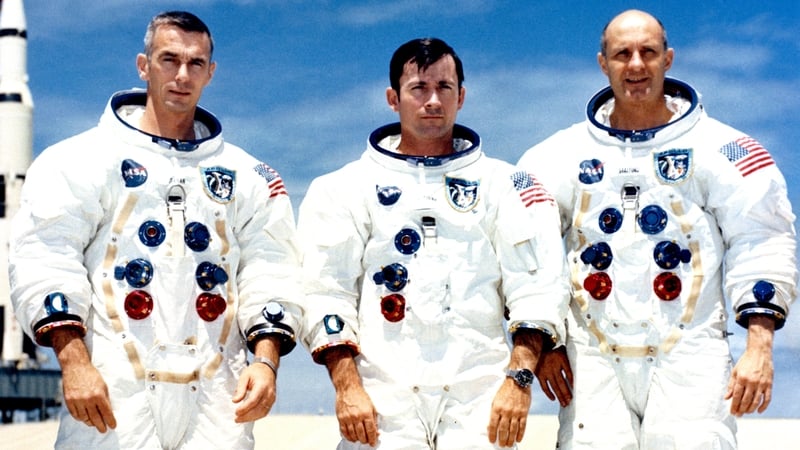
US astronaut John Young, who walked on the moon in 1972 and even smuggled a corned beef sandwich into orbit during a career that made him the only person to fly with three NASA space programmes, has died at age 87.
Mr Young, who went to space six times, died last night at his home in Houston following complications from pneumonia, National Aeronautics and Space Administration spokesman Allard Beutel said in an email.
The former US navy test pilot was the ninth person to set foot on the moon, an experience shared by three others after Mr Young.
He eventually became one of the most accomplished astronauts in the history of the US space programme.
He flew into space twice during NASA's Gemini programme in the mid-1960s, twice on the Apollo lunar missions and twice on space shuttles in the 1980s. He was the only person to fly on all three types of programmes.
"Astronaut John Young's storied career spanned three generations of space flight. We will stand on his shoulders as we look toward the next human frontier," NASA Administrator Robert Lightfoot said in a statement.
Young, described in a NASA tweet as "our most experienced astronaut," retired in 2004 after 42 years with the US space agency.
The Apollo 16 mission in April 1972, his fourth space flight, took Mr Young to the lunar surface.
As mission commander, he and crewmate Charles Duke explored the moon's Descartes Highlands region, gathering 90kg of rock and soil samples and driving more than 26km in the lunar rover to sites such as Spook Crater.
Recalling his lunar exploits, Mr Young told the Houston Chronicle in 2004: "One-sixth gravity on the surface of the moon is just delightful. It's not like being in zero gravity, you know. You can drop a pencil in zero gravity and look for it for three days. In one-sixth gravity, you just look down and there it is."
His May 1969 Apollo 10 mission served as a "dress rehearsal" for the historic Apollo 11 mission two months later in which Neil Armstrong became the first person to walk on the moon. Mr Young and his crew undertook each aspect of that subsequent mission except for an actual moon landing.
