


Russia has entered a recession, nine months after launching its offensive in Ukraine as Western sanctions weigh on the economy, according to official data published this evening.
Gross domestic product shrank 4% in the third quarter, according to a preliminary estimate by the national statistics agency Rosstat.
As that follows one of the same size in the second quarter, Russia now meets the technical definition of a recession with two consecutive quarters of falling GDP.
The 4% drop in economic output between July and September was less than the 4.5% contraction many analysts had expected, however.
The contraction was driven by a 22.6% plunge in wholesale trade and a 9.1% drop in retail trade.
Meanwhile, construction grew by 6.7% and agriculture 6.2%.
Russia's economy has been struggling under a myriad of problems.
Western sanctions have limited exports and imports, including of key manufacturing components and spare parts.
Companies have also been suffering from a lack of staff as a partial mobilisation has taken several hundred thousand men out of the workforce.
Despite a contracting economy, Russia's unemployment rate stood at 3.9% in September, according to Rosstat.
As a result, the Russian economy has become even more dependent upon energy exports, which have accounted for about 40% of federal government revenue.
Power being restored after strikes
Ukrainian officials have said that the power supply was being gradually restored across the country, a day after devastating Russian air strikes targeted its energy infrastructure.
Some ten million Ukrainians were left without electricity when dozens of Russian missiles hit power stations in the biggest aerial attack since the Russian invasion began in February.
This morning fresh air raid alerts were sounding again across the country, raising concerns over new attacks, but the warnings were lifted in the capital Kyiv minutes after.
"After yesterday's rocket strikes, I was informed in the morning that most of the subscribers were reconnected," President Volodymyr Zelensky said on social media.
"Our engineers and rescuers worked all night in different regions," he said, vowing to "defeat all enemies".
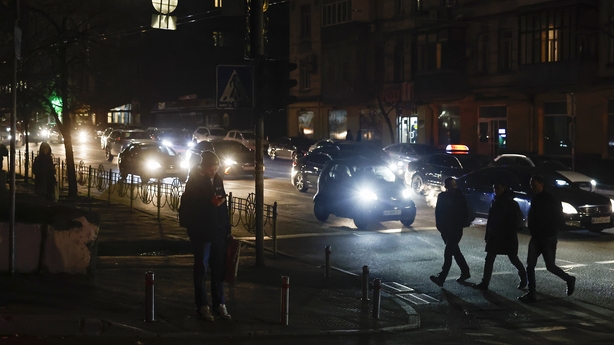
The deputy head of Mr Zelensky's office, Kyrylo Tymoshenko, specified that energy supplies have been fully restored in eight regions, mostly in western and central Ukraine.
In Kyiv, city military administration head, Sergiy Popko, said on Telegram that "thanks to the well-coordinated work of engineers and employees of all public utilities ... the power supply for critical infrastructure facilities has been restored."
The mayor of the western city of Lviv, Andriy Sadovyi, also reported that "power has been restored throughout almost the entire city".
"There are isolated reports of houses where there is no electricity yet. We are working on it," he said on social media.
Yesterday, the Russian strikes also triggered automatic shutdowns of several reactors at two nuclear power plants as Moscow and Kyiv have traded blame for attacks near several nuclear plants in Ukraine.
The explosion at a grain dryer near the Ukrainian border occurred during Russian missile strikes across Ukraine.
Kyiv has said it shot down most of the incoming Russian missiles with its own air defence missiles.
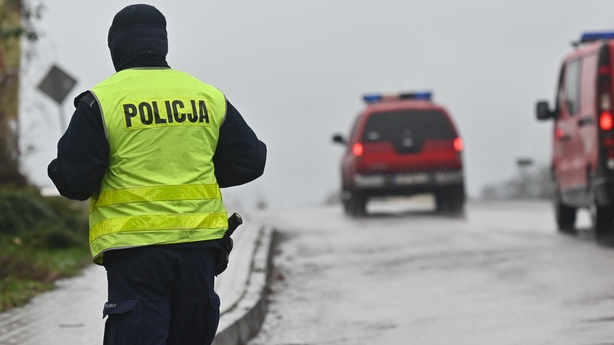
Ukraine's Volyn region, just across the border from Poland, was one of the many it says was targeted by Russia's attacks.
The Polish foreign ministry said the rocket fell on Przewodow, a village about 6km from the border with Ukraine. Polish President Andrzej Duda told reporters that it was "most likely a Russian-made missile", but that there was no concrete evidence of who fired it.
Both Russia's long-range missiles and the air defence missiles that Ukraine fired to shoot them down are Russian-made.
Russia has established a pattern in recent weeks of launching massive strikes on Ukrainian cities to knock out their power after setbacks on the battlefield.
Yesterday's strikes followed the withdrawal last week of Russian troops from the city of Kherson, which it had captured at the start of the invasion.
Ukrainian Defence Minister Oleksiy Reznikov said Kyiv had warned of the danger Russian missiles posed to neighbouring countries and called for a no-fly zone to be imposed.
"We were asking to close the sky, because sky has no borders. Not for uncontrolled missiles. Not for the threat they carry for our EU & NATO neighbours. Gloves are off. Time to win," he said in a Twitter post.
