
The wearables market is crowded and cut-throat.
There are hundreds of manufacturers, making thousands of different products for a still relatively immature and somewhat sceptical market.
IDC estimates nearly 123 million wearables will be sold this year, up 6% on the previous year – the first year ever that percentage growth in sales will be in single not double digits.
But nonetheless, there is demand for good-looking, innovative and most importantly useful wearable devices, especially smart watches, which account for nearly 60% of the market.
We don’t know for sure how many watches Apple has sold, but IDC estimates it will capture around half of all shipments this year which tallies with Apple’s claim to being the biggest watch vendor in the world.
And so the company’s newly revamped Series 4 Watch is attempting to increase its already growing slice of the pie.
DESIGN
The changes to the appearance of the Watch, though pretty subtle, are many.
You won’t really notice a massive difference in the size of the case for example.
It is now 3.5% taller and wider, but 6% thinner – not enough to make it feel any bulkier on your arm.
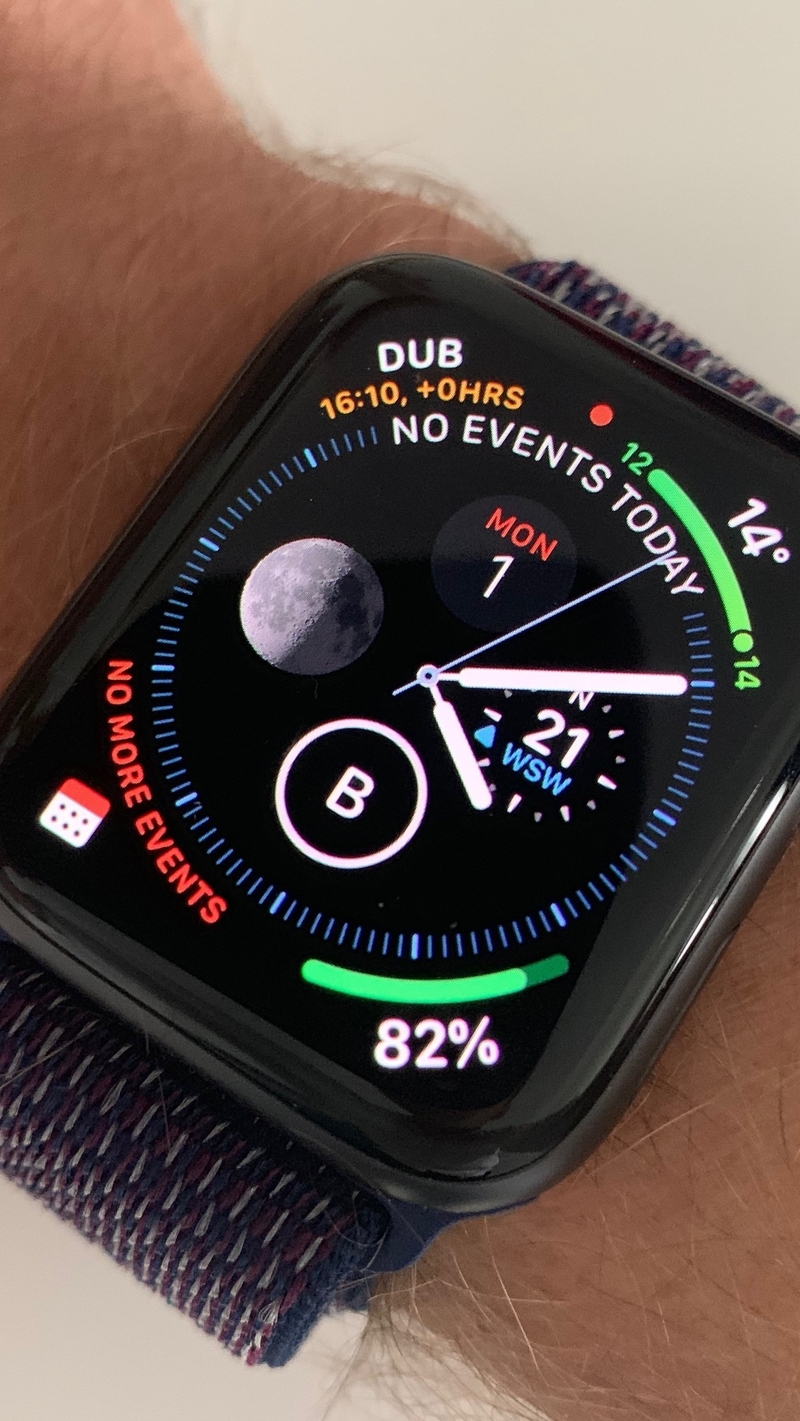
The biggest alteration can be found in the display. The two sizes have increased slightly – the 38mm model to 40mm and the 42mm version to 44mm.
A reduced perimeter means the usable screen also now stretches right out to its curved edges.
These two factors make the display considerably bigger - 30% larger in fact compared to the Series 3.
This coupled with the OLED Retina technology do make for a better user experience.
It is easier to see and read what’s on the screen, and there’s more space there too for new watch faces and more sophisticated "complications", or functions in addition to telling the time.
Among them, for example, is a weather complication which has more detailed information.
There’s also a range of new watch faces including a modular one that can be customised with up to eight complications, an "elemental" series featuring fire and water effects, and a "Breathe" face with direct access to the relaxation encouraging Breathe function.
Apple has also opened up a third party API for developers to make enriched complications, and so while there are some already available, expect plenty more brand or function specific options in the future.
Other than that, the digital crown has been re-engineered to add satisfying haptic feedback when you are scrolling through menus, etc.
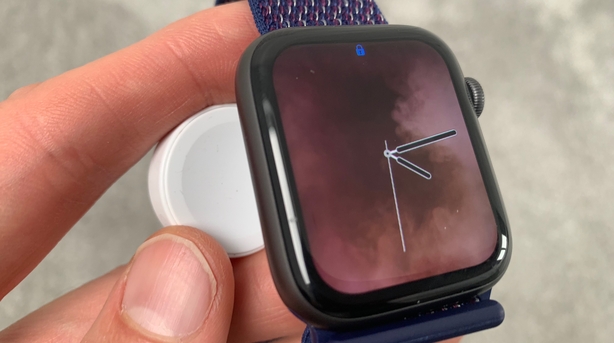
And to the rear, the back of is now made of black ceramic and sapphire crystal for improved cellular reception.
It all adds up to a good-looking, comfortable and functional design that is a definitive improvement on what went before.
PERFORMANCE
The changes to Watch are not just cosmetic though.
There’s a new S4 chip inside which has a 64-bit dual-core CPU and GPU, with a resultant doubling in performance speed when it comes to launching and running apps. And it shows.
The speakers on the device have been made 50% louder, which is handy for the occasional time you might want to make or receive a call, or play music out loud – although the sound is still pretty tinny.
The microphone has been relocated to the other side of the device to prevent it from getting in the way of the speakers and that improves call quality.
On the wireless front there’s also a new W3 chip that Apple says delivers faster Bluetooth 5.0 while at the same time using less power.
As a result, battery life remains respectable with an official all-day 18-hour limit promised.
In reality though, I found it lasts a good deal longer than that and with moderate use I was able to get a good two days out of it before having to charge again
But if you are likely to use the device for streaming music, for a lot of exercise tracking and for GPS duties, then expect to have to reach for the magnetic power cord each night as it won't last two days.
The device runs watchOS5, which along with the previously mentioned new watch faces, also features automatic workout detection (sometimes useful, sometimes not so), different types of yoga and hiking workouts and seven-day Activity competitions.
There’s still no integrated sleep-tracking available though, which will be a downside for some, and there would probably have to be a further boost to battery performance before that could be added.
FEATURES
With each version of Watch, Apple has been quite consistent in adding new features – some more practical and useful than others.
In particular the focus of these innovations in recent versions has very much been on fitness and health features.
The two big ones on the Series 4 are fall detection and heart health monitoring.
From its testing of algorithms to detect motion patterns in the lab, the company has learned that many movement actions are very distinct.
One of those it has picked up on is the motion pattern of a fall.
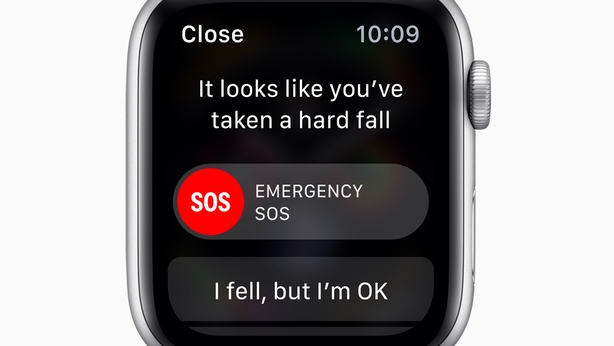
And so, it has used the gyroscope and accelerometer to develop a fall detection system that recognises when the wearer has fallen from a slip or trip.
When this happens and the user remains motionless for a minute, the Watch will automatically call the emergency services and drop a GPS location pin so they can find you.
After 45 seconds of that minute, a 15 second countdown starts during which it is possible to stop the call.
Fall detection is set to default for those over 65 who wear the device, making it a useful (albeit expensive) way of helping an elderly or infirm person feel independent and secure.
Certain other activities, like martial arts for example, will trigger the alert – so you may have to remove it or turn it off in certain circumstances.
But overall, this is a clever bit of kit.
We tried to test it, but couldn’t trigger the detection, probably because we weren’t really falling in an accidental nose-whacking off the ground sort of a way.
So, we’ll just have to wait and see whether it works the first time it happens for real.
The other big talking point is heart monitoring.
The earlier versions of Watch already had heart rate monitoring, with notifications generated if the wearer’s cardiac speed was going dangerously high.
Now though, the device can alert you if your heart rate goes too low also, specifically under 40 beats per minute.
The heart rate sensor has also been upgraded with the addition of an electrical monitor.
There is now an electrode in the digital crown and by touching this the user can create a closed circuit, allowing the device to track and record the heart’s electrical signals too over 30 seconds.
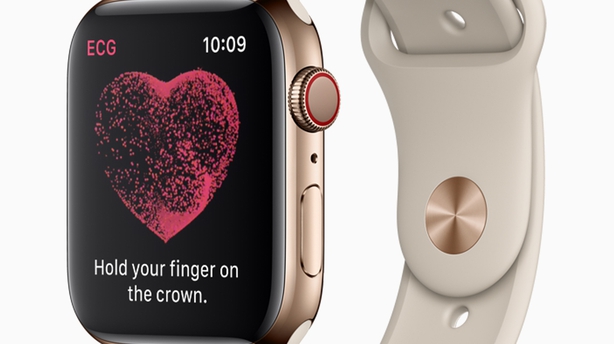
The resulting trace is saved in a pdf which can then be shared with a clinician.
It will also carry out screenings in the background and alert you if an arythmia is detected.
This watch-based Electro Cardiogram or ECG is a first, and an impressive one.
Except, there is a but...
Although it has been approved for use by the Food and Drug Administration in the US, the paperwork hasn’t been finalised so it is not actually usable there yet.
Here in Europe, the application for approval is currently before the European Medicines Agency – which means it will be a while before Apple will be able to push the update to make the ECG functionality active here in Ireland (assuming it gets the go-ahead).
So while it is a potentially great addition to Watch functionality, it is kind of frustrating that it isn’t really ready yet.
Also still not available is cellular support for Watch here in Ireland.
So it still has to be tethered to an iPhone if you need an internet connection.
ACCESSORIES
Existing bands work with the new version of Watch, so if you are upgrading and already have a favourite or expensive one you will still be able to use it.
There is also a new version of the Watch Nike+, which has updated faces, an improved Run Club app and a reflective loop band.
And for those looking for glamour, there are new models in the Hermès collection.
Although if bling is your thing, there is a new gold colour version of the regular Series 4 Watch, which might do the job for a lot less lolly.
CONCLUSION
Watch remains one of the leading devices in the smartwatch category, offering plenty of features, new innovations and a range of styles.
The new look, while not massively different, is attractive, the fall detector useful and the ECG monitor will be a clever addition, when it actually arrives.
On the negatives, battery life could do with a little more-buffer for heavy users, no in-built sleep tracker is a drawback and the lack of access for third party developers means watch face choice is limited enough.
It would also be good to see the addition of some form of simplified low power always-on face, as I still find that half the time I lift my wrist to check Watch, it doesn’t activate.
It also isn’t the cheapest smartwatch out there, at a starting price of €439 that rises steadily for cellular or more stylish versions.
And it is a bit annoying that the cellular option is still not open to Irish users.
But taken in the round, this is the best Apple Watch yet and the upgrades do set a new bar for other manufacturers to reach.
There are a growing number of respectable contenders out there – like for example the Samsung Galaxy Watch, Huawei Watch 2 and a number of Fitbits, including the Ionic and Versa.
Apple’s Series 4 smartwatch though is, for the next few months at least, the one to watch.
Comments welcome via Twitter to @willgoodbody