


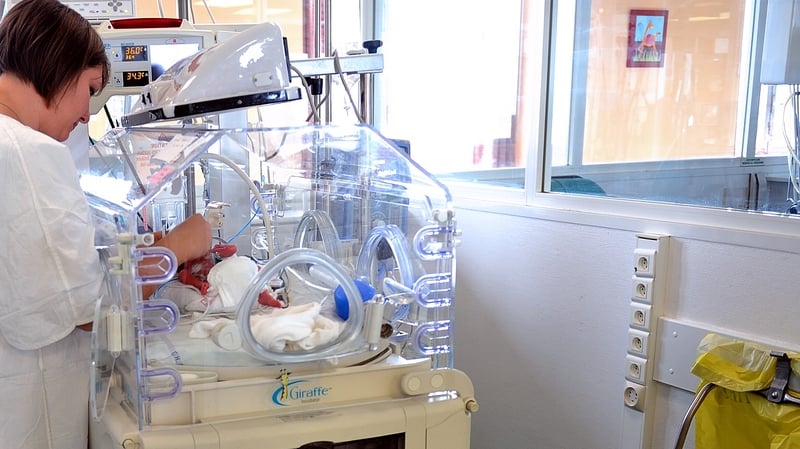
An "artificial womb" has been developed that could soon be used to keep extremely premature babies alive.
The device, which incorporates a plastic bag filled with artificial nutrient-rich amniotic fluid, has successfully been tested on foetal lambs equivalent in age to 23-week-old human infants.
Scientists believe it could be ready for human trials in three to five years.
But they stress there is no question of using the system to replace a mother's womb at earlier stages of development, raising fears of sci-fi technology that could spell the end of pregnancy.
Unlike conventional incubators, the "extra-uterine support device" closely reproduces conditions in a real womb.
The infant's own heart circulates blood through the umbilical cord into an external gas-exchange machine taking the place of the mother's placenta.
No mechanical pump is used because even gentle artificial pressure could fatally overload an underdeveloped heart.
Synthetic amniotic fluid enriched with nutrients flows in and out of the temperature-controlled, near-sterile "biobag".
The aim is to provide an environment in which tiny premature babies can safely develop their lungs and other organs during the critical period from 23 to 28 weeks after conception.
Dr Alan Flake, director of the Center for Fetal Research at the Children's Hospital of Philadelphia, US, said: "Our system could prevent the severe morbidity (illness) suffered by extremely premature infants by potentially offering a medical technology that does not currently exist.
"This system is potentially far superior to what hospitals can currently do for a 23-week-old baby born at the cusp of viability. This could establish a new standard of care for this subset of extremely premature infants."
Six pre-term lambs were used in tests of the most recent version of the device, which evolved from a glass tank to the biobag design over a period of three years.
The lambs remained in the "womb" for up to a month. While most were humanely killed to allow analysis of their brains, lungs and other organs, a few were allowed to survive and were bottle-fed.
"They appear to have normal development in all respects," said Dr Flake as one of the survivors reached a year old.
Dr Flake said there was no technology "even on the horizon" that could replace a mother's womb at the earliest stages of foetal development.
"There's a lot of sensationalistic conversation about supporting humans artificially from embryo forward," he said.
"I would be very concerned if other parties wanted to use this device to try to extend the limits of viability."
