


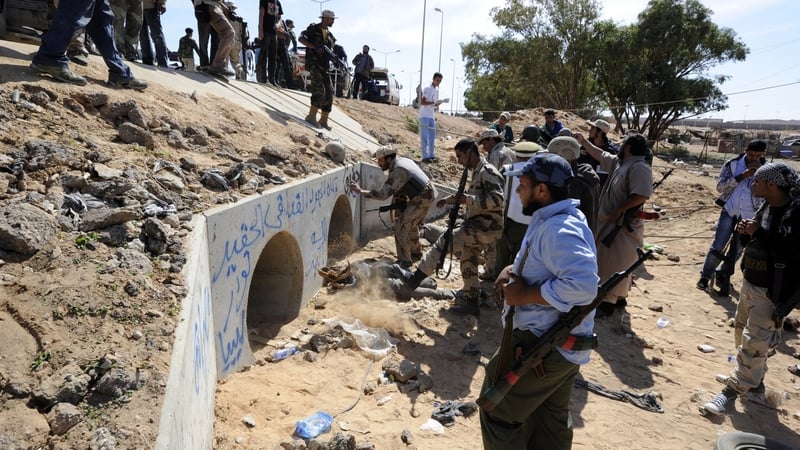
 RTÉ Deputy Foreign Editor Anthony Murnane reflects on the role social media played in the coverage of the death of Muammar Gaddafi.
WARNING: Story contains graphic images
After 42 years, Muammar Gaddafi's rule ended in bloody ignominy in the town where he had been born.
Each moment of his brutal demise was captured frame-by-frame by onlookers using mobile phone cameras.
It followed an uprising - part of the Arab Spring - in which the latest communications technology connected the opponents of regimes in Tunisia, Egypt, Libya, Syria and Yemen.
Thursday, 20 October, two months after Tripoli fell, and the early news from Sirte was of a final push by fighters loyal to the new leadership the National Transitional Council.
Sirte Taken
We had been here before as efforts were made to re-capture this strategically important town - the home place of the former Libyan leader and his family.
Time and again the NTC fighters had been forced to retreat by the Gaddafi loyalists. But this time it was different.
They claimed they had taken control of the town. The mainstream media who were based in the town with the NTC fighters were all over the story this time. But much of what was reported came from a different source - the fighters and Libyans themselves.
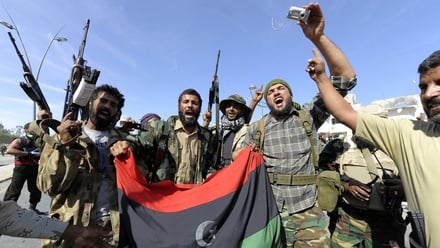
Via Twitter feeds in words and pictures they told of the offensive from the ground. Guns were being fired into the air as joyous fighters claimed victory over the regime.
Others climbed lampposts flying flags of the new Libya. Within a couple of hours by midday word spread on Twitter and into the mainstream media that Gaddafi had been captured.
It took just an hour for things to change rapidly.
'Unconfirmed' was the key word for establishment newswires and broadcast media as social sites like Twitter contributed to the reporting of a story, which would later be confirmed, incredibly, almost in its entirety.
It was the speed of the new media and the immediacy of reports from those on the ground that brought the events to light.
By 1pm, the emerging story was that Gaddafi loyalists had been corralled into a corner of Sirte by NTC fighters. They made a break for it in a convoy, which had come under attack by NATO and local fighters. Gaddafi had been found in a drain shouting don't shoot.
Word then spread he was dead and his body was being taken to Misrata. While reported as unconfirmed at the time these first hand, as it happened, accounts would prove to be true.
Gruesome Scenes
It was a remarkable 60 minutes, which saw ordinary people using their own editorial intuition and the latest technology to filter details of this developing story to their countrymen and the wider world.
Gruesomely, mobile devices captured the final moments of Muammar Gaddafi's life.
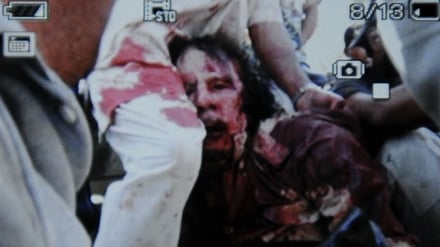
But even in those horrific scenes there was a knowledge among the citizens to the way images are captured, the way a narrative unfolds. None of these techniques were lost in the desire of the crowd to capture forever the event for real.
Within minutes, and in the press of a send button on a mobile phone or laptop, the footage was available half a world away to anyone who wanted to watch. It was picked up by the mainstream media.
For global news organisations it raised many questions about how much of the bloody scene, already out there in the public domain, should be broadcast as they found their job being done by the citizens in this new era.
Gaddafi's Deathbed
Later, as Gaddafi’s body lay stretched out in a meat factory freezer, we saw crowds wanting, indeed needing, to see for themselves the dictator on his less than dignified deathbed.
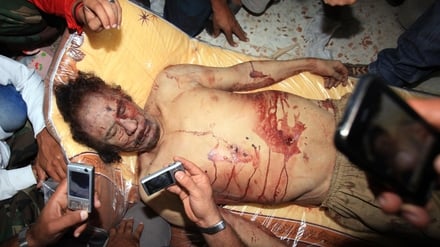
Each and every one of them had a mobile phone capturing the moment on camera. Proof for themselves, their relatives and whoever else with whom they might share the image.
And share the images they did via new media, which was then picked up by traditional media. It was the culmination of a whole shift in citizen journalism and over those few hours on that fateful day for their nation Libyans truly led the way.
Anthony Murnane
