
Over the last few days, NASA has been getting everybody excited with its plans to hold a high profile briefing about a discovery beyond our solar system. Now we know that the announcement concerns the discovery of seven planets orbiting a star elsewhere in our galaxy.
OK, that sounds interesting. What exactly has been discovered?
The discovery concerns a star that's 39 light years away from Earth in our Milky Way Galaxy. The star is known as TRAPPIST-1.
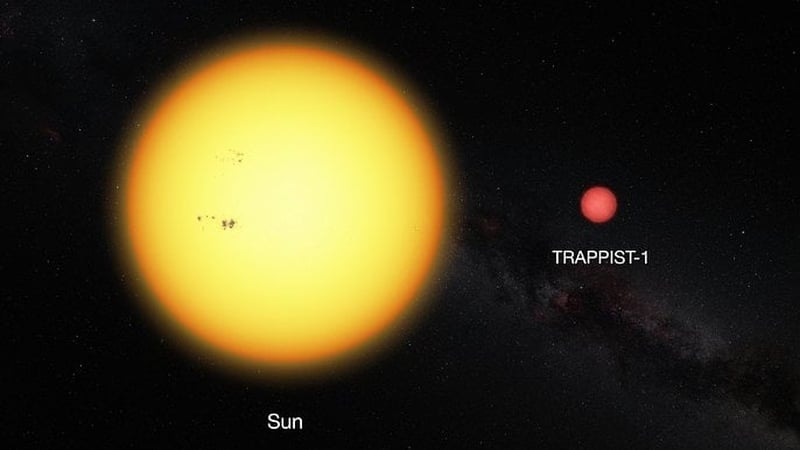
It is an ultracool dwarf star, which means it is smaller than our Sun (around 8% of its mass or roughly the same size as Jupiter) and not as hot.
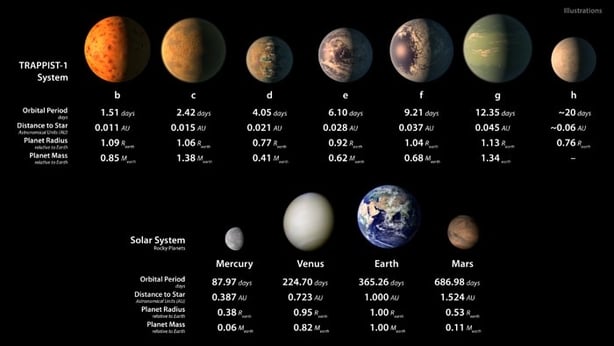
Orbiting around that scientists led by a team from the Université de Liège in Belgium have found seven planets.
Don't we know already that there are lots of other planets in the Universe? What makes these planets special?
What makes them special is that the seven planets are all around same size as Earth or smaller. And their density measurements suggest that at least the six closest to the star, if not them all, are rocky like Earth. But what is most exciting is that all seven could potentially have liquid water on their surfaces, and in particular the three in the middle are very likely to have oceans of water.
What does that mean?
For several decades now, scientists have been busy hunting for planets orbiting stars in the "Goldilocks" or habitable zone. This means they are not too close to the star to be too hot for water and therefore life to exist on them, but also not too far away to be so cold that any water might be frozen. Water is an essential building block for life, so if a planet is rocky, is not too hot or cold and has liquid water, then the prospect of life existing on it is good.
You mean there could be aliens on these planets?
Well, hold your horses! Right now, that's still a bit of a leap. Although it is potentially possible. The planets would need to have other features, like an atmosphere, for example, if living organisms were to stand a chance of survival. Radiation doses coming from the host star would also have to be at a level not to kill everything too. So while there might be something living in the system, it is still way too early to tell for sure.
So how do we find out then?
The scientists made their discovery using a number of ground and space based telescopes and instruments, including the NASA Spitzer Space Telescope, instruments at the the European Southern Observsatory's Paranal and La Silla facilities in Chile and telescopes in Morocco, Hawaii, the Canary Islands and South Africa. But already the NASA/ESA Hubble Space Telescope has turned its attention to the system to try to determine if the planets have an atmosphere. And the soon to be launched NASA/ESA James Webb Space Telescope, as well as the under construction European Extremely Large Telescope are also going to be packed with instruments for this very purpose. So we should know an awful lot more in the next few years.
Haven't other star systems with potentially habitable planets been identified?
Yes they have. For example last year we learned that there is a planet orbiting the closest star to our Sun, Proxima Centauri. And over 3,000 other exoplanets have been identified with hundreds more candidates awaiting confirmation. But what's special about this system is that with at least three potentially habitable planets in it, the chances are much higher that at least one could potentially be suitable for life. That makes it a great system to study. As one of the scientists involved in the mission put it, in this case Goldilocks has many sisters. With seven such interesting planets in one system alone, it also means there must be a vast number of potential habitable planets out there to be discovered.
Can't we just go there to find out more?
Unfortunately it isn't just that easy. It is a very, very long distance to the system - 380 trillion kilometres to be exact. To do that in a jet aircraft would take 44 million years! So we'll have to wait until a space-craft capable of travelling at light speed is invented. In the meantime, we'll have to do our observing from here.
Comments welcome via Twitter to @willgoodbody