


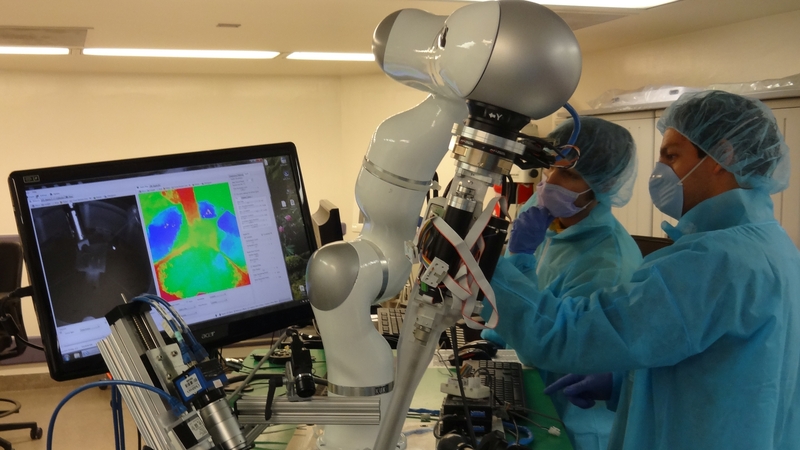
Scientists in the United States have developed an intelligent autonomous robot capable of carrying out basic surgical operations to a higher standard than human surgeons.
The researchers say the new technology has the potential to improve patient outcomes and access to surgery, as well as to reduce costs. However, they also say it is not designed to replace human surgeons.
Robot-assisted surgery has been in use for over a decade.
It involves surgeons manually controlling the robotic device, which means outcomes can vary depending on the skill and experience of the surgeon carrying out the operation.
Scientists at the Children's National Health System and John Hopkins University in the US have built a robotic device that strips out some of the potential for error, because it operates autonomously while under human supervision.
The Smart Tissue Autonomous Robot (STAR) has a robotic arm fitted with surgical tools and which has improved dexterity.
Its capabilities are also enhanced by special technology which enables it to see in 3D and neo-infrared, allowing it to follow soft tissue movement in the target and carry out the surgical task with much greater precision than a human.
But the most important feature is that the STAR has been programmed with the best surgeons' techniques based on consensus and physics, so that it can independently choose how to best accomplish the task.
The results, published in the journal Science Translational Medicine, are very encouraging.
The researchers tested their robot against manual surgery by expert surgeons, laparoscopy and robot-assisted surgery.
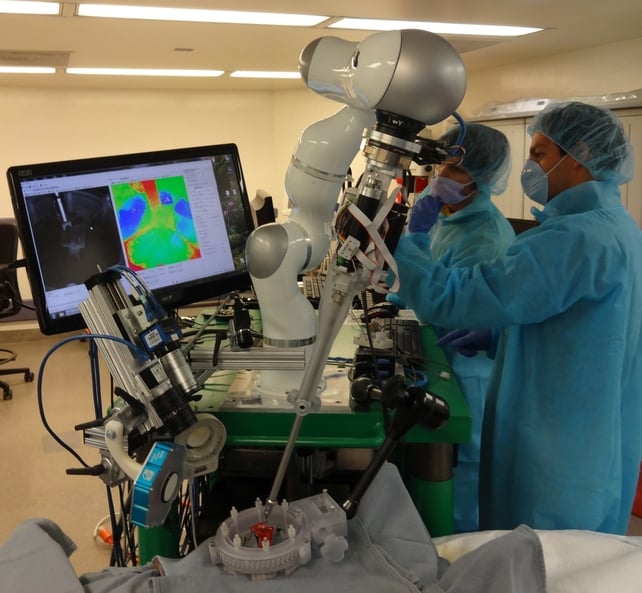
Under supervision, STAR proved superior to all the approaches in suturing and reconnecting bowel segments together, both in tissue samples taken from dead pigs and during open bowel surgery on pigs.
The animals survived the operation with no complications.
While the technology is several years off being ready for everyday use on humans in hospitals, the team say that with further developments, autonomous robotic surgery may one day take human error out of the operating theatre altogether.
It also has the potential to reduce costs in the healthcare system and improve access for patients to surgery around the world.
The development has been welcomed by the Royal College of Surgeons in Ireland (RCSI).
"I think it can only be a good thing," said Professor Oscar Traynor, Director of the National Surgical Training Centre at RCSI.
"Patients are of course reassured by the presence of surgeon when robotic surgery is being performed. But in fact the mere presence of a surgeon in a controlling capacity introduces the potential for error and for less than perfect performance.
"What the computer programme does is take away the potential for error that is included in anything where humans take part."
