
In recent weeks there has been a proliferation of announcements and statements linked to the future of work and the impact of artificial intelligence on the labour force and wider economy.
Ireland's economy is heavily reliant on technology companies, which are among those most exposed to developments in AI.
So, what’s behind the recent announcements, and with artificial intelligence on the rise - are Irish jobs actually on the line?
University graduation ceremonies in some places have become unlikely flashpoints for protest this spring. When former Google CEO Eric Schmidt told students at the University of Arizona that AI would "shape the world", some graduates began loudly booing.
Commencement speeches in Florida and Tennessee drew similar reactions, and there was outrage at a college in Arizona when an AI announcer confused or missed students' names.
Yet for the Class of 2026, here in Ireland and beyond, disruption inside the graduation hall may matter less than the disruption waiting for them in the job market.
Nearly half of Irish employers have reduced the number of entry and graduate-level roles available this year, according to a survey published by recruitment platform IrishJobs.
Graduates Prime Time spoke to say they suspect some of that relates to the proliferation of AI.
"I don't know a single person that's gotten a job out of our year," UCD graduate Caoimhe said.
Speaking after completing her final exams at the RDS, she described spending the past few months searching for work in Human Resources while finishing her degree.
"There is still a lot of entry-level jobs that we can go into, but it's just more difficult to get them."
"It's a shame to see something that I can't even write a good essay with is going to take my job," another graduate, Meri, told the programme.
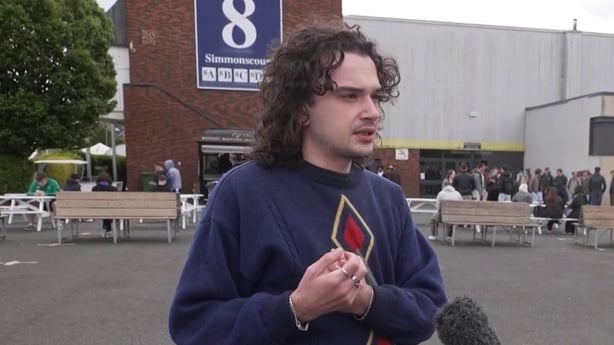
UCD Student Union Education Officer and Pharmacology graduate Matt Mion is also struggling to kickstart his career.
"The pharma sector is not really taking on graduates. That has to do with Trump but also the entry-level skills that are needed on factory lines and in research labs are being replaced through AI," he said.
Mr Mion believes the education system is failing to prepare students for a world where AI has taken over the first few years of a traditional career. New graduates, he said, need to be ready to hit the ground running at a level that previously took years of experience to reach.
More also needs to be done to equip students to work with AI in their chosen fields, he added.
"If we're not teaching those skills and embedding that at an educational level, we're going to leave people with degrees that can't be used."
Tech CEOs have been falling over themselves in recent years to boast of the tremendous power of their new models and tools.
"There will come a point where no job is needed," xAI founder Elon Musk predicted.
Anthropic CEO Dario Amodei claimed 50% of entry-level tech, legal, consulting and finance jobs could be wiped out within five years.
Recent job losses in the tech sector have prompted many to ask whether that prediction is coming true.
Meta is cutting 20% of its Irish workforce with redundancies also impacting Oracle, Shein, Indeed and Glassdoor.
But not everyone is convinced AI is responsible for the scale of recent job losses in tech.
In Ireland the sector grew rapidly through the pandemic, rising from around 130,000 information and communication technology (ICT) employees at the start to a peak of nearly 190,000 18 months ago.
The suspicion is that cuts related to over-hiring are being pinned on AI.
Whatever the reason, the scale of the decline is hard to ignore. Ireland has lost roughly 20,000 ICT jobs in the past 12 months alone.
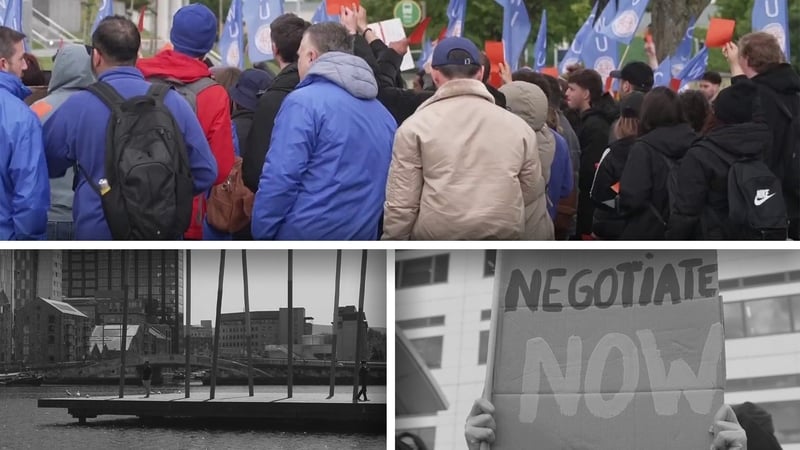
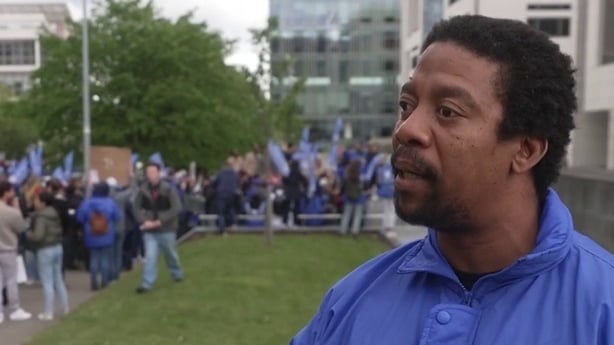
Hundreds of workers at Covalen, a contractor in Sandyford in Dublin, are among those facing redundancy. Employees moderate content on Meta platforms. Recently, some of those staff have been working on an AI development project, according to CWU union rep and employee Owen O’Reilly.
"We thought it was going to help us with our job. We had no clue that it was actually being trained to take over the roles that we're doing," he said.
Despite scepticism among workers on the accuracy of AI models, Mr O'Reilly said he wasn't sure if the role of content moderator would exist in the future.
"I don't think there's going to be much human involvement in time. Things seem to be moving very rapidly at the moment."
There isn't confirmation that the Covalen workers are being directly or indirectly replaced by AI, but Meta itself is cutting human roles at the same time as investing billions in the technology.
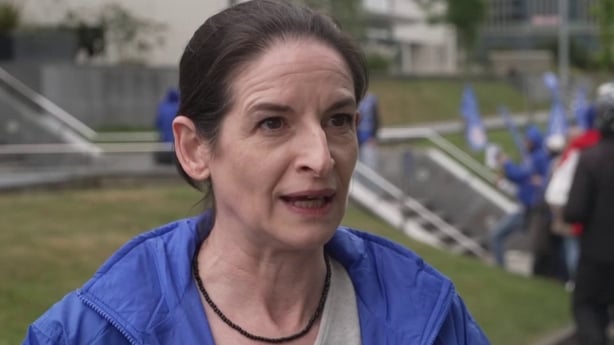
"From what we can see from interacting with all our members across the tech space, not just in Covalen but in other employers, it isn't so much that AI is coming, AI is here," Fionnuala Ní Bhrógáin, CWU's Head of Organising said.
"These redundancies, in our opinion, are the canary in the coal mine," she added.
Most of the Covalen workers are not on high wages, and many have come from overseas. They are anticipating little or no redundancy pay.
Covalen told Prime Time it is proactively consulting with and supporting affected teams and following required processes in line with obligations.
"There are tens of thousands of people employed in tech in Ireland, many of them outsourced, and we can see that this may very well be the future for those workers and the industry," Ms Ní Bhrógáin added.
Ireland's jobs market is among the most exposed in the world to AI disruption, according to the Department of Finance - a view the IMF echoed this week.
While overall employment is up 4.5% since 2023, growth in sectors with high exposure to AI like IT, finance and insurance, was 2.4%, according to the department.
In the same period, employment of workers aged 15-29 went up by 2.4%, but in sectors considered at high risk to AI it fell by 4.3%.
HR consultant Mary Connaughton, Ireland's representative on the board of the European Association of People Management, acknowledged job losses in some sectors, but said workers appeared to have moved into other areas, and noted overall unemployment remains at around 5%.
"We do need to be conscious that as a country that we have to stay competitive, we have to manage our costs, and if we're not successfully doing that, we will run the risk of increasing levels of unemployment."
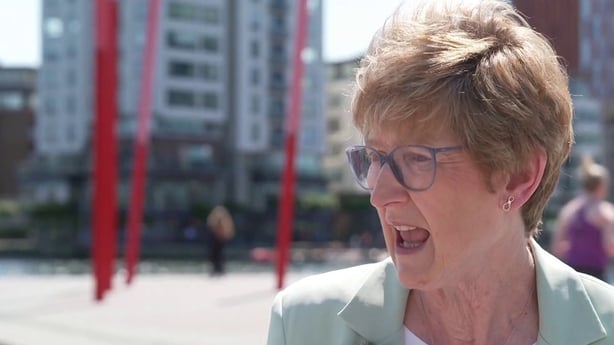
She said traditionally some graduates had found jobs in September after taking the summer off, adding that careers in the future will be less linear and require more flexibility due to the proliferation of AI.
"We're going to be asking people entering the labour market to come up to speed with more complex stuff much more quickly. There is a large level of uncertainty, so people who can work with that uncertainty, who can come in, adapt, and learn, that's the future of jobs."
The Class of 2026 may also, counterintuitively, need to make more human connections to get past AI screening at recruitment stage.
"You might have to search around, use connections, build your network, because that's getting more important for job hunting."
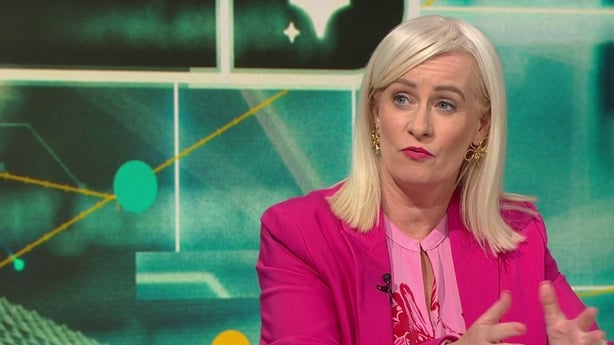
Niamh Smyth, Minister of State at the Department of Enterprise, Tourism and Employment, with special responsibility for AI, told Prime Time she acknowledged there was "a lot of uncertainty" for young people coming out of college.
"Entry-level jobs are obviously the most impacted and where the most vulnerability lies, and the Government is completely aware of that," she said.
She pointed to a refresh of the National AI and Digital Strategy which would have a "laser-sharp view of the skills, where the gaps are, that we can respond to that and be as agile as possible".
To some experts, there is an overarching question about whether it will be necessary, or even possible, for many people to have jobs.
Some of the concerns are rooted in a concept economists call the Lump of Labour, that there's only a fixed amount of work to go around and that anything, a machine or an AI model, that does more of it necessarily leaves humans with less.
But there are examples throughout history of human needs expanding to fill whatever space technology creates. When washing machines freed up hours of laundry time, people didn't just sit around, they wanted entertainment, education, travel.
That drove whole new industries and jobs that didn't exist before.
Companies may ultimately take a similar approach. In an op-ed in the New York Times last week, the CEO of Goldman Sachs suggested reducing the number of employees in regulatory reporting or client onboarding would "free us up to hire more bankers, traders and asset managers who are interacting with clients constantly".
OpenAI's Sam Altman said on Tuesday the rapid development and adoption of AI would not lead to a global "jobs apocalypse" and the technology had not claimed as many white-collar positions as he had feared. It was a reversal of sorts on some of his previous statements.
"I'm delighted to be wrong about this, I thought there would have been more impact on entry-level white-collar jobs being eliminated by now than has actually happened," Mr Altman told a Commonwealth Bank of Australia (CBA) conference in Sydney.
In Ireland, AI-related roles are emerging as the fastest-growing job category, according to research provided to Prime Time by recruitment services firm, Morgan McKinley.
AI Ethics, AI Data Curation and AI Fraud Detection are among more than 80 new AI-specific job titles created over the past 18 months, Trayc Keevans, Director of FDI, told the programme.
"Human oversight is still very much a requirement. The decision-making is still human-led, and the strategy around it is still human-owned."
Roles spanning engineering, machine learning, and governance functions are being created as companies gear up for compliance with the EU AI Act, she suggested.
It's a sentiment shared by NYU professor and tech commentator Scott Galloway who has argued that AI job fears are being driven by the self-interest of AI companies.
"Every generation gets its 'machines will take your job' panic. This one just comes with better PR and a bigger balance sheet," he said
Unlike the Industrial Revolution, which took generations, AI is moving at warp speed and government, industry and education all need to ensure there is a net positive, Trayc Keevans said.
"It's changing very fast, and I think anybody who wants it to stay the same will probably be left behind."
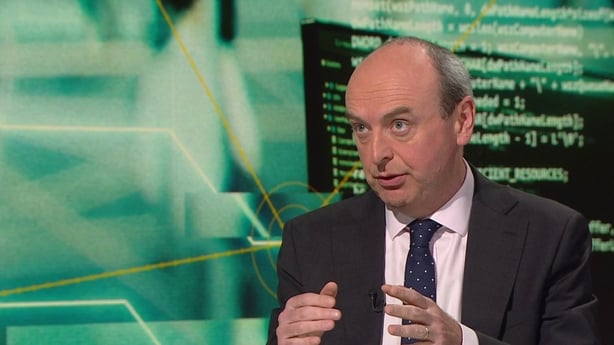
Fergal O’Brien, Executive Director in the business representative group Ibec, says that despite AI and the wider economic challenges there was still "spectacular momentum in the economy".
"The majority of our members on Ibec are still planning to hire both more workers and graduates this year," he said.
Mr O'Brien called for the use of the National Training Fund, which he said had a surplus of €2bn, to be used in this year's budget to help the reskilling of workers.
"Employers have paid 1% of the payroll for upskilling, retraining, and lifelong learning. Right now, that fund is not being put to work."
Minister Niamh Smyth insisted funds required to "make sure that the skills gap is closed," would be utilised.
For some graduates, those facing reskilling, or others reimagining their long-term careers, such opportunities can't come soon enough.