Parking disputes in and around high-density housing estates are fuelling tensions between neighbours, according to a Dublin TD, who says he fears the situation could turn violent.
"It's sowing massive social disharmony," Independent TD for Dublin Mid-West Paul Gogarty told RTÉ's Prime Time.
"I haven't heard of any fistfights yet, but I think it's only a matter of time."
People living in and around new developments said they have seen verbal confrontations, vandalism, cars being keyed, and tyres being damaged, as people use their own traffic cones to try to reserve spaces.
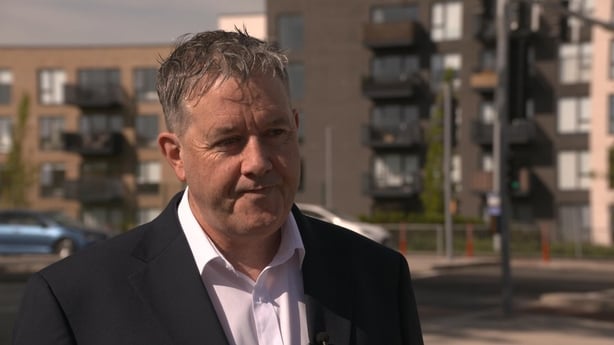
In the Seven Mills estate in the new Dublin suburb of Clonburris, near Lucan, resident Lorna McEvoy said that the parking issue is resulting in stress and tensions.
"I love this house, but the parking situation really gets to you," she said.
Ms McEvoy's section of the development features a mix of houses, each with one or two parking spaces, and alongside an apartment complex run by the Respond housing association, which has limited parking.
While visitor spaces are also provided, Ms McEvoy said there are frequent disputes over parking.
"It's the stress of 'where am I going to park my car - somebody's going to be in my spot,’" she said.
"Nobody wants to be coming home from work dealing with a confrontation over a parking space," she added.
Ms McEvoy said her sales contract says she has exclusive use of two spaces outside her house, alongside the footpath. Her home has no dedicated driveway and the spaces have no numbers or signs to indicate who can use them.
"The management company has been looking into putting plaques on the ground, but I don’t know how much of a deterrent that will be," she said.
"It’s been ongoing since October last year and we still have nothing."
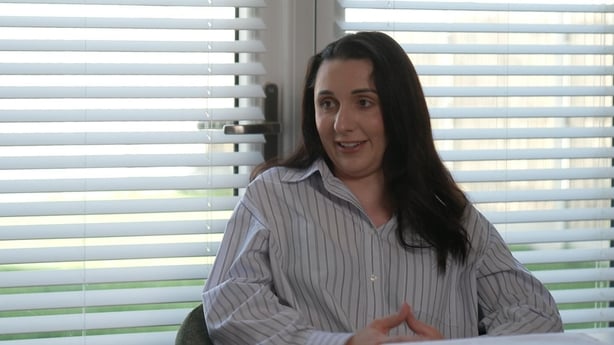
A residents WhatsApp group with more than 400 members features regular complaints about parking, she said.
"People have let air out of tyres, there's been cars that have been keyed, people putting their wheelie bins in the car parking spaces when they leave," she said.
"It's just very hostile and it's not a nice relationship to have, to sort of deal with people that you have to live around," she added.
When Prime Time visited the estate during the day there was parking available in visitor areas, but Ms McEvoy said the evenings and weekends are a different story.
"As soon as people start coming home from work there will be messages in the WhatsApp group - ‘please move your car,’" she said.
"We have huge mortgages and I know to some people it's very trivial, ‘oh it's just a car parking space,’ but it's very stressful when you actually have to live in it."
Cairn Homes, the lead developer behind Seven Mills, said it is aware some residents have been experiencing frustrations with individuals parking in spaces who are not permitted to do so.
It said it was "actively engaging" with South Dublin County Council, residents, and the management company which has ultimate responsibility for parking management.
"Implementing a permanent solution, such as a proactive parking management plan, in order to address residents’ valid concerns, is a priority," it added.
Respond added that it was also supporting measures to improve the situation for residents.
A few kilometres away in Adamstown, another of Dublin’s new suburbs, some residents are using sophisticated methods to try to claim parking spots.
Yellow, metal parking locks have been placed in some spaces. The devices can lift and fall, some are even operated by remote control.
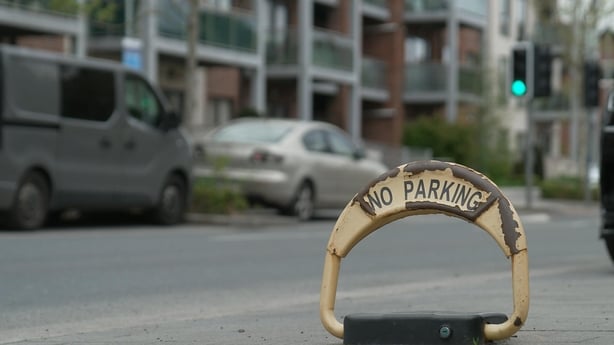
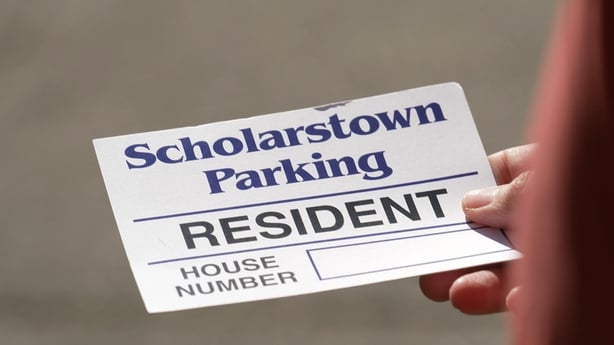
When a new development was built directly beside their estate, residents of Scholarstown Park in Knocklyon began using more traditional methods - cones and wheelie bins - to stop the new neighbours from parking outside their homes.
The adjoining Two Oaks development contains 590 apartments and houses, but just 459 parking spaces. Tenants in rental units are charged €600 a year for parking permits, which are enforced with clamping.
"There’s all these extra cars that need to park and unfortunately it's our estate that seems to suffer," Roy Kennedy, President of the Scholarstown Park Residents Association, said.
Mr Kennedy said residents and visitors to the new development use his road as an overflow car park.
"We don't own the road, but at the same time we should have a right to be able to park within a reasonable distance of our home," he added.
Most of the original homes in Scholarstown Park have single driveways but there are families with two cars and, increasingly, multiple generations with multiple vehicles.
Mr Kennedy said the atmosphere is tense with tyres being let down and vehicles vandalised.
"It’s not something that anybody wants to live with," he said.
"It just seems a little unfair that we can't park in their development, but they can park in ours."
Storyhouse, the company that lets the Two Oaks apartments, said the development is fully compliant with parking standards and every tenant is told in advance whether their unit has parking.
It says it takes neighbours' concerns seriously, but notes it has "no control over how members of the public - whether our tenants or others - choose to use the public road network surrounding the development."
Policy changes
Planning and development experts who spoke to Prime Time noted that in recent years policies have been changed to reduce the number of parking spaces per dwelling, particularly in areas with plans for strong transport links.
"Years ago, they used to refuse schemes that didn't have sufficient car spaces. Now they will refuse schemes for having too many car spaces," Town planning consultant, Tom Philips said.
"Cars take up space and they add to the cost so that's the trade-off. If people want to have more cars they have to put up with having fewer houses.
"The days of building one-off houses in urban areas surrounded by lots of parkland are gone. We have to build much denser units to get more people in," he added, suggesting that increasing the number of residents in an area will lead to more bus services.
Mr Phillips acknowledged that issues with parking were being exacerbated by multigenerational living but said more new homes would reduce the pressure.
The 2024 Department of Housing guidelines state: "Car parking ratios should be reduced at all urban locations, and should be minimised, substantially reduced or wholly eliminated at locations that have good access to urban services and to public transport."
The guidelines instruct that in city centres and urban neighbourhoods the maximum rate of parking in a new development should be an average of one space per dwelling.
In areas within a five–six minute walk of high-frequency urban bus services, parking should be limited to 1.5 spaces per dwelling. While for developments in areas with less frequent transport or smaller towns and villages, the maximum allowed spaces per dwelling is two.
The guidelines define maximum parking provisions; in some developments the ratio is as low as 0.5 spaces per dwelling, when averaged across houses and apartments.
In Cork city centre, an apartment building currently under construction will go even further.
The 25-storey Railyard development will have 217 cost rental and affordable apartments but zero dedicated parking for residents.
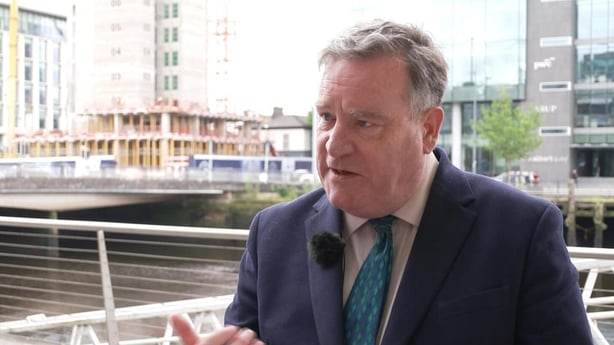
Lord Mayor of Cork, Councillor Dan Boyle, said the elimination of underground parking reduced the cost of each unit by €75,000, but added that the approach was also about promoting active travel and public transport.
"We’re trying to encourage more people to live in the inner city, but where we're less car-dependent and other options are available and used," he said.
"30% of the households in Cork city centre are without cars, and of the journeys that are made within the city centre, over half of those are already either walking or by bike."
Asked whether public transport was good enough to justify having no dedicated parking in a new residential building, the Cllr Boyle said: "It's a chicken and egg situation. We can't have a perfect public transport system while we have the traffic build-up.
"We have to phase out one and phase in the other. There’s no magic wand," he added.
Mobility habits crystallise at major life transitions like buying a home, according to research, making it a moment to nudge people toward public transport.
However, Independent TD Paul Gogarty said the transport infrastructure to support new homes has not materialised in his constituency.
"People have been sold this dream of everything within walking and cycling distance, a train station right beside you, but the train capacity doesn't exist, and it only goes in towards the city centre," he said.
"I was a Green TD back in 2003 when the likes of the Adamstown Strategic Development Zone (SDZ) plan was formulated and at the time I was absolutely sold on this type of development because you put the facilities in, people wouldn't have to drive, they could just walk around the corner.
"At no stage did I ever say ‘don't give people the option of parking.’ If people need to get out of an area, if relatives need to come in and visit them, you have to provide the parking spaces," he added.
South Dublin County Council says that - in line with national policy - a proportion of residential parking in the Clonburris SDZ is "intentionally unallocated and shared, in order to support efficient use of spaces and reinforce reduced car ownership in a highly accessible, public‑transport‑served location."
It added that it’s engaging with public transport providers to progress bus and rail improvements, in particular "the DART+ South West project, which has been delayed, and the activation of planned bus services would significantly enhance transport options for Clonburris."
Nationally, the Government will point to its National Development Plan commitments, where one in every four euros will be earmarked for transport.
Recent passenger numbers also indicate progress: public transport journeys have grown 16% nationally since 2023, with rail travel alone up nearly 20%.
"The less cars that are used, the more public transport can get through the traffic and run on time," Cllr Dan Boyle argued.
"The over-dependence we have on cars is what's causing the constant traffic build-up, and the problems that follow on from that. It's an attempt to put things right and get a better balance."
A report by Louise Byrne and Genevieve Brennan on parking disputes in and around new high-density housing developments is broadcast on the 5 May edition of Prime Time at 9.35pm on RTÉ One and RTÉ Player.