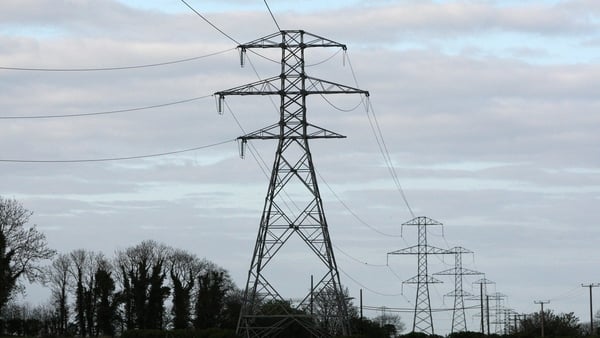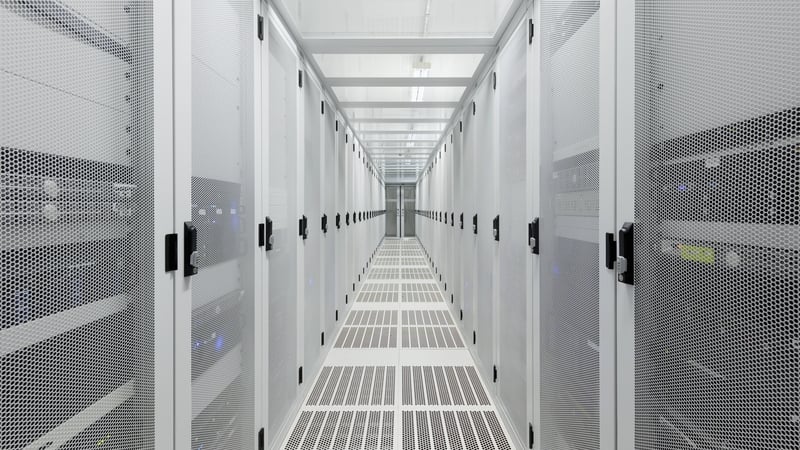

A new strategy has been approved by the Cabinet aimed at enabling the further development of energy intensive facilities, including data centres.
The Large Energy Action Plan (LEAP) is designed to attract more investment in Ireland from large energy users, which also include the semiconductors and pharmaceuticals sectors.
It contains 17 actions to be implemented over the next five years to address what the Government said are existing barriers to such centres and plants.
The plan's publication comes following the lifting of an effective moratorium on new data centre connections.
The restriction was in place since late 2021, while the Commission for the Regulation of Utilities (CRU) reviewed its policy on large energy users amid energy consumption concerns.
Last month, the CRU ruled that data centres could be built where they meet at least 80% of their annual energy demand through new renewable electricity sources.
Under the rules, the projects will be allowed a six-year "glide path" for renewables to be developed and start generating.
Data centres accounted for 22% of electricity usage in Ireland in 2024, up from just 5% in 2015.
It is estimated the consumption level will grow to almost a third of the national electricity demand by 2030.
The Minister for Enterprise, Tourism and Employment said the approach set out in the LEAP plan "will enable regions across Ireland to attract investment in the next generation of strategic industry, promoting long-term economic development and providing further employment across the regions".
Peter Burke said the data centres already employ around 21,000 people who manage and operate the facilities, which he said underpin over 180,000 jobs in the tech sector.
Core to the strategy is the location of new large energy demands near renewable energy sources.

The plan also includes identifying so-called green energy parks, where for example, data centres would be co-located with renewable electricity generation, such as offshore wind, so they do not act as a drain on the national grid.
There is a focus in the plan on developing such projects in regional locations, where renewable energy capacity exists.
Data centres on the east coast - where there is currently a concentration of such facilities - would be permitted when further energy sources come on stream.
Mr Burke said a number of green energy parks are planned and he said there are two that are "currently going to embark upon the planning process and they are going to be very significant".
He said about 50% of capacity from data centre activity "is taking up power in the greater Dublin area".
"So, capacity is very limited over that greater Dublin area over the next period of time. That's why we have to set out an investment framework, a policy whereby we can direct activity to, because there are parts where there is capacity, but we're also saying we're not going to diminish that capacity. You have to bring your energy to the table."
The Minister for Climate, Energy and the Environment said a strategic approach to the development of an energy intensive industry in Ireland "will drive further innovation and investment in our renewable energy sector over coming decades".
Darragh O’Brien said future industrial development "will be aligned with Ireland’s continued green transition, robust energy security, infrastructure delivery, and affordability of energy for households and businesses throughout the country".
Minister O’Brien insisted the plan is "consistent" with the Government’s climate objectives.
"If anything, it will accelerate the delivery of our renewable energy production and our renewable energy capacity," he added.
He said the CRU’s policy decision requires additional renewable sources, "not those renewable sources that are already in place, and not those renewable sources that are already contracted".
"So, if anything, it will accelerate the delivery of our renewable energy production and our renewable energy capacity."
There has been a mixed reaction to the move.
The chairman of Digital Infrastructure Ireland has given a broad welcome to what he described as "a positive step".
Maurice Mortell said the industry has been waiting four years since the moratorium "for a positive decision by Government".
He said during that period, Ireland lost out on significant investments.
"We were unable to offer any new connections onto the grid, so as a result, we've lost billions of euro of investment, particularly around AI infrastructure, which has been announced in other European jurisdictions, the Nordics, Eastern Europe and down in the Mediterranean."
Mr Mortell said the decision provides businesses with the opportunity "to make some informed investment decisions about what the future holds for infrastructure in Ireland".
"At least now there's a roadmap to making those investments and giving those companies the opportunity to make informed investment decisions," he added.
On the requirement for the facilities to have their own renewable electricity generation, the DII chairman said all the companies are "really committed to a sustainable future, and I think as part of that, the six-year roadmap into 80% renewables is easily achievable".
The chief executive of Friends of the Earth said the LEAP plan "risks prioritising the interests of the data centre industry at the expense of households, existing businesses, and Ireland’s climate obligations".
Deirdre Duffy said renewables must be used to decarbonise existing homes and industries, "not to fuel unchecked expansion of the data centre industry".
"We urgently need policies that prioritise decarbonisation and public benefit, rather than offering yet more incentives to a single sector," she added.
Ms Duffy said Friends of the Earth is calling for "immediate clarity that households will not foot the bill for the infrastructure and incentives to support green energy parks for data centres".