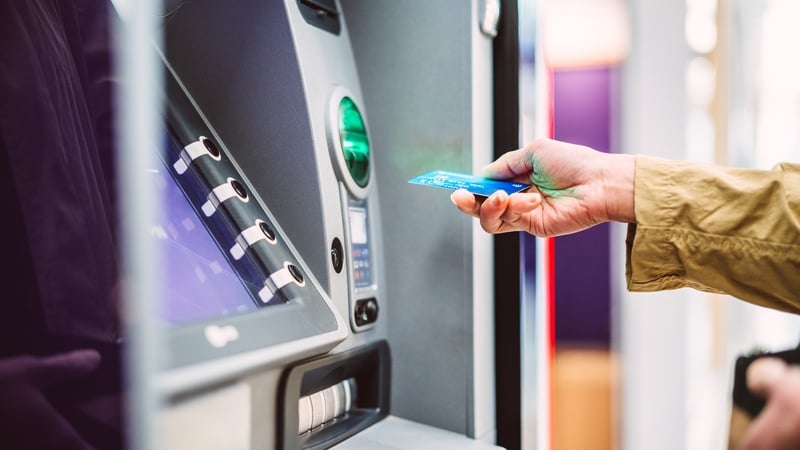

The Central Bank has identified a number of "small" shortfalls in the provision of ATMs and Cash Service Points in parts of the country.
An assessment of the facilities, as part of new access to cash rules, found that was an insufficient number of ATMs in the Border, West and South-West regions.
There is also a gap in the number of Cash Service Points in the Border and West regions.
The Finance (Provision of Access to Cash Infrastructure) Act 2025, introduced last year, put in place a framework to ensure sufficient and effective access to cash.
The new rules included criteria setting out the minimum percentage of the population in each region that must be within 10km of an ATM and a cash service point, as well as the minimum number of ATMs per 100,000 people in each region.
The Central Bank is tasked with monitoring whether the criteria are met, to ensure that the number of ATMs and cash service points are maintained at 2022 levels.
In its first quarterly access to cash report, the Central Bank said the cash infrastructure in Ireland "remains largely in line" with the criteria set by the Minister for Finance.
It found there are just over 4,000 ATMs and just over 1,200 Cash Service Points across the country.
The Central Bank said there are "six instances where the criteria are not met".
"In all those cases, the shortfall relative to expected levels of the cash infrastructure is small," it added.
The financial regulator said it has written the designated entities responsible for providing the facilities - currently AIB, Bank of Ireland and PTSB - to ask for the identified shortfalls to be addressed.
Deputy Governor Vasileios Madouros said the Central Bank is "committed to ensuring that cash is available and accessible as a means of payment".
He said in instances where the criteria are not met, "this will need to be rectified by the firms responsible under the legislation".
"We have outlined the identified shortfalls to firms, and they will provide us with their proposals to address these in the coming weeks," it added.
Mr Madouros also said the bank recognises that, at a more local level, "there may be specific challenges in accessing cash".
He said consumers will be able to make a submission to the Central Bank from July if they believe there is a local deficiency in relation to access to cash.
A public consultation, outlining the guidelines and the bank's proposed approach, is ongoing until 4 March through the Central Bank's website.
The Tánaiste and Minister of Finance said the report "demonstrates how in practice the Access to Cash legislation will protect the access to cash for Irish consumers in the years ahead".
Simon Harris said the level of access to cash infrastructure across the State "is being protected as envisaged in the legislation".
He said as payments continue to digitalise, "it remains important and essential to recognise that cash is a necessary means of payment for many people".
"This includes not only the older generations in our society, but also individuals who may not have access to digital payment options," Mr Harris added.
Following the review of the cash infrastructure, the Banking and Payments Federation of Ireland (BPFI) said its members are "fully committed to providing the relevant ATM and Cash Service Point services as soon as possible".
The BPFI said AIB, Bank of Ireland and PTSB are working together in collaboration through the federation "to support the implementation of the legislation".
It said the banking sector "recognises the importance of cash for many consumers and small businesses" and it said that is demonstrated through "ongoing investment" in the provision of cash services, including branches and ATMs.
"At the same time, consumers are changing the way they pay, with ATM cash withdrawals having fallen by over a third (37%) since 2019 (before the pandemic) as more people choose to manage their money digitally."
"In this context, banks remain committed to ensuring there is reasonable access to cash in line with their obligations under the access to cash legislation."