


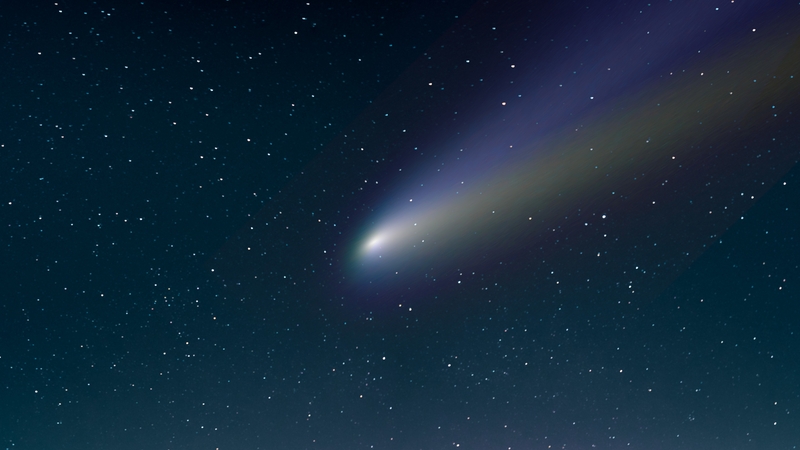
A comet that was last visible from Earth when Neanderthals were alive could be spotted with the naked eye this weekend, scientists have said.
Comet A3 (Tsuchinshan-ATLAS) has been called "the comet of the century" because of how bright and visible it could be, according to the Royal Astronomical Society (RAS).
Astronomers said it would last have been visible from our planet around 80,000 years ago and was only discovered in January 2023.
Stargazers in the southern hemisphere have already glimpsed Comet A3 but it can now also be seen in the northern hemisphere, the society said.
They said there will be two windows to spot the comet.
Firstly, between 27 September and 2 October, when it will be visible east just before sunrise, and then again between 12 and 30 October.
It said the second period will be a better chance to see it, if stargazers look to the west just after sunset.
Between 12 and 30 October, people may be able to see the comet using binoculars or even with the naked eye.
In a video on the society's website, deputy director Dr Robert Massey said taking photos of the comet may be possible, particularly if using a digital single-lens reflex (DSLR) camera.
According to the RAS, the comet comes from the Oort Cloud – a giant spherical shell that surrounds our solar system and contains billions of objects including comets.
Regarding talk that this comet may constitute the "comet of the century" Dr Massey added a word of caution.
"People are asking whether this will be some kind of 'comet of the century’ - if you read some news outlets they imply that," he said.
"I don’t personally think that’s very likely. I think it’ll be a nice comet - and it looks as though it’s holding up for that - but it’s unlikely to be as easy to see as NEOWISE was in 2020 or Hale-Bopp in the late 1990s, which many of us still remember as being a really dazzling object."
