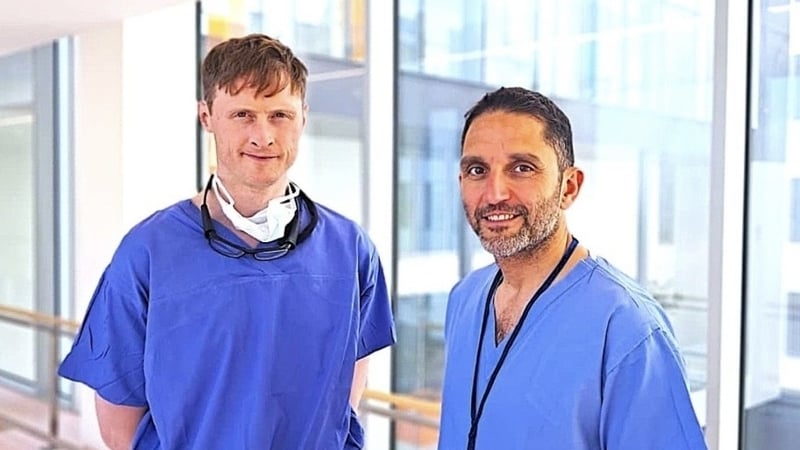

A team at University Hospital Limerick has become the first in Ireland or the UK to deliver a pioneering medical procedure for patients with high blood pressure by accessing the arterial system via the wrist.
Consultant interventional cardiologists Dr Samer Arnous and Dr Cormac O'Connor successfully carried out the transradial renal arterial denervation (RAD) using an extremely narrow 5 French catheter.
The French scale is used internationally to measure the diameter of catheters used in healthcare.
Renal arterial denervation is an emerging treatment for patients with resistant hypertension, or high blood pressure that is difficult to control with medication.
The procedure has been available at UHL since the opening of the hospital’s new €2m catheterisation laboratories in 2024.
RAD involves passing a catheter through the circulatory system to access the renal arteries and using radio-frequency waves or ultrasound to target the excessive nerve activity around the renal arteries that can contribute to high blood pressure.
Even when accessing the arterial system via the groin, RAD is regarded as minimally invasive.
The transradial procedure, completed by a multidisciplinary cardiology team led by Dr Arnous and Dr O'Connor in April this year, is an even less invasive option for people struggling to control hypertension, where the arteries are accessed through the wrist.
For patients, the benefits of RAD are significant and include reduced reliance on daily medication, lower risk of heart attack and stroke, and it preserves normal kidney function.
Dr Arnous said the wrist-based approach offers many benefits for patients.
"Renal denervation can be performed via either the radial artery in the wrist or the femoral artery in the groin, but radial access offers several practical advantages that are increasingly appealing to both patients and clinicians.
"Entering through the wrist is generally more comfortable, less invasive and allows patients to sit up and walk almost immediately after the procedure, avoiding the prolonged bed rest often required with femoral access. It also carries a lower risk of significant bleeding or vascular complications," he said.
Dr O'Connor said: "High blood pressure is one of the leading causes of heart disease and stroke worldwide, and many patients struggle to control it despite medication.
"This landmark procedure positions University Hospital Limerick at the forefront of innovative cardiovascular care, while giving patients access to safer, more convenient treatment options."