


US President Donald Trump has said that he was extending a ceasefire with Iran to give more time for negotiations, but would maintain a US naval blockade of the country's ports.
In a post on his Truth Social platform, Mr Trump said that he would "extend the Ceasefire" until Iran came up with a proposal to end the conflict. However, he "directed our Military to continue the Blockade."
Mr Trump's ceasefire extension came hours before it was believed to be set to expire.
It also came as the White House said Vice President JD Vance would not be going to Pakistan for what had been expected to be a second round of peace talks.
"The trip to Pakistan will not be happening today. Any further updates on in-person meetings will be announced by the White House," a White House official said in a statement.
The US president cast the breakdown in more talks as resulting from Iranian infighting, adding that Pakistan's leaders had asked him to extend the truce.
"Based on the fact that the Government of Iran is seriously fractured, not unexpectedly so and, upon the request of Field Marshal Asim Munir, and Prime Minister Shehbaz Sharif, of Pakistan, we have been asked to hold our Attack on the Country of Iran until such time as their leaders and representatives can come up with a unified proposal," Mr Trump posted.
However the blockade of ports on Iran's coast in the Strait of Hormuz will remain in place, he said, while the US military will "in all other respects, remain ready and able".
The ceasefire, Mr Trump said, will be extended "until such time as their proposal is submitted, and discussions are concluded, one way or the other".
The Pakistani prime minister has thanked Mr Trump for extending the ceasefire with Iran and urged both sides to continue talks.
"I sincerely hope that both sides will continue to observe the ceasefire and be able to conclude a comprehensive 'Peace Deal' during the second round of talks scheduled at Islamabad for a permanent end to the conflict," Shehbaz Sharif wrote in a post on X.
Earlier Iran's foreign minister, Abbas Araghchi, said the US blockade of Iranian ports is "an act of war" which breaches the ceasefire agreement.
Iran and the US have accused each other of breaching the two-week truce.
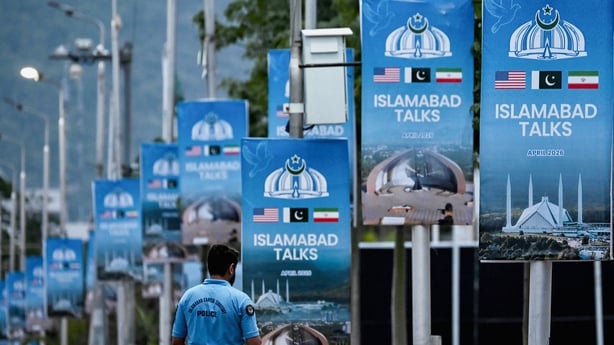
During initial talks in Pakistan earlier this month, the highest-level discussions between the foes since the founding of the Islamic republic in 1979, analysts pointed to the seniority of the delegations as an indicator of a willingness to strike a deal.
But those talks collapsed without an agreement, with Iran since closing the Strait of Hormuz again and President Trump announcing a blockade of Iranian ports.
"So far, no delegation from Iran has departed for Islamabad, Pakistan; whether it is the main or subsidiary delegation; primary or secondary," Iranian state TV said, dismissing reports suggesting otherwise.
Mr Trump accused Iran of firing on ships in the crucial trade route it has choked, while Tehran said the US blockade and seizure of a ship violated the ceasefire deal.
Iranian officials said they felt the Trump administration had not acted in good faith in negotiations and refused to back down from what it called excessive demands.
Iran says will show 'new cards' on battlefield if conflict resumes
Its parliament speaker said the country would not accept talks "under the shadow of threats" from the US leader and would "show new cards on the battlefield" if conflict resumed.
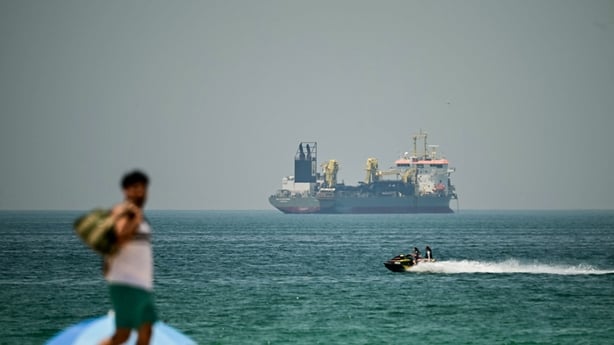
Iran's Revolutionary Guards warned of targeting any vessel attempting to pass through the Strait of Hormuz without permission.
The channel in peacetime sees around 120 daily transits, according to Lloyd's List, a shipping industry intelligence site.
The site reported that more than 20 Iranian so-called "shadow vessels" had transited past the US blockade.
In one of a series of posts on his Truth Social platform, Mr Trump insisted that the blockade was "absolutely destroying" Iran and said it will not end "until there is a 'DEAL'," in which the United States is pressing for Iranian concessions on its contested nuclear programme.
Iranian 'mosquito fleet' may keep Strait of Hormuz closed
Iran's "mosquito fleet", a guerrilla force working on water using speed boats and small craft, could keep the Strait of Hormuz closed for weeks or months, according to a former Head of the Royal Navy Strategic Studies Centre.
Speaking on RTÉ’s Morning Ireland, Kevin Rowlands explained: "It's a guerrilla force operating on water or near the water and having a maritime effect.
"It's a combination of asymmetric capabilities, small craft. They may use missiles, they may use guns, they may use mines. They use them pretty effectively by just overwhelming and confusing those they're fighting against."
Mr Rowlands, who is Editor of the Royal United Services Institute Journal, said that while the US and Israel have overwhelming military superiority, "that’s designed mainly to fight against peer competitors, so fight against the same kind of threat that they would pose themselves".
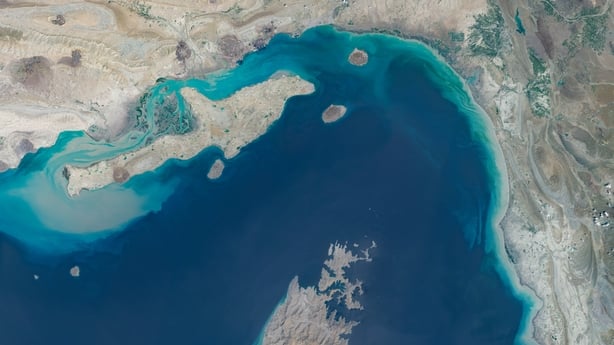
He explained that the mosquito fleet uses lots of different kinds of fast attack craft, effectively speedboats that can nip out from behind an island or hide behind other shipping.
"They have small sort of corvette size, very small, what you may think looks a bit like a warship, but very small. They have some of those. They even have people moving around on jet skis," he said.
"It's a range of small, difficult to detect, difficult to engage craft, and they could have easily double figures of these things, or perhaps into three figures," he said.
"I think this could be sustained for definitely weeks, probably months, and maybe even longer," he added.
Read more:
Lebanon sees its chance - but it is fraught with danger
Bereaved Israeli and Palestinian fathers campaign for peace
Questions remain about realities of Middle East ceasefire
