


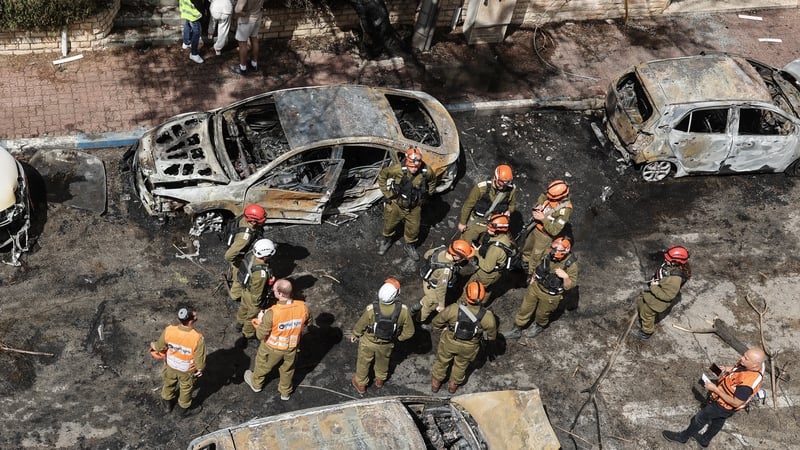
The Israeli military has said it was prepared for weeks more fighting, after Prime Minister Benjamin Netanyahu announced that the war with Iran was beyond the halfway point.
Mr Netanyahu told the US broadcaster Newsmax yesterday that the war was "definitely beyond the halfway point," but declined to give a timeframe.
He added that the halfway point referred to missions, "not necessarily in terms of time."
When asked for the military's stance at an online media briefing, spokesman Lieutenant Colonel Nadav Shoshani said decisions on timing belonged to the political echelon.
"We are prepared to keep operating for weeks to come," he told journalists.
"We have the targets for that, the munition for that, the manpower for that. And it's up to ... the leadership to decide that," he added.
The Middle East war started on 28 February, when joint US and Israeli strikes on Iran sparked retaliatory attacks across the region.
US President Donald Trump initially said the operation would last for four to six weeks.
Secretary of State Marco Rubio yesterday that the war would last "weeks" further instead of months, amid growing US public opposition to a conflict that has sent oil prices soaring.
Strikes in central Iran hit 'military sites' - Iranian media
Iranian media have reported that initial investigations indicated strikes in central Iran had hit some "military sites", without specifying the locations.
"Initial investigations indicate that some military locations in Isfahan were targeted," the Fars news agency quoted Akbar Salehi, a security official at the governor's office in Isfahan province, as saying.
The official also said the extent of the damage and any casualties were not immediately clear.
Isfahan province is a key hub for Iran's defence industry and hosts major nuclear facilities, including Natanz.
The nuclear sites were targeted during a 12-day conflict with Israel last June, as well as in the current war that began on 28 February, according to Iranian officials.
The province is home to several major military bases, including the Badr airbase, the 8th Shekari airbase, and the 4th Air Force base.
Strikes during the conflict have also hit civilian and historical infrastructure, including the Isfahan University of Technology.
Several heritage sites listed by UNESCO have been reported damaged in Isfahan's Naqsh-e Jahan Square, including the Safavid-era Abbasi Jameh Mosque and Ali Qapu Palace.
Hassan Fartousi, secretary-general of the Iranian National Commission for UNESCO, said in a press conference that damage in the province was "huge".
Industrial facilities were also affected, with strikes hitting the Mobarakeh Steel Company complex.
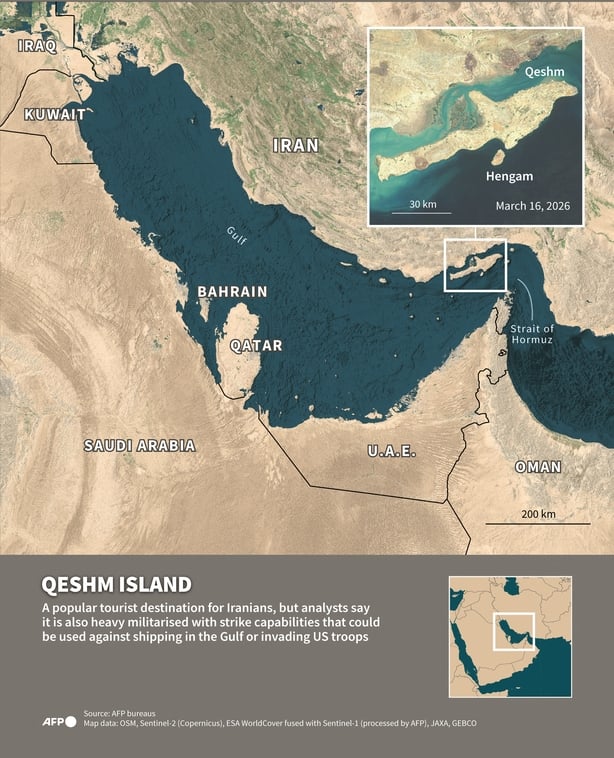
Strikes have also hit a desalination plant on Iran's Qeshm island in the strategic Strait of Hormuz, putting it out of service, Iranian media reported.
"One of the desalination plants on Qeshm Island was targeted ... and is now completely out of service, as it is not possible to repair it in the short term," the ISNA news agency reported, quoting health ministry official Mohsen Farhadi.
It was not immediately clear when the attack took place.
Iran set oil tanker ablaze off Dubai
Iran attacked and set ablaze a fully-loaded crude oil tanker off Dubai this morning, as President Donald Trump warned the US would obliterate Iran's energy plants and oil wells if it does not open the Strait of Hormuz.
The strike on the Kuwait-flagged Al-Salmi is the latest in a string of assaults on merchant vessels by missiles or explosive air and sea drones in the Gulf and Strait of Hormuz since the US and Israel attacked Iran on 28 February.
The month-long conflict has spread across the Middle East, killing thousands, disrupting energy supplies and threatening to send the global economy into a tailspin.
Crude oil prices briefly spiked anew after the attack on the tanker, which can carry around 2 million barrels of oil worth more than $200 million (€174.3m) at current prices.
Kuwait Petroleum Corp, the ship's owner, said the attack happened early this morning, causing a fire and hull damage, but there were no reported injuries.
Authorities in Dubai later said they had been able to bring the fire under control following a drone attack on the tanker. No injuries have been reported, they said.
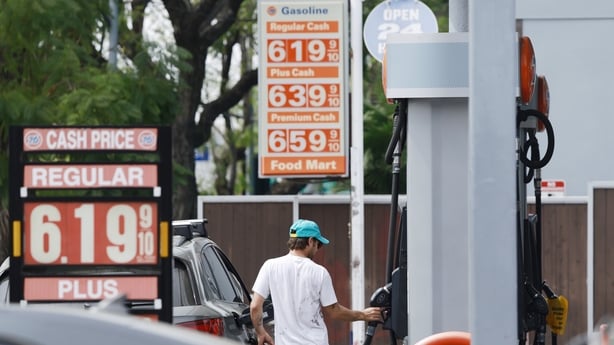
The jump in oil and fuel prices has started to weigh on US household finances and become a political headache for Mr Trump and his Republican Party ahead of the November midterm elections, having vowed to lower energy prices and ramp up US oil and gas production.
The US national average retail price of gasoline yesterday crossed $4 a gallon for the first time in more than three years, data from price-tracking service GasBuddy showed, as tightening global supplies push US crude prices above $101 a barrel.
Read more:
Free public transport and four-day weeks - how nations are responding to fuel crisis
Israel passes death penalty law for Palestinians convicted of carrying out lethal attacks
Israel military launches investigation after peacekeeper deaths in Lebanon
