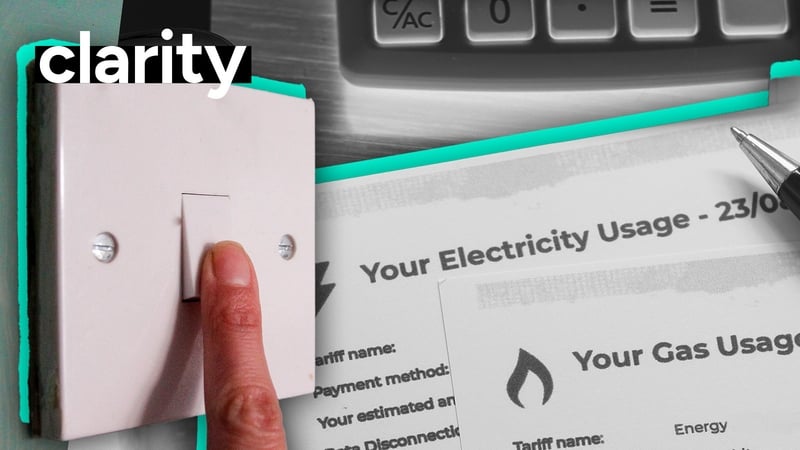

The European Union's statistical agency confirmed earlier this month that Ireland had the highest electricity prices of any EU member state for the second half of 2025.
According to the figures from Eurostat, Irish consumers are paying 40.42 cent per kilowatt-hour (including VAT and levies) - nearly 40% above the EU average of 28.96 cent.
This means yearly household electricity bills here are roughly €480 higher than the EU average.
We need your consent to load this flourish contentWe use flourish to manage extra content that can set cookies on your device and collect data about your activity. Please review their details and accept them to load the content.Manage Preferences
Understandably this has led to questions as to why we are paying so much more than other European countries.
Experts believe there is no single reason, rather it is a combination of structural, geographic, and energy-policy factors.
Ireland is a small island on the periphery of Europe, and it is worth noting that even when gas was cheap, we still had to pay to transport it here.
We should also be careful when assessing the Eurostat figures, as prices are not necessarily reflective of the real cost to households in different countries.
For example, when a population's purchasing power is factored in, Ireland goes from the most expensive EU country for electricity to fifth (behind Romania, Czechia, Poland, and Germany).

In addition, Ireland has had high energy prices compared to the rest of the EU for decades and it is an expensive country to do business in.
That said, it will not make anyone feel any better about paying more for their electricity.
If we break down the various components of the average bill, we begin to get an idea as to where the extra money is being spent.
Senior lecturer in Clean Energy at UCC Dr Paul Deane has carried out research into this. His determination is that just over a third of the bill is accounted for by the actual cost of making electricity.
This is influenced mainly by international gas and wholesale energy prices - which have been on the way up.
The latest figures from the Central Statistics Office (CSO) show that wholesale electricity prices jumped by 18% in the year to April.
Another fifth is the cost of moving electricity - ie, transferring it from where it is made to where it is used.
This covers transmission and distribution through the electricity network.
Then the cost of managing and operating the grid makes up roughly 25% of the average electricity bill; this includes balancing the grid, backup generation, and managing renewable energy supplies.
According to the UCC research, taxes (eg, VAT and renewable energy schemes) account for another 10%, while supplier costs (covering running costs, staffing, advertising, customer service, and supplier profit margins) account for the final 10% of the bill.
In relation to the cost of moving electricity around, Dr Deane notes that Ireland's electricity distribution network is "unusually large relative to the size of the population".
He added: "All of the electricity distribution wires in the country would wrap around the world four times," he said, adding that is "highly unusual in Europe and it means the cost of moving electricity is proportionally much higher here".
Meanwhile, Head of Communication for comparison website Bonkers.ie Daragh Cassidy said Ireland’s dispersed population and large rural network "significantly increase grid infrastructure costs".
"We have a very sparsely distributed population and a lot of one-off housing, meaning moving electricity to all of those homes is expensive," he added.
Other European countries, particularly in Scandinavia, have dispersed populations too.
However, they also have significant hydroelectric power capacity and both Finland and Sweden use nuclear power too - all of which help to keep electricity-generation costs down.
Whereas Ireland, as we will explore further below, has a far higher reliance on more expensive fossil fuels for electricity generation.
The cost of balancing the electricity grid is also a factor.

Balancing the grid essentially ensures that supply and demand are properly matched to maintain a reliable power supply.
Anything that draws huge amounts of power from the grid must be closely monitored.
Data centres are a factor in this regard.
In 2024, data centres accounted for more than a fifth (22% according CSO figures) of all metered electricity in the country, which was proportionally much higher than elsewhere.
Globally data centres are responsible for just 1.5% of total electricity consumption, meaning Ireland is a huge outlier.
According to Mr Cassidy, this can result in a grid that struggles to keep up with demand, and in order to address the shortfall we need to turn to "high-cost emergency electricity generation using fossil fuels".
He said we would not be as dependent on emergency generation if Ireland had better energy interconnection with other countries.
At the moment there is "not much interconnection with other countries", he said, "but that's changing".
"We now have a second interconnector with the UK up and running, but the Celtic interconnector with France has been delayed, which if in use would allow us tap into cheaper French electricity.
"There's also talk of an interconnector with Iberia, but for the moment we have a weakly interconnected grid, so we can't take advantage of cheaper electricity coming in from other countries," Mr Cassidy added.
Ireland's energy mix is another consideration.
We need your consent to load this flourish contentWe use flourish to manage extra content that can set cookies on your device and collect data about your activity. Please review their details and accept them to load the content.Manage Preferences
In 2024, renewable energy accounted for 40% of the country's electricity - a figure that is encouragingly been trending upwards.
However, nearly half of our electricity for the year was still made using fossil fuels - mainly gas, the price of which has been highly vulnerable to market volatility in recent years.
"We stand out in terms of fossil fuels and have one of the highest reliances on natural gas in Europe," according to UCC's Dr Deane
"With gas prices spiking since 2022, and a precarious supply, this is a big driver of our higher electricity prices," he said.
To give an idea as to how other EU members make their electricity: overall in 2024, renewables accounted for 48%, fossil fuels 28% and nuclear power 23%.
Is there any truth to allegations of price gouging by electricity providers?
Earlier this month the energy regulator - the Commission for Regulation of Utilities (CRU) - published an interim report where it assessed electricity and gas markets.
It found competition is strong among suppliers and that there was no evidence of excessive profiteering.
However, the CRU noted that "a lag between changes in wholesale market prices feeding through to the retail market", though it goes on to say this lag "reflects the impact of supplier hedging practices which allows for greater stability in retail prices".
In its review, the regulator also said where customer engagement is strong savings can be made on bills.
Customer engagement essentially means being aware of when your contract is up and switching provider to make sure you are availing of the cheapest possible tariff.
However, this is a positive as it puts the responsibility on the consumer.
Maybe the onus could be shifted here so energy companies might have to offer increased transparency to their customers in terms of cheaper tariffs and how to avail of them.
How can we bring prices down?
The obvious answer to this is to make the country more self-sufficient in terms of electricity generation, and this involves a more radical shift away from fossil fuels and towards renewables.
This, as Mr Cassidy points out, would "help keep a ceiling on prices when there's a spike in fossil-fuel prices", but he added that renewables "are not the answer to cheaper prices in the short-term".
"Renewables look cheap in isolation but they need a backup. In the short to medium-term, we'll need a backup for when the sun doesn't shine or the wind doesn't blow.
"Some days 80% of our electricity still comes from gas and building hundreds more windfarms won't make a difference on a calm day.
"More interconnection will help to address this and create a viable contingency plan, and in 30-40 years a grid powered entirely by renewables might be possible," he said.
Dr Deane echoed this sentiment, saying that when it comes to the potential for renewable energy generation "this is where we need to manage expectations".
"Renewables aren't cheap; they are cost-competitive relative to fossil fuels but not cheaper.
"We're not going to see cheap electricity in Ireland for the foreseeable future, and for now it's about understanding what we can achieve".
Dr Deane said the likes of solar and wind power offer "sustainable electricity prices rather than cheaper ones...there's no easy low-hanging fruit here".
He added: "What renewables offer is taking more control over prices, as well as predictability. This is helpful in terms of spiking prices due to war, etc."
The nuclear option
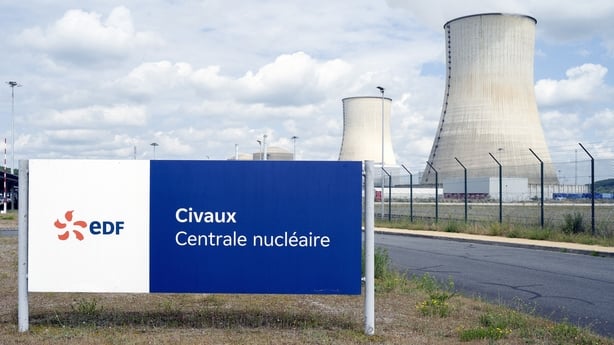
Figures from the European Commission show that nuclear power plants generated around 23.3% of the total electricity produced in the EU in 2024.
There are 12 EU countries with operational nuclear reactors: Belgium, Bulgaria, the Czech Republic, Spain, France, Hungary, the Netherlands, Romania, Slovenia, Slovakia, Finland and Sweden.
France was the largest producer by far of nuclear power within the EU in 2024, with a 58.6% share of the EU total.
The country's substantial incorporation of nuclear energy into its grid helps to keep French electricity prices below the EU average.
And while electricity generation from nuclear power plants across the bloc increased slightly in 2024, there is an overall trend of a move away from nuclear power.
Dr Deane believes the nuclear option is not a viable one for Ireland.
He said the "best time to build nuclear was in the 1960s and 1970s".
"When thinking about nuclear, we need to consider when it was built - we've seen that new nuclear tends to be a lot more expensive."
The UCC energy lecturer said that in terms of cost and infrastructure requirements it was a lot different 50 or 60 years ago and "expectations need to be managed".
"There's a lot of talk about the potential for small modular reactions, like the modular-home idea where the structure is built off-site and transported into place.
"But that technology is not commercially available yet - it's 10-15 years off and with no commercial track record it's hard to know what the cost will be like," he added.
The policy approach
Dr Deane said most of Ireland's policies regarding improving our energy infrastructure in terms of reliability, sustainability, and cost "are correct on paper".
However, he is clear that we need to "reduce our reliance on natural gas - it's one of the most volatile and precarious fuels".
He is also keen to stress that any policy shift in the short-term "won't mean bills will go back to where they were".
"Everything changed in terms of world of energy when Russia invaded Ukraine," he added.
Experts more generally also regularly point out that whatever energy systems we opt for there will always be some amount of waste, because it is too expensive to design a zero-waste system.
However, continued household investment in renewables is widely viewed as an approach that will have a significant positive impact.
For example, based on current technology, solar energy can produce around 40% of a household's electricity, which reduces an annual bill by roughly €500.
The potential for renewables to make a dent in bills is there, and some households who have been able to afford to install solar (with significant grant supports) are already seeing these benefits.
The challenge now is to reduce the barriers to entry, so more people can realistically afford to go down this route.
Dr Deane said solar "would have started out as environmental initiative, now it's about saving money".
"We need to now push solar grants towards those who can't afford the initial outlay", which can run into the high thousands.
He added low-cost loans with longer repayment periods could help with this, as well as the targeting of grants.
This, Dr Deane said, would "get the savings to those who need it most".