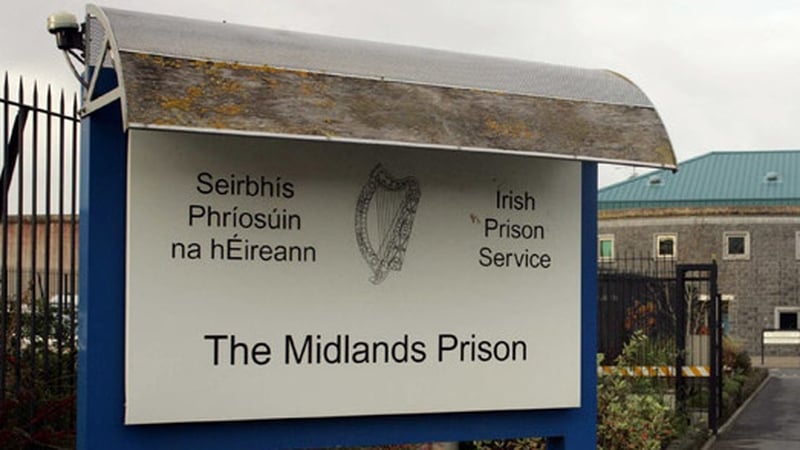

A nurse "was obliged to watch helplessly through a cell door" as a man lost consciousness and died after staff were unable to locate a key at Midlands Prison in Portlaoise.
An investigation report into the death of a 59-year-old at the prison on 2 August 2021, said that the circumstances of his death were "unconscionable", as there was a 14-minute delay opening his cell before he was provided with medical treatment.
The Office of the Inspector of Prisons recommended system-wide measures are taken to ensure such a scenario doesn't arise again.
The Irish Prison Service said it has updated its procedures around keys in Midlands Prison, and that measures in other prisons will be considered during broader security reviews where deemed necessary.
The deceased, referred to in the report as Mr D, had been committed to the prison on 18 October 2018 and was serving a five-year sentence.
At around 12.24pm on 2 August 2021, there was an emergency call to his cell, and that a few minutes later an officer opened the flap and reported that Mr D’s face was swollen.
The officer said that his tongue also appeared to be swollen, and that he was pointing to a handwritten note that said "I had a reaction to antibiotics".
He alerted nursing staff through the Tetra radio system.
A nurse then came to the prison’s G landing along with an Assistant Chief Officer. There, they were informed by the officer present that she didn’t have the key to the key room in the E and G division.
It was in that key room that a key to open the cell was kept.

The person who had it had locked the room, and had gone to a staff team room. That person did not have a Tetra radio on them at the time.
An Assistant Chief Officer managed to locate them and retrieve the key to the key room, where he then retrieved a master key and took it to Mr D’s cell.
As they were looking for the key, a nurse said she spoke with Mr D through the cell door flap, and described him as being panicked.
She said he was having difficulty speaking, and said she stayed at the cell door and reassured him. She said he was distressed and was having difficulty breathing.
She said he then laid down on his bed on his side, and when she called out to him she received no response.
As she was observing, another nurse had retrieved a bag of medical equipment, and had called to control for an ambulance. She directed control to inform the ambulance crew that it was a case of suspected anaphylaxis.
Medical equipment was prepared for administration while they waited for the key.
The door was opened by 12.38pm, and an EpiPen was administered to Mr D who was at that stage unconscious, according to the report.
CPR was administered, however a nurse reported complications with this due to his throat being swollen.
Oxygen was given to Mr D via a non-rebreather mask, and he was moved to the floor to enable more effective CPR.
A defibrillator was used but with no shock applied, before a second EpiPen was then administered.
Mr D was later pronounced dead.
No set procedure
The investigation into the response found that there was no "set procedure" in relation to keys on the E and G wings during staff breaks.
Investigators were told that the E and G key room did not have a dinner guard post as it had been "cut" as a "cost saving measure" during the Irish Prison Service transformation process.
On the day of Mr D’s death, an officer was present in the key room and had been working through lunch.
He was not occupying an official post but had been working through lunch to do paperwork, investigators were told.
The officer locked the E and G key room and went to a staff team room.
As staff were responding, there was initially confusion over where the key to the key room was. The officer in possession of it was located at a staff tearoom at which point the key was retrieved for the room and a master key was accessed.
Since the incident, a Standard Operating Procedure has been implemented to ensure that keys to the E and G key room are left with an Assistant Chief Officer in charge of the area during meal times.
Prescription of antibiotics
The report also raised questions about the circumstances in which Mr D was prescribed antibiotics.
It recommended that the prison service conduct a clinical review into the circumstances in which Mr D came to be prescribed them by a locum doctor, with no reason for the prescription given in the Patient Health Monitoring System (PHMS).
Mr D’s history showed that on 1 July before his death, he was prescribed pain medication for his leg, and was also advised by another doctor that his obesity was life-threatening and they discussed weight management.
His medication was switched from Tramadol to Ixprim.
On 19 July a doctor recorded that Mr D hadn’t been given Ixprim, and apologised for the error before recording that the medication was then prescribed.
On 1 August a nurse queried why two drugs, Augmentin and Flagyl, were in Mr D’s medication pack prescribed by the locum doctor without any note explaining it.

She marked it as "prescribed in error" and requested a new pack without antibiotics.
The next day, another nurse recorded that Mr D had been demanding his antibiotics.
She checked his pack which didn’t have them, and when she looked at his record she saw that he had been prescribed Augmentin and Flagyl on 25 July.
Mr D had been prescribed the drugs by the locum doctor who requested that this would be reviewed by one of the prison doctors on 26 July.
Mr D was not seen by a prison doctor as per the locum doctor’s request.
The report said: "The Irish Prison Service should conduct a clinical review of the circumstances in which Mr D came to be prescribed antibiotics by a locum doctor, who failed to record the reason for this prescription (or any patient allergy information) in the PHMS.
"The review should also examine why the locum doctor’s referral to a prison doctor was not acted upon. More generally, the IPS should review the adequacy of its arrangements to ensure continuity of care for patients when locum doctors are employed."