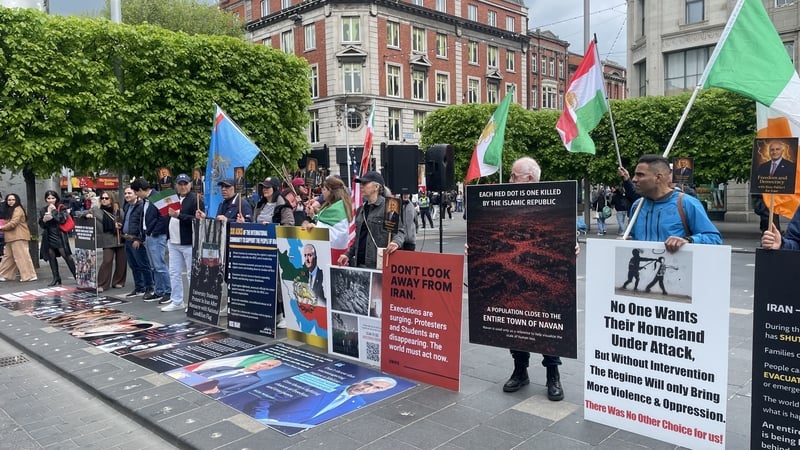
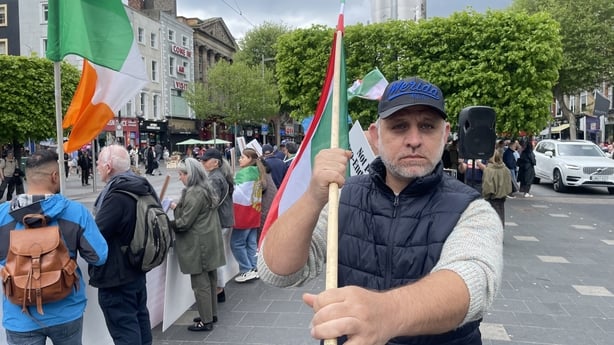
Around 30 people gather at the Spire in the centre of Dublin city. Some of them wave the Lion and Sun flag which has been adopted by the Irianian opposition and previously served as the nation's flag before the 1979 Islamic Revolution.
Others hold placards. One reads: "No one wants their homeland under attack, but without intervention the regime will only bring more violence and oppression."
Another reads: "Don't look away from Iran, executions are surging. Protesters and students are disappearing, the world must act now."
Many hold images of Reza Pahlavi, the exiled leader of Iran’s opposition and former crown prince who had been destined for the throne before the 1979 revolution.
Some hold flags of the US, while one man holds an Israeli one.
All of those who’ve gathered want to see the end of Iran’s regime, although they have different views on what they would like to see next.
Some want democracy, others believe in restoring monarchy.
Earlier this week, the UN Human Rights Office reported that Iran executed 21 people in relation to protests or spying claims, and has made over 4,000 arrests since the beginning of the war with the US and Israel.
It accused the Islamic Republic of torture, disappearances, and targeting minorities, as well as conducting mock executions.
One of the latest to be executed was 21-year-old Sassan Azadvar, who was detained during the early January protests.
He was accused of attacking security vehicles and attempted arson.
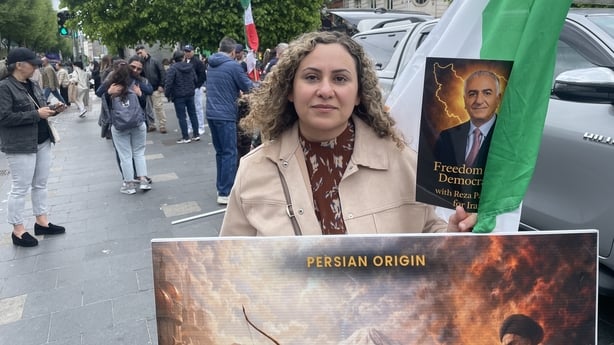
"How can a 21-year-old be an enemy of God?" Roshin Farahani said, referring to comments made by Iran’s Attorney General Mohammad Movahedi Azad, who last January described those protesting as such - a charge that brings the death penalty.
"They kill innocent people, these are the people of the future, they are talented, and they deserve to live and deserve to speak freely."
Ms Farahani is an accountant who has lived in Ireland for the past 15 years. She was one of the organisers of today’s demonstration.
She supports Reza Pahlavi, and when asked what future she would like to see for Iran, she said she sees him as a transitional leader, but that ultimately any future vision for the country should be decided by its people.
Ms Farahani said she wants to see more countries act on Iran.
One aspect she wanted to talk about was how Iranian embassies continue to operate across Europe.
"The IRGC is designated as a terrorist organisation by the EU, and thanks to Ireland for signing up to that, but I don’t understand why the IRGC should have the embassy and diplomats in Ireland. There needs to be questions."
The EU made that designation last February, but Vice-President of the European Commission added that diplomatic ties with Iran would remain open.
According to the UN special rapporteur for human rights, Iran executed at least 1,639 people last year, although some other groups say the figure could be higher than 2,000.
Only 7% of those executions were announced by Iranian officials, while in most other cases only the families of those killed were communicated with.
It is the highest number recorded in the state since 1989, according to the groups Iran Human Rights, based in Norway, and Together Against the Death Penalty, based in France.
It is 68% higher than in 2024 when 975 executions were carried out, while the NGOs said that most of those killed were from ethnic minorities or other marginalised groups.
The majority were convicted of drug offences, while it is believed 57 had been convicted of charges related to security.
Thousands of people were killed during anti-government protests in January, Iran's worst domestic unrest since the era of its 1979 Islamic Revolution.
Rights groups say the government has continued to crack down on opponents during the war.
The exact number of people killed since last December is not clear - the Iranian government officially claims it is just over 3,000, however in February the UN special rapporteur on Iran put the figure in the tens of thousands, while some media organisations citing sources claim it could be over 30,000.
When asked about the US-Israel war on Iran, Ms Farahani said she feels that Iran’s leadership is responsible for it.
"We give them every opportunity to reform, every opportunity to change, but they didn’t.
"And they invested the money of the Iranian people into terrorist activities across the region and created chaos. They aren’t trustable unfortunately."
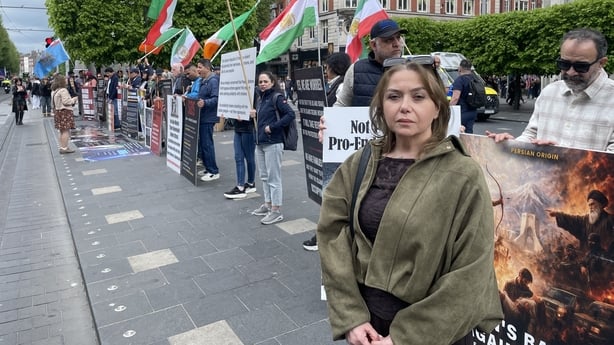
Sami Hezari has been living in Ireland for 30 years and works as an accountant.
She sees Iranians as prisoners inside their own country, and that she thought this war was going to be a "rescue mission".
She also supports Reza Pahlavi.
"We want this regime to be gone, and for a transitional leader to come and help a broken nation that’s been tortured for the last 47 years to be able to elect a democratic regime, whoever they want, whether it’s monarchy or democracy.
"We are not going to fight with that, we are not in a position to tell Iranian people who to choose, we want them to choose whoever they want."
Ms Hezari said contact with home has been difficult due to an internet blackout, and that it has been reduced to short phone calls of one or two minutes on occassion.
She said she is horrified by the executions and arrests of protesters.
When asked about the war, she said "we didn’t want the ceasefire, we just want this regime to be gone".
"The more days this regime is in power, they are going to continue to murder our people. We just want the world to understand the anatomy of this regime, which is terror."
Another person in attendance was Mehdi Nassiri, who described himself as Persian as well as Mexican.
He said he came to the protest because he sees Iran as a "terrorist regime".
The US-Irael war on Iran has received criticism, with international law experts accusing the countries of breaching the United Nations Charter.
UN Secretary General Antonio Guterres condemned it, saying the attacks on Iran were a "grave threat to international peace and security".
Mr Nassiri supports the war, saying "it is the only way to bring this regime down", but added that he does not trust either US President Donald Trump or Israeli Prime Minister Benjamin Netanyahu.
Months into the war, he said nothing has changed for Iranians and has only gotten worse.
"Mr Trump claims that the regime has already changed in Iran, it has not at all."
He described the war as a "show war" that has not achieved anything.
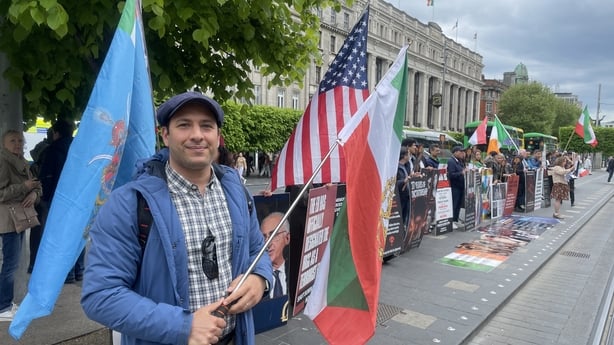
Parsa Fadaei is from Isfahan and lived there for 30 years before moving to Ireland nine years ago.
He came to the Spire to show support to those suffering, and added that he wants to see an end to the Iranian regime "as soon as possible".
He said his family do not have access to internet or news, and that they "don’t feel freedom".
Mr Fadaei said there are people in Iran who view the war as a "rescue operation".
"People of Iran, especially the diaspora, shouted for that operation."
He said he now views the role of Iranians abroad to speak up, and push for others to "understand us".
When asked what he meant by being understood, he said that he feels that some people support Iran in the war because they are against Israel’s actions in Palestine.
He said similar for the US and Donald Trump, adding "you don’t like him, but he is doing the right thing at the moment. He is doing right for Iran".
Mr Fadaei said that he believes Mr Trump does care about Iranian people and has spoken up for them, and that he feels Europe’s leaders should be stronger and that he would like to see other countries get involved militarily.
"We tried for example, peaceful protest. We tried many other ways.
"None of those worked because they have ideology and they are ready to drive that ideology.
"The only thing that will help is military action," he added.