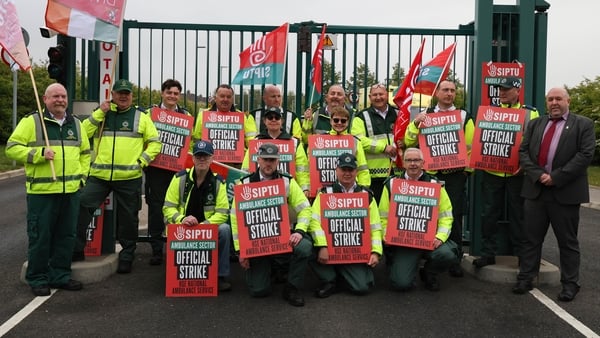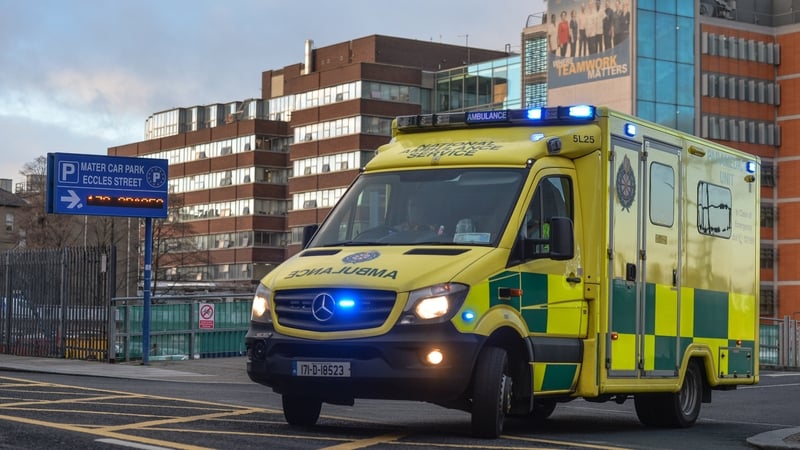

The National Ambulance Service has said that people with less time-critical emergencies "may need to think about whether they need to make their own way to hospital" as SIPTU and Unite members of the service begin a 24-hour strike tomorrow morning.
Around 2,000 union members are also engaging in a work-to-rule, which began at 8am this morning.
The HSE said that during the industrial action, the capacity of the National Ambulance Service to respond will be "significantly impacted".
The HSE added that a contingency plan has been put in place to prioritise patient safety and minimise disruption.
We need your consent to load this rte-player contentWe use rte-player to manage extra content that can set cookies on your device and collect data about your activity. Please review their details and accept them to load the content.Manage Preferences
Speaking on RTÉ's News at One, Clinical Director of the National Ambulance Service Professor Cathal O'Donnell said that "people should consider other alternatives".
"I would not underestimate the seriousness of this. We are going to have a very challenging day tomorrow," he said.
"The National Ambulance Service will have a very challenging day tomorrow and the people who need us may experience very significant delays.
"People should consider other alternatives and people may need to think about whether they need to make their own way to hospital rather than contacting us.
"They should contact us, but it may be the case that they will get there quicker if they make their own way."
Mr O'Donnell said that people should could continue to call 112 or 999 in case of a medical emergency, but that priority would be given to time-critical calls.
"We will be prioritising time-critical calls. So for example, people who have a cardiac arrest where your heart stops, or very serious injuries, they will be prioritised," he said.
"But with over half of our staff not available to respond, it means that we're going to be very challenged in providing any kind of a timely response to people who may have less time-critical emergencies."
The Taoiseach said he hoped the sides would "move to dialogue" and "enter into the trusted mechanisms that are there to resolved issues of this kind.
Speaking in Co Kildare, Micheál Martin said there has been significant investment in "transforming the ambulance service into first responder, emergency medical technicians, huge investment, huge growth, which is good. Population has grown as well and the pressures have grown and that all has to be acknowledged."
He added: "We have good labour relations machinery, we should use it to try and resolve this."
Minister for Health resists calls to intervene
Minister for Health Jennifer Carroll MacNeill has resisted calls for her to intervene in the industrial dispute between the HSE and ambulance workers.
The Irish Patients Association has said Ms Carroll MacNeill should personally intervene and urgently bring all parties back around the table.
However, Ms Carroll MacNeill has intimated she won't intervene at the moment, instead saying the issue needs to return to existing industrial relations structures.
"The ambulance service has been through two processes in the WRC where we have advanced a series of additional measures, additional supports but also a series of reforms so that the model is working much better for patients and for ambulance teams as well," she said on RTÉ's Drivetime, during a visit of health facilities in County Clare.
"The unions agreed to those proposal. Unfortunately the proposal didn't get the support of ambulance workers themselves and this needs to go back to the industrial relations structure that has serviced this state so well and where we can really deliver outcomes.
"But that is the process. And I don't want to step across that as of course its an independent process", she added.
When asked directly about the call for her to intervene in the dispute, she said: "All through the last number of weeks, I've been very well briefed on this, I'm aware of what's happening.
"This is an industrial relations matter. I have to enable that process to happen, because its exists in the State and we respect it and also because we have industrial relations issues that we routinely refer in this way.
"We go to our industrial relations architecture because it is so reliable, because it is so robust and I have to give that the opportunity to work.
That is where matters get resolved, have previously been resolved and this one should be resolved within the industrial relations structure."
Unions accuse HSE of failing to implement recommendations on salary scales
Unions have accused the HSE of failing to implement the recommendations of an independent report on updating staff salary scales to reflect changes in responsibilities and workload.
"We call on the HSE to implement the recommendations of the independent report without preconditions and to introduce enhanced pay scales which properly recognise the training and professional level that our members are now carrying out their duties on a daily basis," said SIPTU Ambulance Sector Organiser John McCamley.
We need your consent to load this rte-player contentWe use rte-player to manage extra content that can set cookies on your device and collect data about your activity. Please review their details and accept them to load the content.Manage Preferences
In addition to this week's action, unions said there will be a 48-hour stoppage on 19 May and a 72-hour stoppage on 26 May, with further strike action planned for June.
Unite General Secretary Sharon Graham said: "It is scandalous that these frontline workers have been waiting for six years for their skills and expertise to be recognised."
The HSE said it regrets the decision of SIPTU and Unite to proceed with industrial action, adding that it has worked intensively with the unions to resolve the dispute over the past two years under the auspices of the Workplace Relations Commission.
"A set of independently brokered proposals aimed at resolving the dispute and all other matters in dispute, including pay and service transformation, were agreed and recommended to their members by both SIPTU and Unite," a HSE spokesperson said.
"The implementation of the timing of the significant increases in pay was also the subject of a Labour Court recommendation," it added.
The HSE said: "In July 2025, the HSE and Government accepted both the WRC proposals and the Labour Court recommendation, demonstrating a clear resolve and determination to address the current dispute."
The executive said the proposals included 3-14% pay improvements, on top of a 9.25% increase under the public sector pay agreement, linked to agreed reforms.
"In September 2025, SIPTU and Unite informed the HSE that the proposals independently brokered by the WRC, supported by a Labour Court recommendation and recommended by both trade unions had been rejected by their members," the HSE said.
The HSE added that it remains firmly committed to addressing the current dispute through the process set out in Public Service Agreement and "calls upon both SIPTU and Unite to withdraw the proposed industrial and strike action and engage through the State's industrial relations mechanisms".
Unite trade union representative Eoin Drummey said that industrial action is about ambulance personnel seeking recognition for significant changes, modernisation, upscaling and additional responsibilities over the last 15 years.
Speaking on RTÉ's Morning Ireland, he said: "Ambulance personnel have helped transform the service from primarily what it was - a patient transport model - into a modern pre-hospital emergency care service, delivering advanced clinical intervention to improve patient outcomes.
"So, what we're calling on HSE management to do is to remove preconditions requiring further modernisation changes and changes to terms and conditions before addressing the long-standing pay inequities."
The Irish Patients Association said patients must not be used as pawns in any industrial dispute by any party.
"The immediate priority must be protecting patient safety while ensuring urgent and meaningful engagement to resolve the underlying issues," a spokesperson said.
"With patient safety at increasing risk, we are calling on Minister Jennifer Carroll MacNeill to personally intervene and urgently bring all parties back around the table," the association said.