


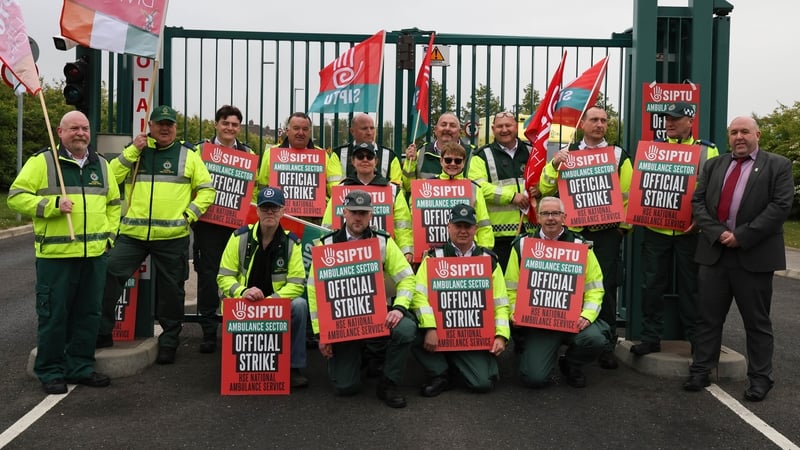
The SIPTU and Unite trade unions have agreed to stand down a planned 48-hour strike by frontline ambulance staff next week.
The unions were invited to the Labour Court for exploratory talks today.
The court heard separate submissions from the unions and HSE management.
Speaking after the talks concluded, SIPTU's ambulance sector organiser John McCamley said the court had asked them not to go ahead with next week's planned strike action, but that plans remain in place for a 72-hour work stoppage on 26 May.
"They've requested that we would stand down the industrial action plan for Tuesday and Wednesday," he said.
"We've met our committee today. They've agreed to do so, but the other action still stands for the following week, but we will be engaging here at the Labour Court on Monday to try to find a resolution of this dispute."
A work-to-rule by frontline ambulance staff, which began on Monday this week, will continue.
Speaking later on RTÉ's Drivetime, Mr McCamley added that he is optimistic that a breakthrough can be achieved on the basis that the parties will meet at an open forum and discuss their issues without preconditions.
"We are optimistic that we can find a resolution."
Mr McCamley said that he always felt there was an easy resolution to the dispute over the implementation of outstanding independent recommendations from 2020.
Unions are set to begin direct talks with the HSE at the Labour Court next Monday.
A 24-hour strike by SIPTU and Unite members in the National Ambulance Service took place on Tuesday.
The HSE said the action had a "significant impact", resulting in longer than usual response times.
Pickets were placed at ambulance bases around the country, but striking workers said they did respond to life-threatening emergencies.
The dispute involves emergency medical technicians, paramedics, advanced paramedics, specialist paramedics and paramedic supervisors.
Unions have accused the HSE of failing to implement the recommendations of an independent report on updating staff salary scales to reflect changes in responsibilities and workload.
The HSE said that it regrets the decision to proceed with industrial action, adding that previous proposals to resolve the dispute, that would have delivered pay increases, were rejected.
Unions say, however, they came with conditions, including changes to allowances, that were unacceptable to members.
