
The Minister for Foreign Affairs has said that she is "absolutely assured" that the agreement between the Irish and UK governments on how to deal with Troubles Legacy issues, would be "fully fulfilled" in the UK legislation.
Helen McEntee said that she was disappointed the UK legislation could not move to the committee stage at Westminster during this session, but that there has been a "clear commitment" from the UK government to progress Legacy legislation.
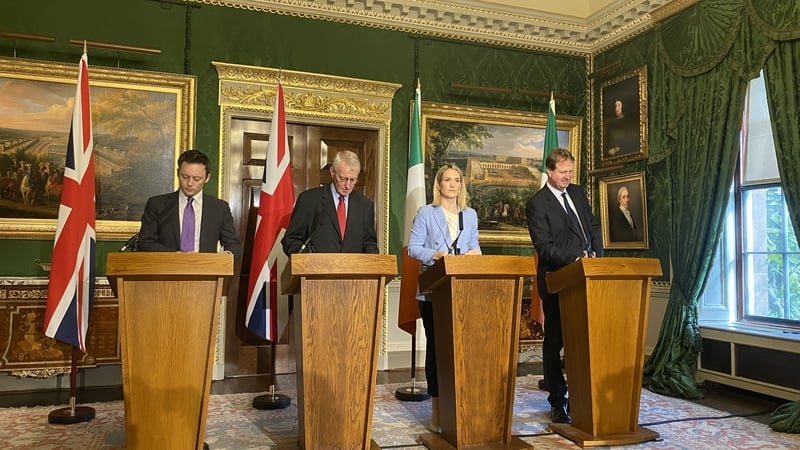
She was speaking following the latest British-Irish Intergovernmental Council held at Hillsborough Castle today, with Northern Ireland Secretary of State Hilary Benn.
Ms McEntee described the meeting as "warm and constructive" and said that both governments had shared priorities to deliver for victims and families of the Troubles.
During the meeting, Mr Benn outlined that the British government was committed to a legacy framework that helped victims, and that offered the "strongest possible protections to veterans who served in Northern Ireland".
Amendments to the bill in this regard will be brought forward in June.
Mr Benn said that there was a "duty and responsibility to make sure that those who served the state to keep the people of Northern Ireland safe, are properly treated in the legacy process".
He said that "none" of the amendments affect the commitments made in the joint framework agreement with the Irish Government last year.
"Dealing with legacy is complex. Dealing with legacy is difficult. It is the unfinished business of the Good Friday Agreement," Mr Benn said.
"Here we are 28 years after that agreement was signed. I think there is consensus that this is the last chance we have. What has come through today's meeting is that we are absolutely determined to get this done", he added.
The meeting was also attended by Minister for Justice Jim O'Callaghan, who said he would be seeking approval for the drafting of a general Legacy Bill to deal with the Legacy Commission that will be set up by the UK government, by the end of May or early June.
He said he hoped that it would be "enacted promptly thereafter", within three to four months.
Minister O'Callaghan said that because it will seek to provide information to the Legacy Commission, as enacted by the UK, it is dependent on that legislation being enacted.
He added that the Irish legislation is "dependent" on the UK legislation, but said he was "encouraged" that the committee stage amendments would be published in June.
He said he had not seen the amendments but had Mr Benn's "assurance" that they would be compliant with Article 2 of the European Convention of Human Rights.
Mr Benn said that members of the House of Commons will be the first to see the detail of the amendments around protections for veterans, adding that they are usually published around a week before the committee stage of the bill.
He said he looked forward to the debate.
"My aim from the start was to try to achieve as much consensus as possible. This is difficult and there is a reason for it, because people have different views," Mr Benn said.
"We cannot have a system that the last government put in place that is not compliant with our international legal obligations. We have to fix it".
"At the end of the process I hope that people will come to see that we have managed to create something that can work for families," Mr Benn added.