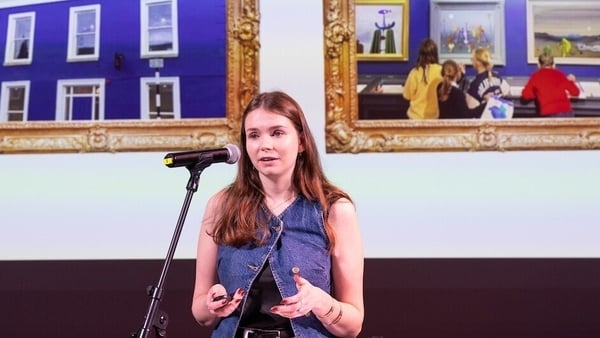
A new exhibition in Dublin called 'No Irish Need Apply? The Economic History of the Irish in England' is examining the lives of Irish emigrants and their descendants in England from the 19th century to the present day.
Diving deep into the paperwork of the emigrants' story, which saw generations of Irish people travelling to England and using birth, death and health records, a new picture of the challenges faced by the Irish and England is on display here.
This new exhibition, brought in partnership with the London School of Economics, asks how the generations of Irish people in England have fared over the past 200 years.
Based on landmark economic history research and big data analysis, it tracks the wealth, health and living standards of Irish migrants and families of Irish descent, showing how the Irish were substantially poorer than their English neighbours for generations.
Based at EPIC The Irish Emigration Museum, the exhibition showcases the work of researchers Professor Neil Cummins (LSE) and Professor Cormac Ó Gráda who used analysis of records mixed with personal stories to offer a new perspective on the lives of Irish emigrants and those of Irish heritage in England.
For Professor Neil Cummins, an economic historian from Dublin who is based at LSE, this research project was of particular interest to him.
"I grew up in Dublin, then lived and worked in New York for a few years and am now living in London, so I understand this story," he said.
He explained his motivation and how he "crunches big data" and looks at it in terms of social mobility, wealth and equality.
He was interested to see what he could discover by trawling through the facts and figures from the official records and paperwork, "the big data", and combining it, using names to identify the Irish in these English records, to pin down exactly how the Irish fared in England over centuries.
The findings were fascinating, he said, adding that while "we hear about the success stories of the Irish who emigrate to the US, and the UK, for example the Kennedys who go on to make a great fortune, there has not been a really precise sense of how the other emigrants fared in England".
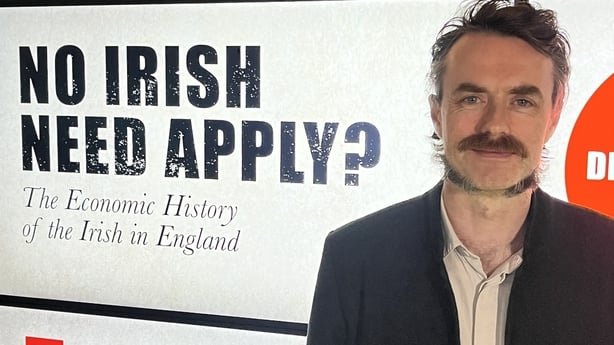
For Dr Christopher Kissane, who curated the exhibition, the research showed "that for over 150 years, the Irish in England were on average 50% poorer than their English neighbours".
"The big revelation is that even though Irish people found work and opportunity in a new life in England, they also faced significant disadvantage for a very long time.
"It really took until the 1990s for things like infant mortality and average wealth of Irish families to catch up with the English, but what's really interesting is that since then, the Irish have done very well in England," Dr Kissane said.
The exhibition also highlights the contribution of Irish women and men across the English economy, from healthcare to construction.
Nathan Mannion, head of exhibitions and programmes at EPIC, welcomed the exhibition.
"Irish people have been emigrating to England for longer than anywhere else. It's been a primary destination going back centuries."
"Since the 1920s it's the largest group that has emigrated there, so we have one in ten people in England today have Irish heritage and are entitled to an Irish passport, so this is a really significant story."
The exhibition is filled with photographs and digitised graphs to explain the statistics behind the stories.
It also offers a rare glimpse of the black and white film, 'The Irishmen: An impression of Exile' which was made by Philip Donnellan in 1965.
The documentary portrays the harsh realities of life for so many Irish emigrants and is accompanied by a score supervised by Seamus Ennis with the voices of traditional singers Paul Lenihan and Joe Heaney on the soundtrack too.
It also features the lyrics of Peggy Seeger and Ewan MacColl.
The film includes sequences depicting the grim conditions on the building sites that Irish men faced and offers a unique insight into the working and personal lives of the emigrants.
"What you see in the data here is an overwhelming sense that the social mobility in terms of the Irish assimilating into the English socio-economic system takes close to two centuries," Prof Cummins said.
"This story has a personal resonance for us that goes beyond just the social science academic material presented here," he concluded.