


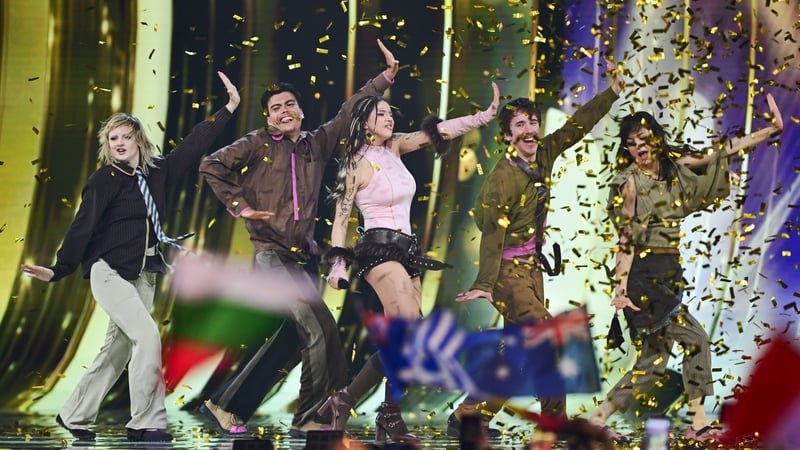

Inside the Wiener Stadthalle, the Viennese home to this year's 70th Eurovision final last Saturday night, we were introduced to a new phrase - 'Bangaranga'.
As journalists furiously googled 'what does Bangaranga mean', the singer of Bulgaria's winning entry Dara explained it was a "special energy that everyone has got in themselves, a feeling that everything is possible".
Other interpretations say that it means riot, or is a warm greeting, a kind of "Hi how are you?"
For the Bulgarian EBU member broadcaster BNT, Eurovision 2026 was a joy, a real Bangaranga, winning the contest for the first time.
After a tense voting session, where for the second year running the Israeli entry was one of the two finalists standing, Bulgaria prevailed garnering 516 points, putting them 173 points ahead.
Sweeping aside the hotly-tipped Finnish and Australian entries, and crowned across both the popular vote and the jury vote, the Bulgarian entry charmed audiences and the international press that had gathered in Vienna.
With arms wrapped around each other, and a spread of many different flags being waved enthusiastically in the air, the international press in the media centre was "united in music" for a few minutes as Dara led the crowd with her song inside the arena.

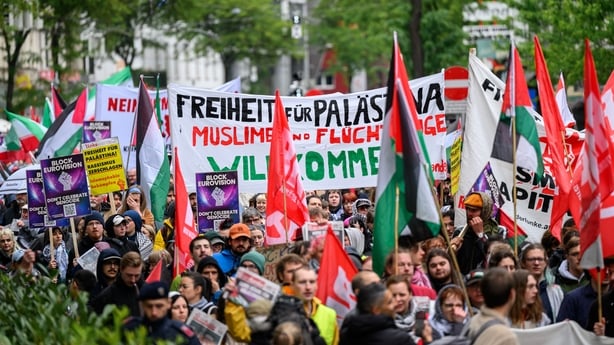
Outside the arena, however the focus was on very different flags.
Hours earlier, a pro-Palestinian demonstration had taken to the streets in Vienna city centre, following on from a similarly themed concert on Friday afternoon.
Surrounded by a visible police presence, protesters carried banners, flags and placards and were united in protest chants.
So, this week, as the delegations depart Vienna, and the trucks line up to take away the stage and the scaffolding, what is ahead for Eurovision 2027?
Director Martin Green takes questions
On Friday, Eurovision Song Contest Director Martin Greene gave an in-depth interview to RTÉ News. He answered all the questions put to him.
With five broadcasters including RTÉ boycotting the contest, he began by saying that: "The way I’ve come to describe it is that we are a big family, and five members of our family are missing this year, and we miss them, and we love them."
The EBU would do "everything we can" to try to address the concerns of RTÉ and the other absent broadcasters," he said.
On Israel’s participation, Mr Greene said "my first view is that it is a public service broadcaster, Kan, who participates here, and we don’t believe they’re responsible for the actions of their government".
"But again, I understand the debate, I understand the argument, I respect the alternative point of view," he added.
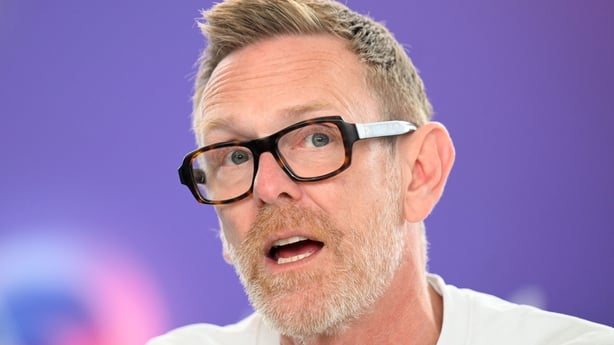
Asked about concerns that the broadcaster’s trust had been damaged with the concerns over the voting process in 2025, when the Israel entry leapt from 14th to second place after the public votes had been added, Mr Greene pointed to the new rules that had been rolled out this year.
He explained that he "can completely understand how they feel that way, and that’s what we’ve set about trying to change and have an active reassurance."
In relation to the lack of details of the voting in 2025 being shared with broadcasters he said, "we’ve been very clear with them, part of the security system of the voting is that we don’t release the deep data".
"We release as much as we can, but I know it sounds like an irony, but there is part of the data that we have to hold in order to secure the safety of the system," he added.
The dialogue with the EBU family is ongoing, he said too.
RTÉ stance on Eurovision
On Friday's Morning Ireland, the RTÉ Director General Kevin Bakhurst said that "our rationale still holds" adding that "there's no reason at the moment to change our decision but we will review it in the coming months".
Minister for Culture Patrick O'Donovan also said that RTÉ made a decision that he fully acknowledged and empathised with adding that "RTÉ didn't take this decision unilaterally".
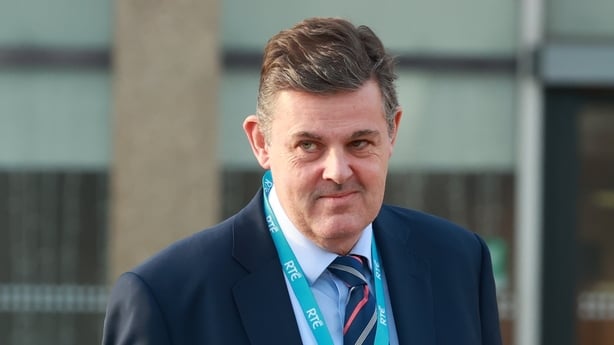
"There's a number of other countries did it for the same reason," said Mr O’Donovan.
The EBU, he said, has to "come to a fix that will allow people to take part in a contest that ultimately should reflect harmony in Europe" and he believed the different stances taken by RTÉ and the EBU can be reconciled going forward.
Impact of boycotts
The next time EBU members formally gather will be at the 96th EBU General Assembly, scheduled to take place in Prague, Czechia, on 25-26 June this year.
The EBU is an alliance of 113 public service media across 56 countries and all member broadcasters are allowed to take part in the contest.
With 35 acts on the Vienna stage this year though, this was the smallest line-up since 2003.
This has financial as well as reputational consequences with reductions in fees having a direct impact on the large budget required to host the complex and ambitious event.
Yesterday, Mr Greene said: "Like any major global event we conduct a post contest review. This will include, as always, gathering the views of our membership on all aspects of the event."
There were journalists from the five broadcasters boycotting this year's event present and reporting in Vienna, so the impact of Eurovision is an ongoing, newsworthy and significant issue for EBU members.
There have been no official statements from the broadcasters yet regarding 2027.
However, Spain's RTVE, counted as one of the so called 'big five' who make the most significant financial contributions to the contest and boycotted this year's event - released a strong message on Saturday night as the grand final began.
On social media the broadcaster posted: "The Eurovision Song Contest is a competition, but human rights are not. There is no room for indifference. Peace and Justice for Palestine".
Other broadcasters too are engaged in the question of future participation, with Belgium’s Flemish broadcaster VRT saying that "the chances are slim that VRT will send an artist next year".
Spokesperson Yasmine Van der Borght said the broadcaster was calling for "a clear framework for participation, an open debate and a direct vote among EBU members".
While Eurovision Asia is due to hit the screens in November, with organisers hoping the event with will breathe the new life into the contest, discussions about the original Eurovision will continue.
At 70 years old, Eurovision holds a unique pop culture place in the hearts and minds of audiences.
In 2025 over 166 million people watched the song contest worldwide, which is significant at time when globally, linear TV audiences are fracturing.
On stage, the colour, the lights, the pop, the passionate fans, the glitz and the glamour of the show offers a valuable platform for hugely talented and creative professionals.
The production values are impressive and every year, the technical and artistic teams push for increasingly ambitious stage shows.
But, off stage, the Eurovision is at a crossroads.
As EBU members commence their reviews before heading to Prague in June, has the gleam permanently come off the Eurovision glitter ball?
The General Assembly in June will put the show firmly back in the spotlight.
