
Prison overcrowding is at a record level with capacity at more than 125%.
Almost 600 prisoners are sleeping on mattresses.
With 10% of those sentenced serving a term of 12 months or less, the Government says it is committed to introducing a greater use of community sanctions in a bid to reduce reoffending and divert people away from imprisonment.
PACE, Prisoners Aid through Community Effort, is a charity that works with former prisoners and those serving community service orders. It is funded by The Probation Service.
The Criminal Law and Civil Law Bill, published in January, could result in legislation obliging the courts to consider community service in lieu of prison sentences of up to 24 months.
This is something that PACE's Chief Executive Maggie Clune would welcome.
"One of the biggest risk factors for people who've been in the criminal justice system is finding employment after prison, with a criminal record, it can be a real barrier to jump over," she explained.
She said the charity believes that given the levels of overcrowding in prisons, particularly where someone has been given a short sentence, that "there's really no point in sending anyone to prison because they're so under pressure and people with short sentences, in particular, are not getting the support that they need while they're in there."
Peter, not his real name, says his life has taken a "complete 180" since he came to PACE.
He began taking drugs in his early teens, sniffing glue, before turning to cannabis, alcohol and ecstasy, leading to a heroin addiction.
During this time, Peter committed crimes, including robbery.
"I started taking heroin, which ended up leading me into more prison sentences, more trouble at home, just chaos really, 'til I was 45 and still in prison."
Peter says that a conversation with his now adult daughter helped him to get off drugs.
He did this before he was sent to prison for a 24 month sentence.
Becoming emotional, he says: "I was having an argument with my daughter and my exact words were, 'Listen, I've always got you the best of what you wanted' and she said 'I didn't want any of that. I just wanted your love'. That broke my heart. So it was after that, I knew, I had to change my life around".
When Peter went to prison, he also cut out his use of methadone.
Now he's now on a Community Employment scheme and the chaos has gone from his life.
"This was recommended to me by a probation officer and I came here for two weeks just to try it out and I loved it. The staff were great. I was never judged, they never spoke down to me."
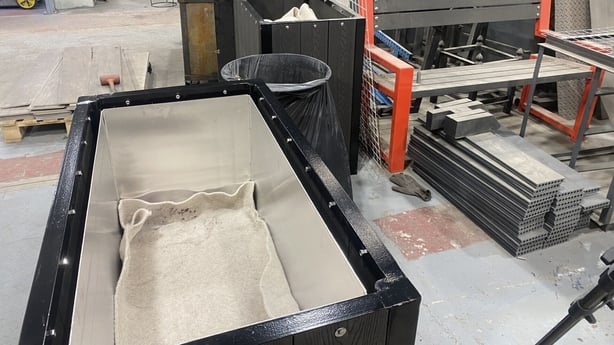
Peter now installs the environmentally friendly planters, lined with wool to filter rainwater, and the painted street furniture that can found along waterways and in community projects across Dublin.
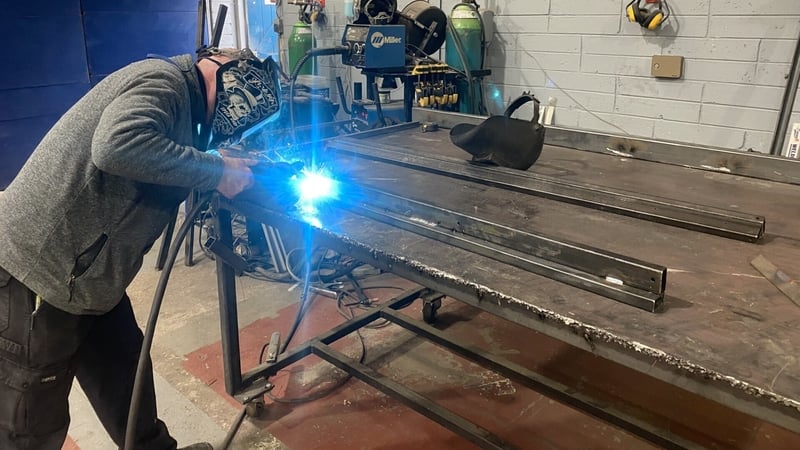
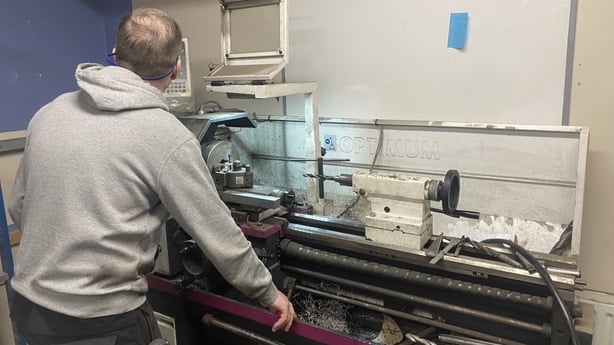
Workshop supervisor Damien Doran says that many of the skills that workers learn at PACE are transferable to the real world when construction skills are in short supply.
"A lot of the guys would say that the main thing that they take away is that they enjoy working with their hands and hands-on work, rather than the education system, which wouldn't have worked for a lot of them.
"The stuff that they really take away is the structure of coming to work on time, taking a break on time, not going for a smoke break whenever you can, that kind of thing.
"Then that helps them hold onto a job, when they do get a job outside of PACE."

The Irish Prison Service (IPS) points out that it is required to accept all of those committed to jail by the courts and has no role in determining the number of people remanded in custody at any given time.
This population has continued to climb steadily in recent years and continues to rise on an almost daily basis when the courts are in session, reaching 5,889 this week, with bed capacity at 4,736.
Using a snapshot comparison of daily numbers in custody, the IPS says there has been a 30% increase in the number of inmates between 2023 and 2026 with a 13% growth rate from 2025 to 2026.
The remand population is a primary factor in driving the overcrowding, with 40% of those on remand being released without receiving a sentence during the first half of last year.
This week, 10% of the sentenced population is serving a sentence of 12 months or less.
The Justice Indicators report, published in February by the Law Society of Ireland's Centre for Justice and Law Reform, found that just 34% of people had confidence in the IPS to effectively rehabilitate prisoners.
Comparing indicators with other jurisdictions it also found that the average sentence served in Ireland in 2023 was 6.9 months, significantly shorter than the Council of Europe average of 9.1 months for the same year.
"There's a lot of evidence to suggest that short prison sentences might increase reoffending," Associate Professor of Criminology at Maynooth University Dr Ian Marder says.
"They cause a huge amount of stigma. They interrupt a lot of factors and conditions in your life that are very useful at stopping reoffending.
"So, for example, your family relationships, your access to health services, your access to other services that you might be connected to on the outside, including housing, employment, including your prospects for future employment and future education.
"If you send someone to prison, especially for the first time, you are causing potentially a huge amount of damage to them. That is very difficult to make up for later.
"That's why short probation orders are much more important to be used."
Asked about how the public, including victims of crime view community sanction, Prof Marder says: "We have to decide what we want the primary purpose of sentencing to be.
"If we want the primary purpose of sentencing to be retribution, whereby sentencing is about imposing a proportionate amount of harm on people, then we're going to see more and more use of prison.
"But if we want sentencing to play a role in preventing crime, in reducing reoffending, then we have to look at what the evidence says about how best to do that.
"What we know from studies around the world, and from the statistics coming out of the CSO (Central Statistics Office) here, is that reducing sentencing is much more straightforward when people are being sanctioned to spend that sentence in the community."
The Irish Prison Service said that overcrowding was impacting on how prisons can operate but there was cause for optimism as "relationships with community agencies continue to strengthen to support transitions from prison to community, and internally, governance processes continue to improve.
"The sheer volume of people, means more people requiring key care and rehabilitative services, which impacts wait lists and time waiting for assessment and intervention.
"Equally, access to certain services can be intermittently disrupted or closed due to staffing shortages or redeployment of staff to address operational matters.
"This culminates in people waiting longer to be seen or leaving custody without appropriate assessment and treatment."
Despite the challenges the IPS said that it had witnessed an increase in the variety of interventions, including addiction studies courses, recovery college, the introduction of occupational therapy and an increase in group programmes for people with addiction.
It says the first memorandum of understanding between the IPS and Education and Training Boards is almost finalised, seeking "to enhance process and practice in prison education".
Minister for Justice Jim O'Callaghan says he is committed to increasing prison capacity, as well as progressing and implementing policies aimed at increasing the use of community sanction.

A statement from the Department of Justice said: "The Government as a whole are acutely aware of the capacity constraints in our prisons and the resulting challenges faced by those who work and live in our prisons."
Budget 2026 provided for a 13% increase in funding for The Probation Service, it added.
The department said this additional funding will be used to increase the use of supervised community sanctions in the criminal courts as well as expanding restorative justice services and expanding supervised temporary release schemes nationally.
Despite plans for the use of more community sanctions, legislation to increase their use is still not fully in place.
The Department of Justice said that the Criminal Justice (Community Sanctions) Bill, first introduced in 2014, is intended to update the Probation of Offenders Act 1907, with modern provisions, to facilitate the effective and efficient use of community sanctions and by the judiciary.
A policy review of the bill is still under way.
PACE CEO Maggie Clune says that she would like to see increased awareness about the impact of community sanctions amongst the judiciary and from employers.
"Employers can have a fear of taking on somebody with a criminal record. We're now in a market where employers are crying out for workers and I do believe that the people we work with have huge skills and talents and a lot to offer and really they just need to be given an opportunity to prove that."