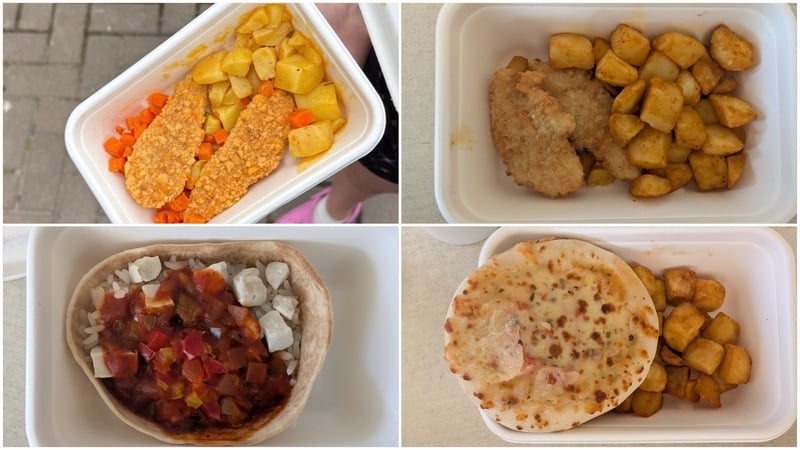

A new survey about the Government's hot school meals programme has found that three-quarters of respondents reported their children do not enjoy the variety of food.
The survey, commissioned by Fine Gael, also found that parents were very critical of how the food is presented as well as the nutritional content.
There were are also concerns about the origin of ingredients used for the meals, including meat.
The survey ran from 6 January to 18 February and received almost 8,000 responses.
Only one-third of respondents considered the food nutritional, with many parents reporting that the school does not offer a cold food option.
This option was a preference as the survey found that most children would be more likely to eat a fresh cold lunch rather than the hot school meal.
93% of respondents said the programme was currently operating in their primary school.
However, three-quarters of respondents attributed perceived quality issues to the lack of centralised cooking and said leftover food was being sent home.
Most people also stated that more than half of the food provided is left uneaten.
Of the suppliers who responded to the survey, many said that providing hot and cold options was not economically viable due to reasons including transport and cooler box usage.
There were also issues for schools in terms of heating meals on site.
The scheme is due to be further rolled out in secondary schools but in the survey, suppliers emphasised that portion sizes for secondary students (approximately 450g) were significantly larger than for primary students (around 250g), and it was not feasible to deliver larger meals at lower prices.
Some primary schools, particularly those in rural areas, have had difficulties setting up the scheme.
Initial excitement about the scheme has also fallen since it was first implemented by former minister Regina Doherty in 2019 in 36 pilot schools, before it was rolled out further.
Since last September, there are 3,200 eligible schools in respect of 550,000 children.
The survey showed the highest drop off in demand for hot meals was in 5th class, with one supplier reporting that demand has decreased by 35% amid recent public debate.
In a statement, the Department of Social Protection said that a dietician seconded from the Department of Health is carrying out a review of school meal supplier menus and complaince with nutritional standards.
The department said that a full report will be finalised in the second quarter of the year.
It also said that clear nutritional standards have been in place for the programme since it began and that any concerns with the quality of food should be brought to attention of the principal or board of management at the school.
Survey was extensive, says Fine Gael senator
Fine Gael senator Linda Nelson Murray said the survey was extensive and showed that as well as having more choice, children also wanted more time to eat their school meals.
"It's not the same as eating maybe a ham sandwich that you would have had, maybe in the past. So they're looking for extra time because they want to be able to go out and play as well," she said.
She said half a million children were already availing of the scheme and it had proved its value, whilst having been improved in terms of nutrition.
"Since last September, the amount of salt and the amount of fat has been taken out of the food. And for example you have chicken goujons now covered in rice flour and some sausages covered in seaweed as opposed to high fat content, so its constantly being worked on," said Ms Murray.
She said the free meals needed to be fine-tuned before they are rolled out in secondary school to make sure comments from parents and constructive criticisms are taken into account.
Senator Nelson Murray said having spoken to boards of management and principals, having hot meals had improved the number of children who were staying in school for the full day into the afternoon. She said child food poverty was a big issue and that this scheme had been a game changer.
However she said the scheme did need to adapt further to meet more dietary needs, including providing gluten free options for those with celiac disease.
"The whole idea of the scheme was that we wouldn't alienate any children and some children do feel alienated because their dietary needs aren't being met," said Ms Murray.
She said special schools had also made their needs known to the Joint Oireachtas committee on this issue.
She said it was also important for parents to let schools know if they were opting out and providing a lunch alternative, to let the school know in order to cut down on food waste.
Sarah Keogh, a registered dietician with eatwell said the vast majority of hot school meals being provided were nutritious.
"I think there's a huge amount of scaremongering about the meals to parents," she said, adding that it was making them nervous.
"I think its reassuring that the Department of Social Protection has a dietician. She's going through everything and I've seen some of the work that has come out of that," she said.
She said she worked with the Celiac Society and whilst there were gaps at the start, a large number of providers had now sorted this out with certified gluten free meals.
She said there were kids in Ireland going to school hungry to an extent that might surprise some parents.
"We know from research on this that for every one €1 you spend on school meals, you get €35 back into the economy, both from work and education but also health. So this an incredibly important programme and I'd love to see more positive reporting about it because I think parents are being unnecessarily scared by what's on social media," she said.