
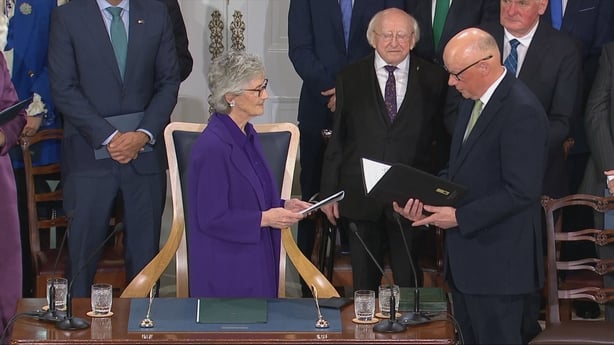
Exactly 100 days ago, Catherine Connolly stood in the historic surrounds of St Patrick's Hall in Dublin Castle as she outlined her plans as Uachtaráin na hÉireann alongside former presidents, current and former taoisigh and other representatives of wider Irish society.
The 10th President of Ireland had comfortably won the race to replace Michael D Higgins in a landslide victory against Fine Gael's Heather Humphreys and the still-officially-on-the-ballot Fianna Fáil candidate Jim Gavin, gaining 63% of first preference votes.
And in her inauguration speech, she was quick to explain what she intended to do with what she insisted was a powerful mandate she had been given by voters.
"The change that led to this joyful day began with the small group of elected representatives and volunteers facing what appeared to be insurmountable challenges.
"We were led to believe that it was too great a leap, that our ideas were too far out, too left - at odds with the prevailing narrative.
"In shared conversations all over the country, however, it became evident that the dominant narrative did not reflect or represent people's values and concerns.
"Time and time again, people spoke of how it served to silence, to other, to label, to exclude and to stifle critical thinking.
"Along with that meaningful engagement, we saw the emergence of hope. We saw the emergence of joy, along with the courage and determination of people to use their voices to shape a country that we can be proud of.
"Our actions today will shape the world our grandchildren will inherit," she said.
How President Connolly has started that process over her first 100 days in office has, perhaps in keeping with her personality, been relatively calm and under the radar.
But with significant decisions needing attention in the coming months, it means her next 100 days could be far more dramatic.
First 100 days - key points
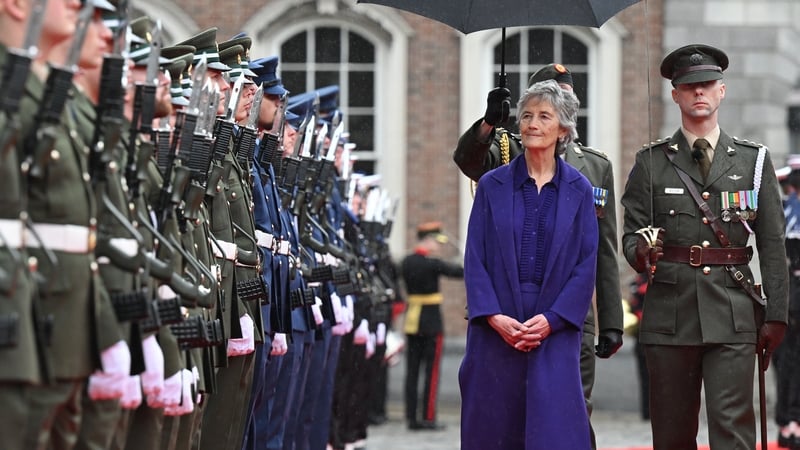
1. Election day speech: President Connolly's maiden speech in power has in many ways been her most significant act in the role to date. Speaking on 12 November, the president said she wants to be the head of state for a Republic which values all citizens and where a home is a fundamental human right.
She said this country is well-placed to lead on diplomatic solutions to war, famine and climate change at home and abroad, and referenced what she said is Ireland's long-cherished tradition of neutrality and peacekeeping.
On Northern Ireland, she said she believes in national unity through consent. And in terms of the Irish language, an Uachtaráin said she wanted to see an teanga Gaeilge become more widely used both in work and in society.
2. Foreign policy: While Catherine Connolly's views on foreign policy were well aired before she was elected president, they have been less obvious in her first 100 days as Uachtaráin. There have, though, been some glimpses, including in a circulated speech the president was due to give to ambassadors who arrived to be introduced to her at the Áras last month.
However, the circulated copies of the speech which had been given to attending journalists including RTÉ News, President Connolly did warn of the "consequences of a 'might is right' mentality", saying the issue is now "crystal clear before our eyes" amid a period where "countries can be invade at will, or threatened with invasion".
The planned and carefully prepared remarks were due to be publicly said, to ambassadors no less, during a period when US president Donald Trump had ordered strikes on Venezuela and threatened Greenland.
And while they did not reach the same levels as Michael D Higgins during his second term in office, they did put down a marker of President Connolly's potential future forays into the diplomatic world.
3. Northern diplomacy: Another significant moment in President Connolly's first 100 days was her visit to Northern Ireland in early February, and her unplanned interaction with DUP MP Gregory Campbell.
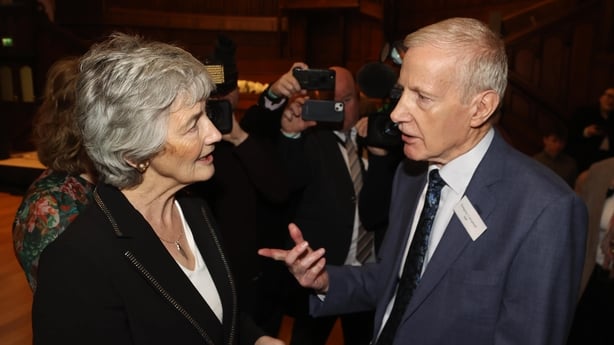
The far from shy and retiring Mr Campbell's remarks to President Connolly are by now well known, with the MP telling Ireland's head of state "you're in our country" and that he wanted to "make your acquaintance" to point out in his view Northern Ireland is "not leaving the United Kingdom".
The interaction - which had as much to do with Mr Campbell appealing to his voter base as wider societal matters - had the potential to cause a significant diplomatic incident as there was a clear question over whether protocol had been breached in how it occurred.
However, President Connolly - herself no stranger to strongly stated public remarks - took the calmer road, responding by saying "we're here to listen and to learn from each other".
Next 100 days - key points
1. Council of State: That ability to side-step a potential difficulty, of course, can only take you so far, with a number of complicated matters unavoidably coming down the tracks for President Connolly in her next 100 days.
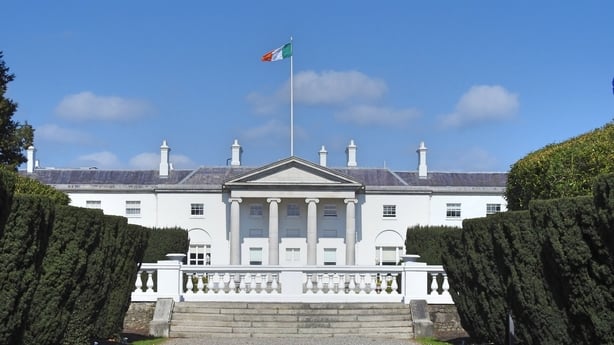
The first is the appointment of her Council of State, the lack of appointments to which so far has privately raised at least some eyebrows in political circles. The Council of State is a key requirement and support group for any president in office, as it is the body which the president sends legislation to for further examination if there is a concern over its constitutionality.
To date, a spokesperson for the president has responded to a number of requests in recent weeks by giving no indication as to when the appointments will be made. When they are, they will be watched closely for signs of how President Connolly's priorities will manifest in practical terms, and which - if any - of her political and societal supporters will benefit from the help they provided during the election campaign.
2. Legislation: Three pieces of legislation set to receive President Connolly's potential signature in the near future will also increasingly be at the forefront of debate - none of which she is likely to have been in favour of in her previous role as a Galway West TD.
The first is the Government's controversial rental reform plans, which having passed all stages of the Dáil and Seanad on the 100th day of President Connolly's tenure and will now sit front and centre in her to do list pile.
The Defence Amendment Bill, more commonly known as potential changes to the Triple Lock system, is also continuing to attract political and public attention given a belief Catherine Connolly opposed the amendments before her election.
And long-awaited legislation on the Occupied Territories Bill will also be in the spotlight, particularly whether it includes both goods and services whenever Government eventually puts it forward.
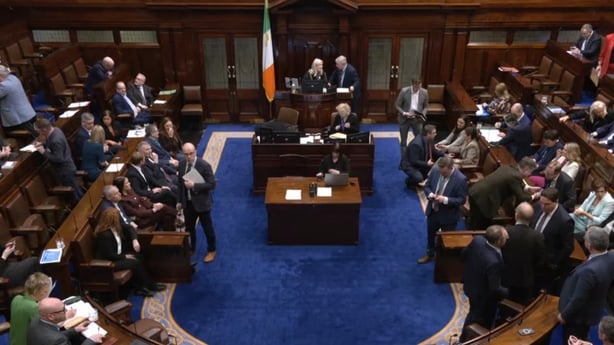
Certainly, the president's election campaign and her supporters during it made their views on the topics known. But due to the limitations on the power of Ireland's president, how that campaigning is acted on now Catherine Connolly is in power will be watched closely.
3. Foreign matters: One other matter for the president's next 100 days will be foreign matters, and specifically both US president Donald Trump's potential visit to Ireland in the near future and Ireland's EU presidency term in the second half of this year.
Both of those events will naturally place Ireland in the world spotlight, and given how chaotic much of the world has become that will mean closer than usual attention to Ireland's view of the world.
Catherine Connolly has made no secret in the past of her views on Donald Trump, European Commission president Ursula von der Leyen, global conflicts and colonialism.
Those coming moments mean the now President Connolly will have both the opportunity and in some people's eyes the problem of how to stay true to those views while in the high-profile role as Ireland's head of State.