


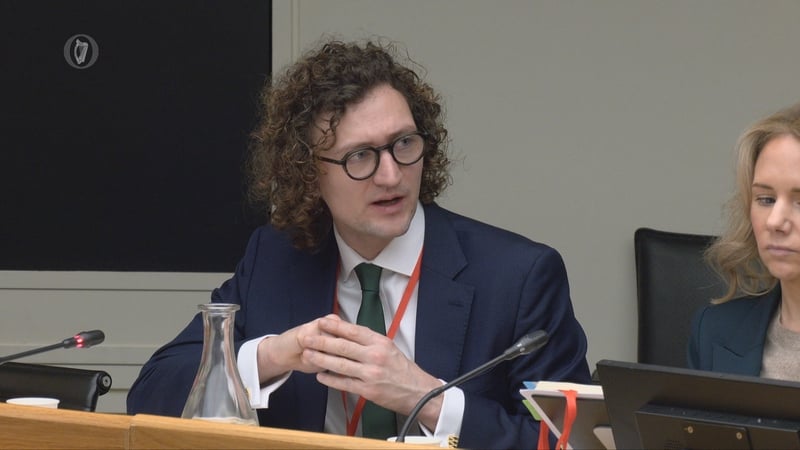
Executives from Meta, TikTok and Google faced questions and criticisms of their online safety policies at a hearing of the Oireachtas Media Committee today.
X refused to attend the meeting, a move that was branded as disrespectful, worrying and disappointing.
A social media ban would see children move to more unsafe areas of the internet, a public policy lead at TikTok told the committee.
"If countries are going to proceed with this type of legislation, it does need to apply equally to all technology companies, based on the risk they could potentially cause to children," the company's Minor Safety Public Policy Lead Richard Collard said.
His comments came after Minister for Communications Patick O'Donovan said that he would bring a proposal to the Cabinet next month on age verification for young people using social media.
He said the system would be based on a person’s PPS number and the information would be held by a third party, not by online platforms.
Representatives from social media companies appeared before the Committee on Media, where they outlined the safety features on their platforms.
Members of the committee repeatedly criticised the platforms for not having detailed on information on levels of abusive content and response times for taking it down.
Executives from Meta, TikTok and Google attended, but X declined an invitation to do so.
Taoiseach Micheál Martin said it was "concerning" that X declined to appear.
Committee chair, TD Alan Kelly, said the company "refused to come before, essentially, the people of Ireland" and described the decision as "deeply worrying, dissatisfying and pretty disrespectful".
Mr Kelly later told RTÉ's Drivetime that it was "outrageous" that 'X' refused to appear, given recent controversy over Grok and "the sexualisation of images."
He also criticised the evidence given by executives from Meta, TikTok and Google who did appear, saying he found "a lot of their evidence deeply worrying.
"I felt that they were not really representative of the companies in some cases.
"I believe they didn't have the authority to tell us - they couldn't tell us, for instance, TikTok or Meta couldn't tell us, the amount of users in Ireland who were under 16.
"These are massive e-commerce companies, they're worth zillions [sic], they're controlling so much information around the world...
"These companies are trying to minimise the amount of regulation, the amount of scrutiny, and despite the fact that the three of them did turn up today, I felt even more so afterwards that we have to legislate."
Mr Kelly said he does not believe that Ireland "can wait for Europe on this, I don't believe it will happen at that level, I think we need to invert the responsibility and the responsibility has to be with these e-commerce companies.
"And they should be prosecuted and individuals within the companies should be prosecutable where abuse is being generated and shared."
Watch: Taoiseach says X refusal to attend committee 'concerning'
Fianna Fáil Senator Alison Comyn asked those in attendance about the benefit for teenagers being on social media.
Director of Public Policy for Meta in Ireland Dualta Ó'Broin said the company had designed accounts to ensure that teenagers had the ability to use social media in a positive way.
Senator Comyn asked if people also had the right to target young people with child abuse images.
Meta's Safety Policy Director for Europe, Middle East and Africa David Miles said that content was taken down and teenagers would not stay on their platforms if they were targeted in that way.
"If you look at the uptake on teen accounts ... nearly 97% of tens of millions of teens have stayed on the platform," he said, claiming this showed that they were having a positive experience.
Mr Collard, from Tiktok, said there were multiple benefits to being online, but agreed that social media companies did need to differentiate between 13 to 15 year olds, and older teens and adults.
Senator Comyn gave the example of an 11-year-old child who was "clearly seeing self-harm content" on TikTok. She asked who was responsible for taking the child off the platform.
Mr Collard said the company tried to ensure that such children were not subscribers, firstly by ensuring they could not download the app if the settings had been input properly by their parents or guardians.
However, he said the company recognised that children could get around this.
TikTok, Mr Collard added, uses artificial intelligence to try and estimate a child’s age, before the issue is referred to human moderators.
Underage users can also be reported to the company, he said.
When TikTok was asked why it doesn't have a zero-tolerance position on harmful content, the company said no large-scale platform can realistically guarantee zero violations.
We need your consent to load this rte-player contentWe use rte-player to manage extra content that can set cookies on your device and collect data about your activity. Please review their details and accept them to load the content.Manage Preferences
AI trained not to produce pornographic images, Meta says
Independent Senator Ronan Mullen asked if it was possible for online platforms to make it impossible for chatbots to generate "nudification or pornographic images".
"The technology would allow that, wouldn't it, to prevent such content?" he asked.
Mr Miles, of Meta, said that its AI tool is trained not to produce these images and "is baked in from the outset".
"We have taken legal action against nudification apps last year. It's very important that we pursue to make sure that it doesn't violate our community standards."
Social Democrats TD Sinéad Gibney said the term "big tech" conveys "the control of power" that a "very few" companies have within the sector.
The Grok scandal over the generation of nude images has "sharpened" people's attention to the dangers of online harm, she said.
Ms Gibney added that nudification is only one of the ways that "big tech" is inflicting "serious harms" on society.
Google was asked why, if it is unhappy with the so-called nudification features on the Grok AI tool, that it continues to allow it to be downloaded from the Google Play App store
The company said it has raised concerns with the app developer and the matter was not completely closed.
Murphy, Martin clash in Dáil over X
In the Dáil, a People Before Profit TD claimed that Elon Musk, owner of X, had turned the platform "into a machine for the mass production of child sexual abuse imagery" and sexual imagery of women.
Paul Murphy accused the Government of having a "see no evil, hear no evil" approach.
He said that ministers did not want to take action because "big tech investment is more important ... than standing up to these people".
Taoiseach Micheál Martin described the claim as "reprehensible and shocking".
"How dare you. Who the hell do you think you are? That you have moral superiority over everyone else?"
Mr Martin also said that he took exception to the portrayal of the Government "that it somehow condones the behaviour of X, or the behaviour of Grok, or the behaviour of Elon Musk".
"That's reprehensible political behaviour by you but it's par for the course from you ... to distort the actual truth," he told Mr Murphy.
