
The Minister for Justice has said that drones identified over Dublin Bay last week during Ukrainian President Volodymyr Zelensky's visit were not the work of amateur drone enthusiasts and were "generated for the purpose of putting pressure on EU and Ukrainian interests".
Speaking on arrival at a meeting of EU justice ministers in Brussels, Jim O'Callaghan said that while Mr Zelensky's visit was a success and gardaí kept security at a "high and effective level", there would be an investigation into the drone sightings.
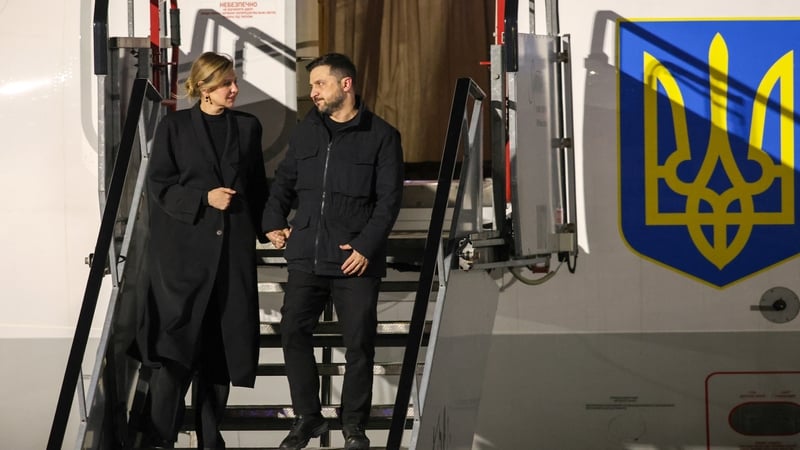
He and Ukrainian First Lady Olena Zelenska arrived in the capital late last Monday night.
Reports surfaced that unidentified drones were spotted flying in the north-east of Dublin around the time Mr Zelensky's plane landed at Dublin Airport just before 11pm last Monday.
"The gardaí have very good anti-drone technology and we're going to be spending more in terms of defence, in terms of seeking to combat drone technology," Minister O'Callaghan told reporters.

"It's not just an issue in respect of Ireland, but throughout the European Union, there are issues in respect of greater threats being exposed as a result of drone technology, and something that we've seen in Denmark and Belgium as well.
"It's obviously difficult to attribute a source or an actor behind it. I'm not going to reach a determination yet.
"I get a lot of information from An Garda Síochána in respect of issues concerning our security, but I think it's fair to say that we think this is part of a coordinated threat to EU and Ukrainian interests."
The minister said gardaí would be spending more on counter-drone technology ahead of Ireland's presidency of the European Union in the second half of next year.
He also said Ireland would be contributing around €10 million to the EU's so-called Solidarity Pool as part of the Migration Pact, as opposed to taking in relocated migrants from frontline member states.
He said this was "appropriate, considering that Ireland is designated as being …at risk of migratory pressure".
Zelensky confirms drone presence during visit to Ireland
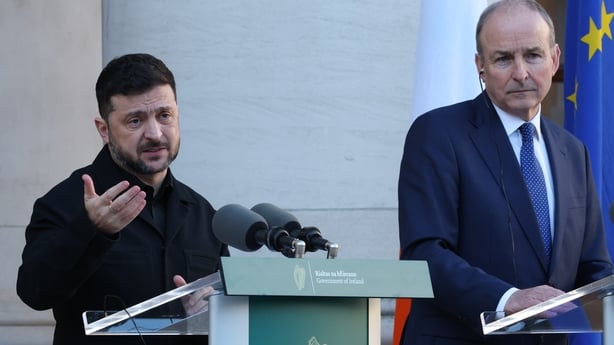
Mr Zelensky confirmed reports that unidentified drones had been spotted near the flight path of his plane during his trip to Ireland last week.
"There will be an investigation ... There were drones indeed," he told reporters.
"Somehow, we have become accustomed to living in these circumstances," he said, answering a question about security concerns.
It was reported on Thursday that a naval ship had spotted up to five drones operating near the path of the presidential plane.
Read more:
Investigation into drone activity during Zelensky arrival
Senior Government figures briefed on drone presence during Zelensky visit
Security around Zelensky visit effective - Taoiseach
Taoiseach Micheál Martin said the incident is under review and he will receive a "comprehensive report" from gardaí and the Defence Forces.
He said the National Security Council, which he chairs, will meet next week or the week after.
Such incidents have been increasing since the beginning of the war in Ukraine, he added.
"There's been a significant escalation of a whole range of types of attacks and threats, largely, we would think, emanating from Russia in terms of cyber attacks, in terms of hybrid attacks in many of the Baltic states and members of the European Union," he said.
"And as you know, in Copenhagen, we had the emergence of drones. We've witnessed the emergence of drones in Belgium. We've had incidents in UK territorial waters, also in France and also in Ireland, in the context of the visit of President Zelensky."
The Taoiseach said that in many ways, what happened was not a surprise, given the pattern that has emerged in recent times.
He said all members of the EU and the UK share knowledge and Ireland will share this with colleagues.
Asked about Ireland being exposed on security during the upcoming Presidency of the EU from July 2026, Mr Martin said capabilities are being enhanced.
"We're increasing spending on defence over time ... and significantly enhancing our capabilities on the cyber front," he said, adding that Ireland has developed a new, individually tailored plan with NATO that focuses on critical undersea infrastructure and cyber security, and is in the process of procuring radar systems.
The security operation around President Zelensky's visit was very effective, he added.
Crew monitoring maritime activity spotted unidentified drones
The drones are understood to have operated near Irish Naval Service vessels positioned in the Irish Sea.
Crew on board the LÉ William Butler Yeats spotted several unidentified drones north of Dublin while monitoring maritime activity off the east coast.
RTÉ understands that the drone activity took place more than 10km off-shore, east of Howth and Dublin Bay.
The weapons on board LÉ William Butler Yeats' were not used to intercept the drones but it is understood extensive video footage of them was obtained.
An Garda Síochána's Special Detective Unit is investigating, as it has responsibility for threats to national security.
According to data from marine traffic websites analysed by RTÉ, one of the vessels present in the Irish Sea at the time of President Zelensky's arrival was previously suspected of involvement in the sabotage of subsea cables.
Earlier this year, the ship was detained by a Scandinavian military, after it severed a telecommunications cable running from that country to a Baltic nation.
The incident was later deemed an accident by Scandinavian investigators and the vessel was released. An investigation by authorities in the Baltic nation is understood to remain ongoing.
For both of those reasons, RTÉ is choosing not to name the vessel.
The owners of the vessel and the crew denied deliberate sabotage, saying the anchor was unknowingly pulled across the cable after it was released when a device securing it malfunctioned in adverse weather conditions.
The vessel is owned by a company based in the Eastern Europe. Prior to the incident in the Baltic Sea, it had most recently docked in a Russian port.
The ship entered Ireland's exclusive economic zone (EEZ) in the Irish Sea around 8am last Monday, twelve hours before the arrival of President Zelensky, and loitered in position for the next three days, setting sail again on the evening of Thursday 4 December.
It is currently in the Atlantic with its destination listed as a US port.
Several dozen large vessels were operating in the Irish Sea on the night of President Zelensky's visit.
It is understood two Naval Service vessels were patrolling off Dublin.
The presence of the drones such a distance off-shore and at such a sensitive time has led to high level political and military concern. Crew members said the drones hovered over the LÉ William Butler Yeats for an extended time period.
Senior Government figures, including the Taoiseach, were briefed on the incident.
A meeting of the Ministerial Council on National Security later this month will discuss the incident.
The council was established in March and is tasked with "reviewing strategic developments in Ireland’s national security, and considering reports on national and international security."
According to a release from the Department of Taoiseach upon its establishment, membership of the council includes the Taoiseach, Tánaiste, Minister for Foreign Affairs, Minister for Justice, the Garda Commissioner, and the Defence Forces' Chief of Staff.
The release says meetings are to be held three times per year, and the "Director of the National Cyber Security Centre, Secretaries General of Government, Foreign Affairs, Defence, and Justice, and the Taoiseach and Tánaiste's Chiefs of Staff" will also attend.
Additional reporting Joe Galvin and Joe Mag Raollaigh