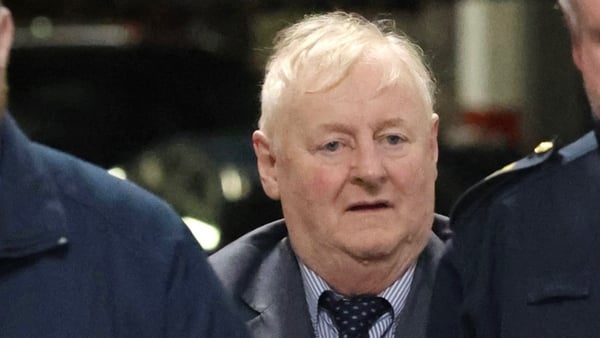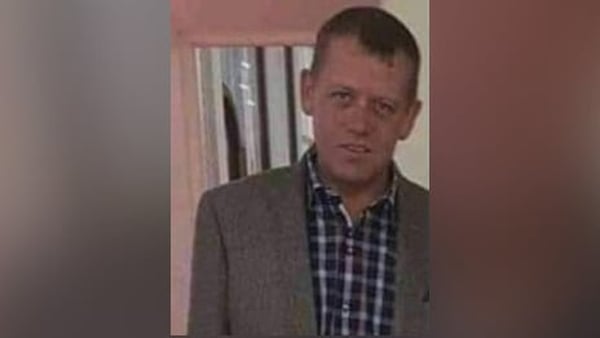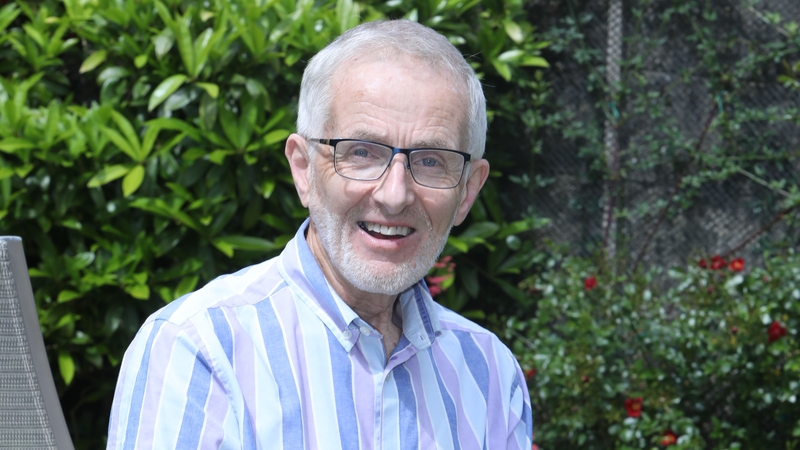

A former science teacher who was diagnosed with motor neurone disease in 2022 has spoken about how he has benefited from a new voice-banking service supported by the fundraising efforts of Charlie Bird.
John Daly, from Cabinteely in Dublin, has described feeling isolated after losing his speech because of his condition and how Scotland-based company SpeakUnique helped him to find his voice again.
SpeakUnique began in 2012 as a University of Edinburgh research project, offering personalised synthetic voices.
The company has received funding from the the Irish Motor Neurone Disease Association and the Motor Neurone Disease Association in the UK, which in turn have benefited from fundraising by former RTÉ journalist Charlie Bird.
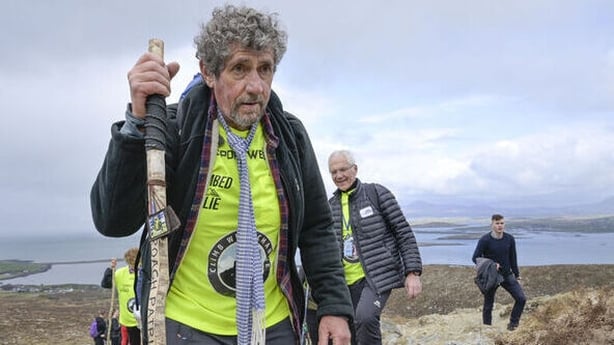
Mr Bird's 'Climb with Charlie' campaign raised at least €3.4m for charities including the Irish Motor Neurone Disease Association and Pieta.
Mr Bird died on Monday at the age of 74 after a long battle with MND and had himself used a voice-banking technology to communicate with family and friends that was designed with the help of Dublin software consultancy, Marino Software.
Although, Mr Daly used a separate voice-banking company to Mr Bird, he said how it improved his quality of life was the same.
"I spent many hours reading phrases to allow my fading voice to relax," he said.
"Then with some artificial improvements from the app, I now have a way of speaking phrases and even whole paragraphs that I type into the app.
"I can use it on my iPhone and iPad, and I can amplify it a bit for social settings using a small Bluetooth speaker on my waist.
"Two weeks ago, I had to make a short thank-you speech at the Irish Science Teachers' Association annual conference in Waterford. I held the iPad up to the public address system and it worked brilliantly.
"I even got a standing ovation for my efforts."
Mr Daly reflected on the isolation felt by someone who has lost the ability to speak independently as a result of MND.
"This is not a complaint, just a statement of fact," he said.
"Even with this miracle app, I am suddenly isolated in a world of my own.
"If a casual question is asked from across the room, I must write or type a response and show it to the other person or get SpeakUnique to say it.
"Conversations, after all, are full of interjections and rapid changes of topic. Typing falls far behind, and my laborious remark becomes irrelevant by the time it is announced so I am both grateful and frustrated at the same time."
The CEO of SpeakUnique said Mr Bird's work with the IMNDA was invaluable in making the service accessible for everyone.
Speaking on RTÉ's Morning Ireland programme, Alice Smith said a couple of hundred people register with the service every month.
We need your consent to load this rte-player contentWe use rte-player to manage extra content that can set cookies on your device and collect data about your activity. Please review their details and accept them to load the content.Manage Preferences
"It costs a couple of hundred euro but we partner with charities to try and remove financial barriers," she added.
She said that the technology has been developed over a number of years and combines linguistics and computer science to create a system that can take a short recording of someone speaking. This then creates a synthetic voice that is capable of saying anything the individual might like to say, she said.
Ms Smith told Morning Ireland that the service helps a number of people who are unable to speak.
"There's a number of medical conditions that can result in people being unable to speak, for example, neck cancer, some people will undergo surgery.
"People living with conditions like cerebral palsy might mean they've never had their own voice, but also other neurodegenerative diseases and Parkinson conditions.
"So, again, we try and work with people living with those conditions to make the technology fit for their purposes as well," said Ms Smith.
SpeakUnique now plans to continue to develop the technology by adding new languages to the service (English is currently the only language available) and also help children who may never have been able to speak or who may have other conditions such as autism spectrum disorder (ASD).
Mr Daly also spoke about the difficulties that come with an MND diagnosis.
"My swallowing ability is almost gone," he said.
"I have a direct line into my stomach for calories and hydration and it works very well ... because my leg muscles get no signal, my head won't stay up and so [my] walking ability is deteriorating.
"I'm getting all the help you could ever ask for, between the local HSE support and the Irish [Motor] Neurone Disease Association and Professor Orla Hardiman’s clinic at Beaumont.
"I feel everybody is on my side. My love, Deirdre, and I will struggle on. There are many in the country with much greater problems."