
Questions remain following the news this week that a resident at a HSE centre for people with disabilities in the northwest accessed material of child sexual exploitation online.
Having been notified in October that the most recent incident occurred in July, the Health Information and Quality Authority (HIQA) expressed serious concern in correspondence to the HSE last December.
It pointed out that it was not the first time that the "serious incident" had happened. It also occurred in 2016 and 2017.
HIQA was not informed, despite the HSE being legally obliged to do so within three days of the incident occurring.
Questions centre around how a resident in a HSE run facility for people with disabilities accessed the dark web.
Who owned the device the resident was using and did anyone else at the facility have access to it?
Who were the children in the footage that were being sexually exploited?
What was done by staff in the centre to intervene?
It is understood that one action taken was to switch the router to the internet off.
This is not part of the HSE's safeguarding policy.
Resident formally cautioned in 2017
The correspondence from HIQA says gardaí were called in 2017 and this resulted in a formal caution to the resident.
An Garda Síochána said it had not seen or been provided with a copy of the HIQA correspondence.
Therefore, it said it could not provide any comment.
Was a capacity assessment requested to determine if the resident, a person with an intellectual disability who lives full-time in a residential service, could understand both the nature of the alleged crime and the caution provided?
What therapeutic support was offered to assist the resident to understand and address this behaviour?
What efforts were made to establish how he knew how to access this material?
Did the HSE follow its own safeguarding and protection policy, notify their safeguarding and protection social work service and develop a safeguarding plan?
HIQA said failure of the HSE as a registered provider to act, resulted in "possible life changing consequences for a resident and put others at risk".
An inspection over a year ago found the centre to be compliant under the regulation on protection.
It noted there were previous concerns around safeguarding, but a review of documentation showed all incidents were appropriately reported as required.
The most recent inspection occurred in November after HIQA was alerted to an issue at the complex.
This is what led to serious concerns and it is what led the authority to write to the HSE on 10 December.
The correspondence included a letter from the outgoing HIQA CEO, Phelim Quinn, to the HSE CEO, Paul Reid, expressing serious concern about the HSE's fitness to provide disability services in the northwest.
The letters arrived in the HSE just days before the publication of the Brandon Report Executive Summary, which found that adults with learning difficulties had been subjected to sustained sexual abuse by another resident at a HSE run facility in CH01 between 2003 and 2018, in full knowledge of staff and management.
CHO1 includes Donegal, Sligo, Leitrim, Cavan and Monaghan.
The Brandon Report centered on a facility in Donegal.
On 16 December, the HSE responded in written form to HIQA - the day that the Brandon Report was published.
The correspondence according to the HSE "acknowledged a shared concern for HIQA and the HSE regarding governance and safeguarding, including assessment of the need for and type of enhanced national oversight external to CHO1".
On the same day, the HSE held a briefing on the Omicron variant of Covid-19, which at that stage accounted for more than a quarter of all cases in Ireland.
All eyes were on potential of changes to restrictions ahead of Christmas.
The Brandon Report was also raised by journalists with Mr Reid at the briefing.
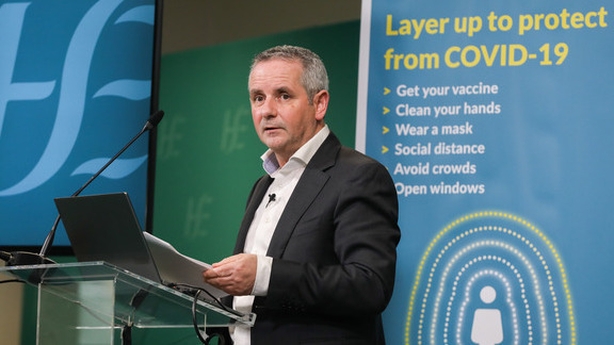
He described it as one of the most "gruesome" reports he had to read in his career.
On RTÉ's Six One News, he was asked if he could assure viewers that what happened in the Brandon case was not happening in any other HSE run care facilities.
Mr Reid said a range of initiatives had been put in place in recent years: "We have put in safeguarding procedures, and resources into each community area, we have now put in place dedicated lead managers for disabilities, in the whole area of social care with dedicated managers leading across each area and a range of initiatives for people to talk up and tell us...," he said.
It is not clear at this point in time if residents or the families of those who are in the facility are aware that a resident was viewing material of child sexual exploitation online.
It is also unknown if efforts were made to establish whether other residents also viewed the material.
Asked on RTÉ's Morning Ireland if they had been informed, Minister Anne Rabbitte said she was not aware that they had been.
She acknowledged that the latest incident happened on her watch, but she said there are "patterns" in HSE disability services in the northwest and this highlighted the need to find out what has been going on.
Minister of State Anne Rabbitte has said she would like there to be an independent review into the CHO 1 Northwest region of the HSE following HIQA concerns | Read more: https://t.co/0Q9qUMPaxz pic.twitter.com/YISVnKp2Dg
— RTÉ News (@rtenews) February 15, 2022
Those "patterns" are echoed in the HIQA correspondence to the HSE.
It pointed to several regulatory interventions going back to 2016, because of "ineffective governance, management and oversight in this area".
Since then, there has been a programme of "escalated regulatory action" to improve governance due to ineffective management and oversight in the operation of a range of designated centres which negatively impacted on the safety of residents and their quality of life.
Ongoing findings of non-compliance in governance and management across a range of designated centres and poor findings impacting on the safety and quality of life for residents in CH01 meant the HSE had to attend seven cautionary meetings since 2016.
It was issued with 16 warnings; it was required to undertake 32 provider investigations (Provider Led Investigations and Provider Assurance Reports) and was issued with four notices proposing to cancel the registration of designated centres operated by the HSE in CHO1.
The HSE issued a statement saying it was constructing a wider governance review of disability services which would "build on the improvement work to date".
The terms of reference for an independent review of CHO1 have already been drawn up by the disability minister to uncover reasons for "the pattern of failure in the region".
The review - which she wants conducted by a social worker outside the jurisdiction, independent of the system and all stakeholders in it - will need the go ahead from the senior minister in the Department of Health - Stephen Donnelly.
This is despite Minister Rabbitte and her staff moving to the Department of Children under Minister Roderic O’Gorman.
Calls for independent review escalate
Calls for an independent review escalated in the Dáil on Wednesday.
Co-Leader of the Social Democrats Deputy Catherine Murphy, and Independent TD Thomas Pringle put it to the Taoiseach that accountability was required from the HSE following recent scandals such as the Grace case, CAMHS (Child and Adolescent Mental Health Services) in South Kerry, the Brandon case, and the latest developments in the northwest.
The Taoiseach told Deputy Murphy that numerous commissions of inquiry had been established in the past on a range of issues.
"Invariably one is never satisfied with either the length of time they take, they never lead to prosecutions and in some instances can jeopardise prosecutions..."
The Minister for Disabilities is seeking an independent review, not a commission of inquiry.
Deputy Thomas Pringle suggested a wider investigation into HSE services across the country.
Visibly frustrated, Taoiseach Micheál Martin said: "Increasingly, almost daily, it is an independent review for this and an independent review for that, where we have existing statutory agencies which are meant to be doing that work."
"That tells you something is wrong," Deputy Pringle retorted from under his mask.
This week, the HSE said HIQA found no safeguarding concerns in any designated disability centre during inspections that were completed in the northwest region last month.
This cannot alleviate the minister’s concerns, nor should it convince the HSE the pattern of safeguarding failures in CHO1 has been addressed.
HIQA has repeatedly highlighted the limitations of its own inspections and has called for strengthened regulatory powers.
Despite commencing inspections in the complex featured in the Brandon Report in 2014, HIQA did not uncover the assaults carried out.
Were it not for the actions of a whistleblower in 2016, it would not have come into the public domain.
What is clear is that a review of CH01 is required, despite reservations by some in Government.
It should not be a witch-hunt, but it should offer a clear account without legal entanglements of how the system is repeatedly failing.
It should provide transparency to residents and their families.
Staff should be trained to understand that they are responsible for reporting safeguarding concerns without hesitation or fear.
Whether the problem is one of legacy, of culture, of governance, or all three combined, those in receipt of disability services in the region and their families deserve to be secure in the knowledge that safeguarding is the priority.