



The European Commission has issued a preliminary finding against US tech giant Meta for allegedly failing to prevent minors under 13 from using Instagram and Facebook.
The Commission said shortcomings in Meta's operating system are in breach of the Digital Services Act (DSA).
In an announcement this morning, the Commission said the company had failed to "diligently identify, assess and mitigate the risks of minors under 13 years old accessing their services".
The finding comes amid a growing and worldwide move to limit access to social media for younger teenagers.
Commission President Ursula von der Leyen this month said a new age-verification app to allow users to verify their age when accessing online platforms is "technically" ready and would be available for use soon.
While a number of EU member states are planning to implement social media bans for 15 and 16-year-olds, the Irish Government is developing a digital wallet which will verify a user's age based on their PPS number.
This morning, the Commission said that despite Meta's own terms and conditions setting the minimum age to access Instagram and Facebook safely at 13, the measures put in place by the company to enforce these restrictions "do not seem to be effective".
In a statement, the Commission said the measures did not adequately prevent children under 13 from accessing their services, nor promptly identify and remove them if they had already gained access.
The Commission said that children under 13 could enter a false birth date when creating an account, showing that they were 13 or older.
Meta did not provide effective controls to check the accuracy of the self-declared date of birth, the Commission said, adding that the company’s tool for reporting minors under 13 on the platform is "difficult to use and not effective, requiring up to seven clicks just to access the reporting form, which is not automatically pre-filled with the user's information".
Even when a minor under 13 is reported for being under the age threshold, there often is no proper follow-up, and the reported minor can simply continue to use the service without any type of check, said the statement.
The Commission claims there is an "incomplete and arbitrary risk assessment" provided by Meta, which inadequately identifies the risk of minors under 13 accessing Instagram and Facebook and being exposed to age-inappropriate experiences.
"Meta's assessment contradicts large bodies of evidence from all over the European Union indicating that roughly 10-12% of children under 13 are accessing Instagram and/or Facebook.
"Moreover, Meta seems to have disregarded readily available scientific evidence indicating that younger children are more vulnerable to potential harms caused by services like Facebook and Instagram," said the statement.
The Commission said Instagram and Facebook, owned by Meta, "must change their risk assessment methodology, in order to evaluate which risks arise on Instagram and Facebook in the European Union, and how they manifest".
We need your consent to load this rte-player contentWe use rte-player to manage extra content that can set cookies on your device and collect data about your activity. Please review their details and accept them to load the content.Manage Preferences
"Moreover, Instagram and Facebook need to strengthen their measures to prevent, detect and remove minors under the age of 13 from their service.
"Meta must effectively counter and mitigate risks that minors under the age of 13 could experience on the platforms, which must ensure a high level of privacy, safety and security for minors," it said.
As this is a preliminary finding, Instagram and Facebook will have access to the documents in the Commission’s investigation files and will then have the opportunity to reply in writing.
In a statement this morning, a Meta spokesperson said it disagreed with the preliminary findings.
"We're clear that Instagram and Facebook are intended for people aged 13 and older and we have measures in place to detect and remove accounts from anyone under that age.
"We continue to invest in technologies to find and remove underage users and will have more to share next week about additional measures rolling out soon.
"Understanding age is an industry-wide challenge, which requires an industry-wide solution, and we will continue to engage constructively with the European Commission on this important issue," the spokesperson added.
We need your consent to load this rte-player contentWe use rte-player to manage extra content that can set cookies on your device and collect data about your activity. Please review their details and accept them to load the content.Manage Preferences
Commission investigation launched in 2024
Under the DSA guidelines for protecting minors, tech platforms can take measures to remedy the breaches.
If the charge is ultimately confirmed, the European Commission may issue a non-compliance decision, which could lead to a fine of up to 6% of Meta’s worldwide turnover.
The Commission launched its investigation into Instagram and Facebook in May of 2024.
The preliminary findings are based on an "in-depth investigation that included an analysis of Instagram's and Facebook's risk assessment reports, internal data and documents, as well as the platforms' replies to requests for information," said the statement.
The DSA guidelines identify age estimation and age verification as an "appropriate and proportionate way of ensuring a high level of privacy, safety and security for minors," said the Commission.
Under the forthcoming EU age verification system, users can download an app and then set it up with a passport or digital ID, which will then allow users to verify their age when accessing online services.
The Commission has said the app will be "completely anonymous" to ensure people cannot be tracked when accessing websites.
Privacy campaigners in Ireland have expressed concerns about requiring people to share their PPS numbers in order to gain access to online platforms.
Duty of care to young people
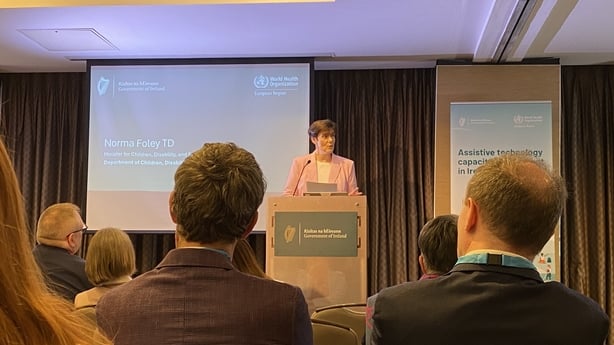
Meanwhile, Minister for Children Norma Foley said there is an "indisputable" duty of care to young people regarding social media.
Ms Foley said social media platforms have a responsibility to those who are underage.
She said that the issue of age verification was probably the biggest challenge for Government, and "a clear-cut identification of underage" was a matter of priority.
She pointed to the phone pouches introduced in schools when she was Minister for Education.
"Might have been controversial initially, but I think if you meet with principals today, they will tell you that they have been quite transformative within our schools," she said.
Ms Foley was speaking at the launch of a report by the World Health Organization which assessed Ireland's use of assistive technology.
Minister of State Minister for Artificial Intelligence and Digital Transformation Niamh Smyth welcomed the European Commission's preliminary findings/
"Ireland will use our upcoming Presidency of the European Union to advocate for greater online safety, and the protection of all vulnerable groups from the misuse of digital tools," Ms Smyth said.
"I urge Meta to take swift action to review these findings and immediately remedy the breaches identified by the Commission," she added.
Additional reporting: Brian O'Donovan
