


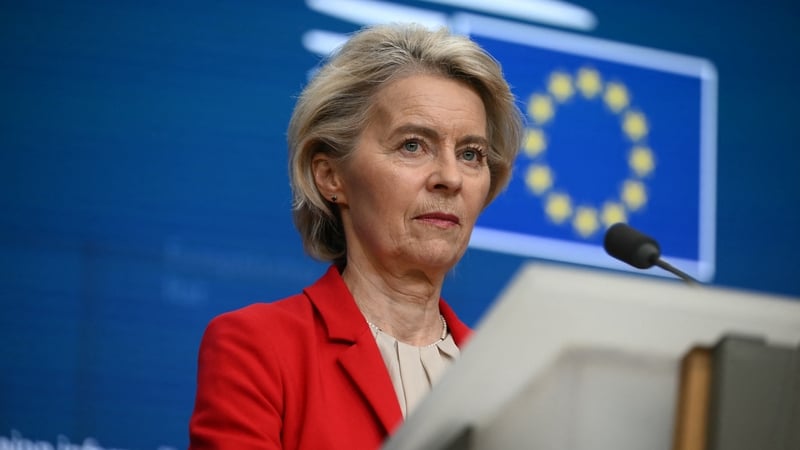
European Union leaders have said that the bloc is ready to bolster its maritime operations in the Middle East to protect shipping routes after holding talks with regional leaders.
The EU has been discussing reinforcing its naval mission in the Red Sea after US-Israeli attacks on Iran triggered a broader regional war, causing maritime traffic in the Strait of Hormuz to all but halt.
European Council President Antonio Costa and European Commission President Ursula von der Leyen "expressed their openness to further tailor and enhance these operations in order to better respond to the situation", a statement read.
The statement comes as the impact of the war in the Middle East increases across Europe, with rising energy prices and NATO allies targeted.
A long war in the Middle East could unleash a "substantial inflationary shock on the global and European economy", a top EU official Valdis Dombrovskis said.
"In a more benign scenario where the conflict is contained within a couple of weeks, one can expect that it would not have major effect on the global and European economy," the EU economy commissioner told reporters.
But he said if it became "more protracted" with continued maritime disruption and attacks on Gulf energy infrastructure, it could result in an "inflationary shock" with higher energy prices.
Oil prices soared this morning, peaking just short of $120 a barrel as the US-Israeli war against Iran continued into a second week, with Tehran launching fresh retaliatory strikes in the Gulf.
'Caught in the crossfire'
"We are now seeing a regional conflict with unintended consequences. And the spillover is already a reality today," the European Commission president told EU ambassadors, ahead of the midday call with Middle Eastern leaders.
"Our citizens are caught in the crossfire. Our partners are being attacked," she said, citing an Iranian-made drone hitting a British base on EU-member Cyprus, trade disruptions and the "displacement of people".
While Iran has not officially shut off the Strait of Hormuz - through which a fifth of the world's crude supplies and a substantial amount of gas run - shipping through the critical waterway has all but dried up.
European gas prices also jumped as much as 30%, albeit remaining well below the peaks reached in the aftermath of Russia's 2022 invasion of Ukraine.
Ms von der Leyen stressed that "there should be no tears shed for the Iranian regime".
"The people of Iran deserve freedom, dignity, and the right to decide their own future - even if we know this will be fraught with danger and instability during and after the war," she said.
The "longer-term impact" of the war posed "existential questions" on the future of an international rules-based system and the 27-nation's bloc place in the world, she told the annual gathering of European Union diplomats in Brussels.
"The idea that we can simply retrench and withdraw from this chaotic world is simply a fallacy," she said.
Ms von der Leyen also addressed the Ukraine conflict and assured the gathering that Brussels will see through a vital €90bn loan to Kyiv that is being blocked by Hungary.
"We will deliver on our commitments, because our credibility - and more importantly, our security - is at stake," she said.
The EU also insisted there was "no imminent oil supply" shortage in Europe, despite the benchmark price for a barrel of crude having soared beyond $100 for the first time since Russia's invasion of Ukraine four years ago.
"There is no imminent oil supply shortage in Europe. Per our rules, all member states must have the 90 days emergency stocks," European Commission spokeswoman Anna-Kaisa Itkonen said.
