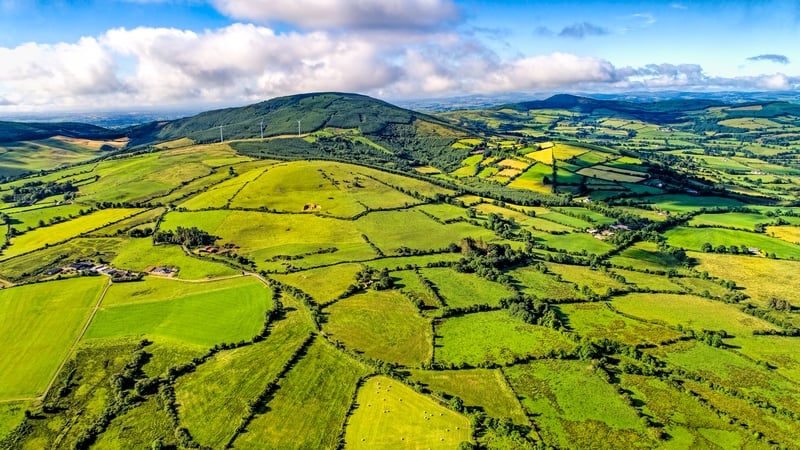

Ireland needs to invest hundreds of millions every year to restore nature and to support farmers, fishers and foresters to protect the environment, according to a report from the Independent Advisory Committee on Nature Restoration.
The report found that 90% of protected habitats are in an unfavourable conservation condition, with Ireland being one of the lowest-ranked countries in the world for intact biodiversity.
"Nature has been in decline in Ireland for many decades" is among the opening words of the report.
The introduction to the recommendations from the committee said that the decline is already hitting home, linking recent floods to poor management of rivers and catchment areas.
Ireland ranks in the bottom 10% in the world for intact biodiversity and spends the lowest share of GDP of any EU state on nature.
The committee said that needs to change and estimates the investment needed to meet the EU Nature Restoration Regulation at €450-€700 million per year.
Failure to implement that law could cost dearly, the report said the State has already paid many millions of euros in fines to Europe for failing to protect nature, and future penalties could run into tens of billions.
Fund Nature Restoration is the first of three key priorities identified in the recommendations, and it said: "Ireland requires an adequate and dedicated multi-annual fund for nature restoration."
We need your consent to load this rte-player contentWe use rte-player to manage extra content that can set cookies on your device and collect data about your activity. Please review their details and accept them to load the content.Manage Preferences
The last government set up the Infrastructure, Climate and Nature Fund. This Government has been criticised for allocating €2bn from the fund to the Dublin Metro project.
The committee said that while massive investment is required, the returns will be far greater.
It said €150bn will be required across Europe to restore nature, but the rewards will be 10 times higher, around €1.5 trillion.
It called on the Government to conduct an in-depth analysis to show the benefits of nature restoration.
Speaking on RTÉ's Morning Ireland, Chair of the Independent Advisory Committee Aoibhinn Ní Shúilleabháin "that’s not just money that goes into the ground".
"For example if we look at other policies, if we want to keep our nitrates derogation we have to improve our water quality, and we have to improve our habitats... also we if we think of flooding if we are looking at our rivers in terms of free flowing and flood plains, if we think about them at a catchment level, if we plant more trees in the right place, if farmers are willing to give over some of their land as flood basins that then solves the problems elsewhere."
The second key priority is "restore nature on public lands as a priority".
The Government and State agencies own between 8% and 11% of the land in the State.
Coillte and Bord na Móna are the largest landowners in that sector, and the report said that while they have done some "exemplary work", they operate under a commercial remit, and this "contradiction of purpose presents a real challenge".
There are many other State owners of land, including the Department of Agriculture, the ESB, the HSE and the OPW, and the report said they must all ensure they contribute to meeting nature restoration obligations.
The third priority is "support farmers, fishers and foresters".
'We can take back nature from the brink,' says Minister of State
The committee includes farming and fishing representatives as well as environmentalists and academics.
It said in its consultations with the public and with stakeholders, a consistent theme highlighted was that actions to restore nature by those groups are not given sufficient financial return for individuals.
It said these groups are the people who work closest to nature, and their role should be given national recognition.
Dr Ní Shúilleabháin said: "We’ve seen consistently that when you give farmers the correct evidence and incentivisation, they are the best stewards for nature. These are the people who want to make sure the land is passed on for generations to come."
The report noted that while the current results-based agri-environmental scheme ACRES covers almost one quarter of agricultural land, with about 40% of farmers participating, it does not include all farmers who would like to join.
It called for greater ambition for agri-environmental schemes.
While the report identified three key priorities, there are seven general recommendations and eight related to specific regulations.
The general included educating, engaging, and empowering society, and recognising and supporting the special role of Gaeltacht and Island communities in restoring nature.
The recommendations relating to EU regulations include restoring freshwater and marine ecosystems and urban ecosystems, and the EU target of planting an additional three billion trees across the union.
We need your consent to load this rte-player contentWe use rte-player to manage extra content that can set cookies on your device and collect data about your activity. Please review their details and accept them to load the content.Manage Preferences
Minister of State looking for separate nature restoration fund
The Minister of State for Nature, Heritage and Biodiversity has said he is looking for a separate fund solely for nature restoration.
The Government has a Fund for Infrastructure, Climate and Nature but the Independent Advisory Committee on Nature Restoration has called for ring-fenced funding for nature.
Speaking at the launch of the committee's recommendations, Christopher O'Sullivan said: "We've had great discussions so far with the Taoiseach, right across government, that we would have a dedicated fund.
"Of course, we have to accept that nature restoration and bringing species back from the brink is going to be a cross-departmental, all-of-society approach, but I think having a dedicated fund will be a significant development."
Also speaking at the launch, Aoibhinn Ní Shúilleabháin said funding is their number one priority and that requires separate funding "It's great that we have a climate nature and infrastructure fund".
"There's a lot of demands on that, and we can see that there's already a lot from that fund dedicated elsewhere, and that's why this committee has said that funding should be there that is ring-fenced specifically for nature restoration," she added.