


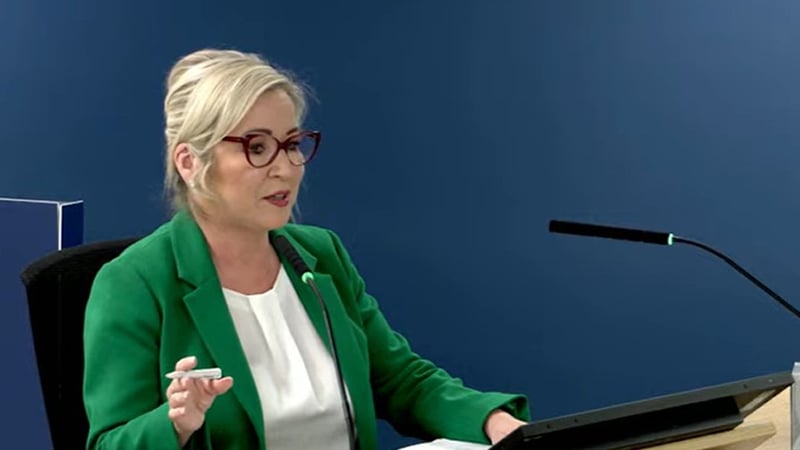
Northern Ireland First Minister Michelle O’Neill has said there is no evidence to suggest there was a fall in compliance with Covid-19 restrictions after the funeral of republican Bobby Storey in 2020.
Ex-first minister Arlene Foster made the claim as she appeared before an inquiry in London examining Stormont's decisions on test, trace and isolation.
The former DUP leader said there was a fall in compliance after Sinn Féin ministers, including Ms O’Neill, attended the large-scale funeral for the senior republican in west Belfast in June 2020, when there were restrictions on social gatherings.
"I don’t think that we were slow to promote compliance because day after day at press conferences we were urging the public to comply," Mrs Foster told the inquiry.
"There was a breakdown in compliance after the attendance of senior members of Sinn Féin at a high-ranking republican funeral at the end of June, which caused severe difficulties in Northern Ireland with compliance and adherence."
She said that despite efforts made, including working with the PSNI and giving money to councils to employ Covid-19 marshals, there was "a difficulty which still hung over the executive" around non-compliance because of the funeral.
Asked about Mrs Foster’s comments, Ms O’Neill told the inquiry: "I think, unfortunately, I believe Arlene Foster raised that issue again today in the inquiry because the comments are politically motivated.
"I don’t believe there is any evidence that suggests that actually is the case."
Ms O’Neill apologised at the inquiry last year for having attended the funeral.
Northern Ireland's Chief Medical Officer Professor Michael McBride told the inquiry that there was no evidence to support the claim that compliance dropped as a result of the event.
"From a purely scientific and public health perspective, I'm not aware of any evidence that that’s the case.
"I think the major driver of the increase in cases throughout that summer, into September, into October, were the relaxations in the non-pharmaceutical measures, which had been agreed by the executive, that’s what led to the increase in transmission.
"There was more mixing with more people coming together in a range of environments, and that led to an increase in the pandemic," Prof McBride said.
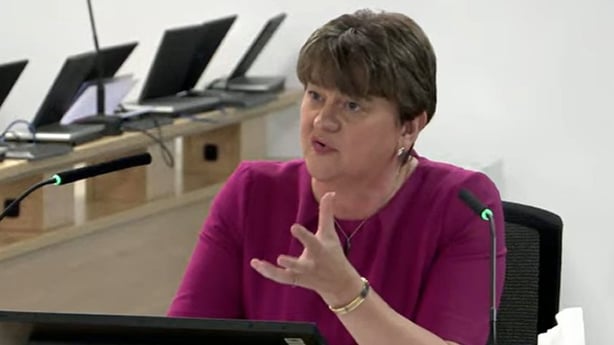
Mrs Foster said it was "inhumane" that people had to die alone during the Covid-19 pandemic.
She said that if she could change one thing from that period, it would be that families should have been allowed to make their own informed decisions on being with their dying loved ones.
Asked about whether black, Asian and minority ethnic groups suffered as a result of pre-existing inequalities, Mrs Foster said this was true "of a number of different groups".
"Young people, for example, were denied chances in life that they would have otherwise had.
"Those living alone were isolated and lonely, people who were dying alone in hospital and if I could change one thing, my lady, it would be that.
"We should have given families all of the information, told them about the risks, and allowed them to make the decisions as to whether they wanted to be with their loved ones as they were dying.
"Because I think it is quite inhumane, when one thinks about it, to allow someone to die alone in the way that so many people did."
Mrs Foster and Ms O’Neill were also asked about the decision to end contact tracing on 12 March 2020.
The former DUP leader said the decision was made after a UK government meeting at which she, Ms O’Neill and Northern Ireland's then health minister Robin Swann had little opportunity to engage and were "in receive mode".
Both Mrs Foster and Ms O’Neill said they did not take from the meeting that contact tracing was to stop.
"I didn’t have the understanding after that Cobra meeting, clearly wrongly now, that we were going to stop contact tracing as a consequence of the discussions at that Cobra meeting," Mrs Foster said.
"The Department of Health clearly did have that understanding and stopped the contact tracing."
Mr McBride said it was "clear" to him that a decision was made to stop contact tracing at the Cobra meeting.
Asked by inquiry chair Heather Hallett whether Mrs Foster and Ms O'Neill "didn’t understand that was what the decision was", he said: "I thought it was clear and it was clearly reflected in the minutes of the Cobra meeting."
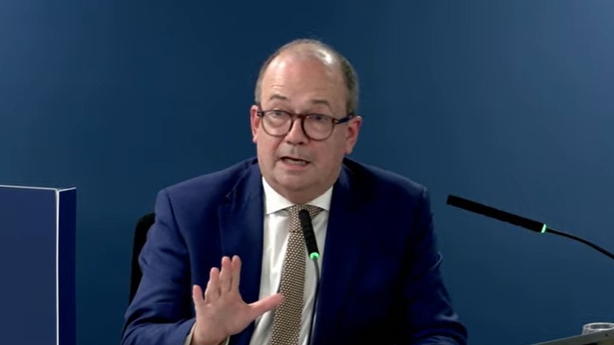
Prof Michael McBride told the inquiry that capacity issues were behind the decision to stop community testing and the ending of contact tracing was a "second order" as a result of that.
"Even a week after 12 March, we had less than 200 tests available to us in Northern Ireland on a daily basis, and even that was limited because of the lack of reagents that we had and swabs that we had because of global supply issues."
Mrs Foster was asked whether, given there were 20 confirmed cases in Northern Ireland at the time, a different decision about stopping testing and contact tracing on 12 March 12 could have been made.
"There was an option ... but those options weren’t taken. I think we were quite early in the pandemic, and were not prepared for what was coming at us, to be honest with you," she said.
Mrs Foster said that test and trace was not initially seen as a "significant" issue that warranted a Stormont Executive decision.
In hindsight it "probably should have come to the executive" but also added it "probably would have made it slower".
"I know that there was a very real concern at that time that the amount of work officials were being asked to do was quite significant, and I’m not suggesting that it didn’t come to the executive for this reason but it would have certainly slowed decision-making down at that time."
She said there was no "plug and play" system in place for contact tracing, adding that she hoped one lesson would be the ability to "scale up at speed if something like this were to happen again".
Ms O’Neill said she had raised concerns about ending contact tracing in March 2020, as it went against the advice of the World Health Organisation (WHO).
Notes by Ms O’Neill, who was deputy first minister, were read out from a meeting on 16 March where she wrote "GB [Great Britain] approach nightmare compared to rest of world".
She told the inquiry that it was "absolutely" a decision by the Department of Health to stop contact tracing in mid-March.
Ms O’Neill was asked about a note she had that the department would "prefer to use resources to combat Covid-19 rather than count, self-isolate for seven days first rather than testing".
"I think perhaps it could be characterised as a defensive statement that let’s not just count, let’s do something else. But I believe that, again, it wasn’t the right approach."
Ms O’Neill was asked by inquiry chair Heather Hallett whether she was not listened to because of deep political divides in Northern Ireland.
"The fact that we live on an island, the fact that we were one single epidemiological unit, that wasn’t factored into decision-making.
"That’s not a political point, that’s just a logical point. I didn’t feel like that was being taken on board.
"I think perhaps that, at times, could be seen as I wanted to follow everything in the south. I didn’t.
"I wanted to follow everything that worked, and I didn’t mind where it came from, as long as it worked for the people that we represented."
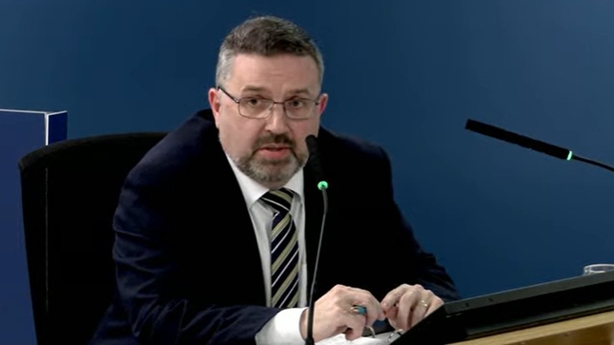
Mr Swann said that he remembers being challenged on the decision to end contact tracing in March 2020, but not being told to change course.
He told the inquiry that the first and deputy first ministers have the power to call any decision made by a minister to the executive "for a different approach to be taken".
"My reading, my understanding of that conversation and their statements is that none of them thought we had taken that step too early," Mr Swann said.
"In regards to the comments 'test, test, test', I think (it) was an easy soundbite because it didn’t match actually our capacity in regards to the tests that we had.
"There was challenge, there was questioning, there was robust debate around the direction we were taking, but there was no direction from the executive, first or deputy first minister, actually to change course," he added.
"That approach for saying ‘test, test, test’, just because you say it doesn’t mean to say tests will miraculously appear, reagents will appear, swabs will appear, or the machines that were necessary across the labs would suddenly materialise."
Asked about Hazel Gray, whose mother and father died of Covid-19 and who had contacted Mr Swann in 2020, he expressed his sympathies with the family.
"If I had had the ability to test everyone regularly when they wanted it, as they required it, I can assure you, my lady, and this inquiry and the members that I would have been doing that from the very beginning," he said.
