


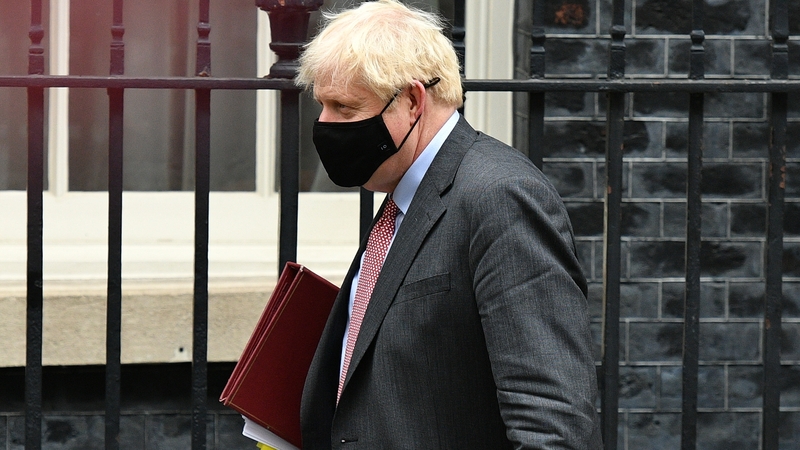
The British government has insisted it is still "guided by science" following criticism that senior ministers had ignored the advice of experts three weeks ago for tougher restrictions to cut rising coronavirus infections.
Health Secretary Matt Hancock told MPs the government had not acted on most elements of a 21 September shortlist of possible virus interventions because it had to consider the economic fallout alongside health impacts.
A panel of scientific experts had set out the five-strong set of potential measures "for immediate introduction", and included a 'circuit breaker' lockdown to cut transmission rates.
"We make decisions that are guided by the science, taking into account all of the different considerations that we need to look to," he told MPs as they prepared to vote on the latest, more limited, set of measures announced by Prime Minister Boris Johnson yesterday.
Labour leader Keir Starmer has also called a "circuit-breaker" lockdown lasting up to three weeks across England.
The latest figures show there had been a further 17,234 lab-confirmed cases of coronavirus in the UK.
It brings the total number of cases in the UK to 634,920.
The British government also said a further 143 people had died within 28 days of testing positive for Covid-19 as of this morning. This brings the UK total to 43,018.
It is the highest daily figure reported since 164 deaths were reported on June 10 but there is often a delay in the reporting of deaths over a weekend.
Separate figures published by the UK's statistics agencies show there have now been 58,500 deaths registered in the UK where Covid-19 was mentioned on the death certificate.
Mr Johnson announced a three-tiered system categorising areas of England by rates of infection to try to simplify a complex web of local restrictions.
It was approved by MPs in three motions in the House of Commons this evening.
The northwest city of Liverpool, the only place put into the highest category, will see a ban on household mixing and pub closures from Wednesday for at least four weeks.
However, England's Chief Medical Officer Chris Whitty, flanking Mr Johnson at a Downing Street news conference yesterday evening, warned he was "not confident" the measures could reverse an upward trend that has seen Covid-19 cases quadruple in the last three weeks.
He urged local leaders in the most-affected areas to go further.
"I am not confident, and nor is anybody confident, that the tier three proposals for the highest rates... if we did the absolute base case, and nothing more, would be enough to get on top of it," Prof Whitty said.
"There's a lot of flexibility in the tier three level for local authorities ... so that they can do significantly more than the absolute base because the base will not be sufficient."
Mr Johnson's announcement was also then further undermined by the emergence of the details of the government's Scientific Advisory Group for Emergencies (SAGE) advice.
Alongside the circuit breaker measure, they had recommended closing bars, restaurants, cafes, gyms and personal services such as hairdressers, banning different households from mixing in homes and switching all university and college tuition online.
However, the prime minister adopted only one of the five recommendations, urging people to work from home.
His spokesman said that Sage itself advises considering the economic impact of any measures and associated harms, noting: "And that's exactly what the prime" minister, the chancellor and colleagues did."
"The interventions which we have made are having an effect," he added.
Mr Johnson has been heavily criticised, not least for being too slow to move to a national lockdown in its early stages.
Britain's death toll of more than 43,000 is the worst in Europe. Hospital admissions are now higher than when the national lockdown was introduced on 23 March.
Businesses, Conservative MPs and right-wing newspapers have urged Mr Johnson to resist another national lockdown because of the effect on the economy.
SAGE member John Edmunds, an epidemiologist, said tougher restrictions needed to be in place "as fast as possible".
"I suspect we will see very stringent measures coming in place throughout the UK at some point but it will be too late again," he told BBC Radio.
