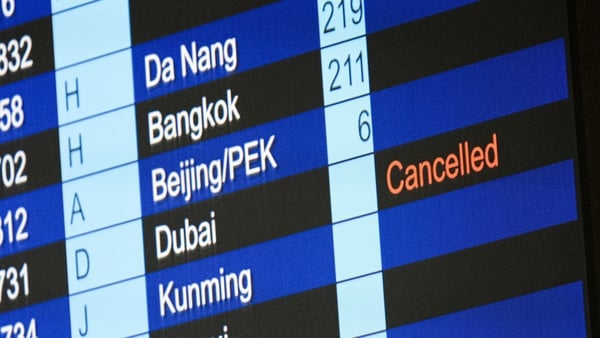
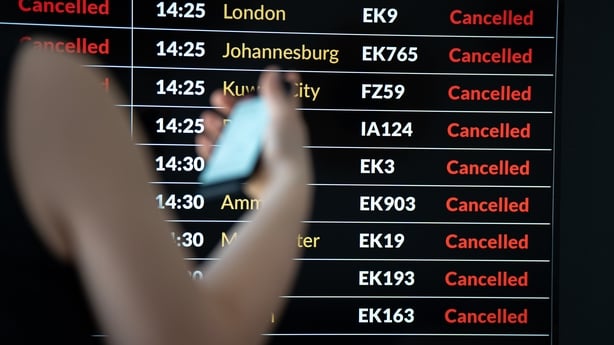
Only limited flights are operating through the Gulf, as passengers scramble to make sense of their travel plans - both now and for weeks or months ahead.
Dublin-native Brian Sullivan was due to fly home with his wife and three children from Melbourne via Abu Dhabi on 13 March.
Speaking yesterday, he said: "We would've been on the plane right now."
Etihad offered a cancellation and a refund, and the family accepted this option.
Brian has lived in Australia for 21 years and was hoping to show his children, who are aged six, nine, and 11, "what Paddy's Day is like".
Rebooking via a different route was ruled out. The trip that originally cost just over €6,000 would have ended up costing up to €16,000, he said.
Middle East operations
Combined, Emirates, Qatar Airways and Etihad Airways normally carry more than half of all passengers between Europe and Australia, New Zealand and the nearby Pacific Islands.
Etihad is now operating at 15% of pre-war capacity, according to Flightradar24.
Qatar operates a limited schedule with no Dublin-Doha connections currently in place.
Dubai, the world's biggest air hub, has seen more activity. Emirates are currently operating at around 60% of their pre-war activity levels.
For this weekend, flights from Dublin to Sydney via Dubai were available for about €600 one way on the Emirates website.
However, for many that remains an unthinkable option.
"There's no way we're going to get on the plane when there's rockets flying around in the air in that area. Not a chance," Brian Sullivan said.
"Statistically we'll probably get through, and nothing might happen, but what's the point in taking the chance?"
The travel advice by the Department of Foreign Affairs remains unchanged: avoid all non-essential travel to Kuwait, Bahrain, UAE, Qatar, Saudi Arabia.
The Gulf's role as a key East-West transit hub hangs in the balance if war persists.
Passengers are seeking alternatives, with the likes of Thai Airways taking on board more passengers to and from Europe.
"Before the UAE opened up as a hub, Australia mainly funnelled through Singapore and Bangkok," Paul Hackett, the CEO of Click&Go and Vice-President of the Irish Travel Agents Association, told RTÉ News.
"People went Dublin-London, Dublin-Frankfurt or Dublin-Paris to Singapore and Bangkok and then on. Australia used to be a two-stop journey."
There isn’t a one-stop alternative on that route to Dubai, the travel expert said, though North American routes might work for some from New Zealand or Australia's east coast.
Amid security concerns avoiding the Middle East air space could become a long-term choice for some passengers, especially for families.
Brian Sullivan is now hoping to see his parents and brother and bring the family over for Halloween, but even then, is likely to choose a stop-over in Singapore and Frankfurt.
Price hikes
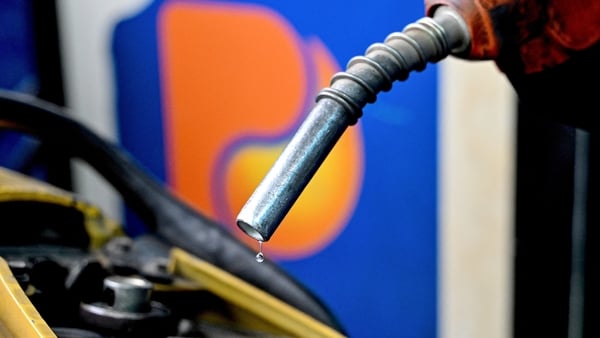
Amid soaring oil prices and reduced Gulf capacity, global airlines started passing costs of the disruption to consumers.
Dutch airline KLM said on Thursday it will raise long-haul fares due to jet fuel costs, without specifying amounts.
Earlier, Qantas, Air New Zealand, SAS and Thai Airways all announced hikes.
"Some airlines are more exposed than others but ultimately they're going to try and pass the cost through to the consumer," said transport and logistics analyst at Davy Group Stephen Furlong.
Jet fuel prices have been growing much faster than crude oil, doubling to about $160 a barrel since early March.
However, some airlines are better protected by hedging - locking in a portion of their fuel needs in advance via contracts that guarantee a set price for a set period.
In Europe, where hedging is common, Air France has 62% of its fuel hedged, while Lufthansa - 77%.
The owner of Aer Lingus, IAG, is hedged by 62% for 2026 and said it is not planning to increase prices "immediately".
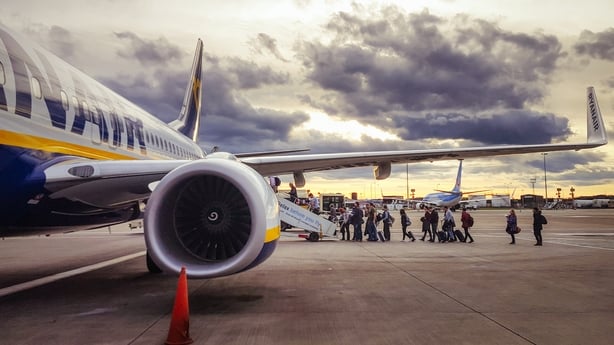
Ryanair has "the best hedging position", according to Mr Furlong, with 80% of their fuel hedged until March of 2027.
Davy's analyst doesn't expect "dramatic price increases" on European routes for now but warns about likely increases on long-haul and transatlantic flights, as unhedged US airlines could "aggressively" raise prices.
Even hedged carriers like KLM, Qantas and Air New Zealand have hiked fares, as demand for flights increase.
"It’s just simple economics," says travel expert Anita Mendiratta, adding that Emirates, Qatar Airways and Etihad typically offer fares 20-30% lower than competitors.
"Removing a significant portion of that capacity from the system quickly reduces consumer choice and can push prices higher," she said.
The impact on tourism
Middle East tourism, worth some $367 billion annually to the region, is already reeling from the conflict.
Analysts at consultancy Tourism Economics estimate 23-38 million fewer visitors this year, costing the Gulf up to $56 billion.
For Irish passengers the Gulf is not a major holiday destination despite Dubai's rise in popularity, says Click&Go's Paul Hackett.
The firm's Dubai cruises are cancelled for the rest of the month, with customers rebooked elsewhere.

The impact on European travel remains unclear.
"We’re doing lots of reassuring," Mr Hackett said, citing calls from clients worried about their upcoming trips to Oslo or cruises booked for 2028.
The expert is expecting some passengers aiming to avoid the eastern Mediterranean, possibly boosting demand and prices for destinations like Spain, Portugal and the Canary Islands.