
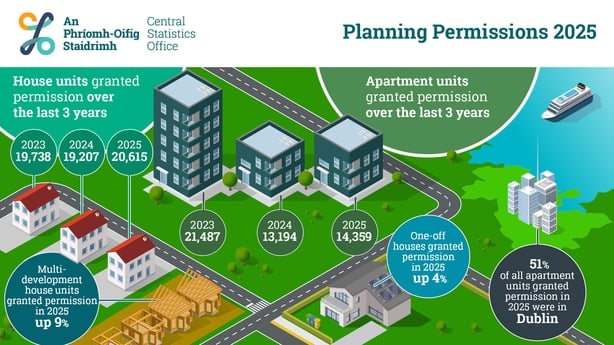
The number of homes granted planning permission rose by 7.9% last year with 34,974 given the green light, up from 32,401 in 2024, according to the Central Statistics Office.
In 2025, the number of apartments given planning was up 8.8% compared with a year earlier while the number of house approvals rose 7.3%.
Planning permissions are considered an important indicator of future building, with observers forecasting that more than 50,000 homes need to be built annually to tackle the crisis.
The CSO said that across the four Dublin local authorities planning permissions for apartments were up 20.3% last year.
The capital accounted for more than half of all apartments granted planning permission in the State.
The CSO also published figures for the last three months of 2025 which showed there was a 19% increase in planning permission compared to same period a year earlier.
The Government has a target of building 300,000 homes between 2025 and the end of 2030.
That will require a significant increase in housing output from last year when there were 36,284 homes built in Ireland.
Trevor Grant, chairperson of Irish Mortgage Advisors, stressed that planning approvals alone do not guarantee that homes will be built.
"It is vital that these permissions translate into actual construction, which requires a functioning planning system, access to serviced land, a supportive policy environment, access to labour, and more investment in water infrastructure," he said.
"High building materials inflation and high construction earnings are critical challenges for the building industry which must also be tackled," he added.
Mr Grant said that planning permission approvals and house prices are directly interlinked.
"Unless there's a steady pipeline of approved developments, housing delivery will be sluggish and in turn, steep house price and rent inflation will persist – with homes continuing to be unaffordable for a large cohort of young people as well as the many others who wish to buy," he cautioned.
"This also has repercussions for those who can get onto the property ladder as ultimately, the higher the house price, the larger the mortgage and the larger the mortgage interest bill," he added.
He also said that despite the increase in planning permission approvals, the planning system remains one of the biggest obstacles to housing delivery.
"Planning and infrastructure delays continue to stall the building of thousands of new homes. If these delays can be eliminated, more development projects will be brought to fruition and more homes will become available for, and affordable, to the many that need them," he added.
More than a third of permissions 'never get built' - expert
Lorcan Sirr, housing policy analyst, and lecturer at Technological University Dublin, agreed.
He told RTÉ's News at One that, while it is good that there are more planning permissions, these need to translate into more homes being built.
He cautioned that around 35% of planning permissions "never get built," which is "typical" in countries where there is a high-level of "speculation", where people purchase land, get planning permission and then sell it on without building anything.
"So when we see the actual housing on the ground is when I start to be a little bit more optimistic," he said.
Mr Sirr also noted that the figures reveal that in Dublin, "particularly in Fingal and South County Dublin", home-building activity has "slowed down quite a lot".
He pointed out that the majority of new apartments "are destined for Dublin".
For the last four years 95% of all new-builds in the capital have been apartments, and most of them have been for rental, he said.
Mr Sirr predicted that the number of planning permissions for new homes in 2026 will be between "36,000 and probably 40,000" because the "development levy waiver and the Irish Water rebate will end in this year".