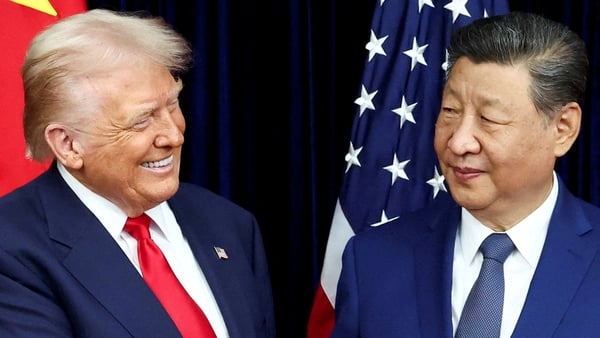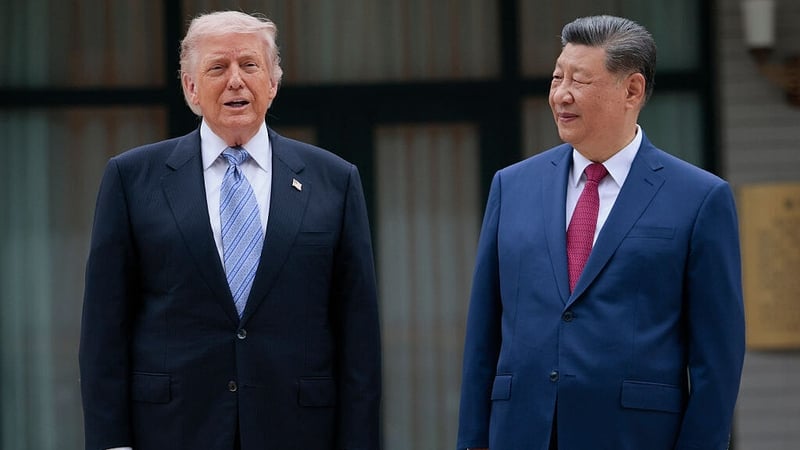

Google searches for 'Thucydides Trap' spiked on Thursday following a mention by China's leader Xi Jinping during his highly anticipated meeting with US President Donald Trump in Beijing.
People wanted to know what this ancient Greek had to do with the very modern matters on the agenda, like artificial intelligence and hi-end computer chips.
The phrase, coined by a US political scientist called Graham Allison in 2011, is a reference to Thucydides’ observation that it was Sparta's fear over the rise of Athenian power that led to the Peloponnesian War.
It has remained a popular talking point ever since among observers of US-China relations, as China's rapid rise stoked US fears.
China these days presents less like a rising power and more like one that's already risen - and doesn't mind showing it.
Gone are the "hide your strength, bide your time" times of former leader Deng Xiaoping.
This week Chairman Xi looked like a man showing his strength, claiming his time and, crucially, addressing the US president as an equal.
"Currently, transformation not seen in a century is accelerating across the globe," he said, echoing the line he had delivered to Russian President Vladimir before the full-scale invasion of Ukraine.
He didn't add "the East is rising and the West is declining," as he has said before, but he might as well have done.
"The world has come to a new crossroads," he said, before posing the question of whether China and the United States could overcome the Thucydides trap and "create a new paradigm of major country relations".
That question hung in the air throughout this meticulously choreographed summit, which seemed to wow the Americans.
On arrival, Mr Trump was treated to a Chinese military parade, complete with goose-stepping soldiers and marching brass band outside the Great Hall of the People.
Schoolchildren waving bouquets and US and Chinese flags jumped up and down in formation, chanting "welcome, welcome!". Mr Trump smiled and clapped.
After inspecting the soldiers, the two men carried on along the red carpet up the steps of the colossal building, then stopped and turned to view Tiananmen Square to the east. Mr Xi gestured and said something to his guest, presumably not about the student protesters shot by the army near there in 1989, still a taboo subject in China to this day.
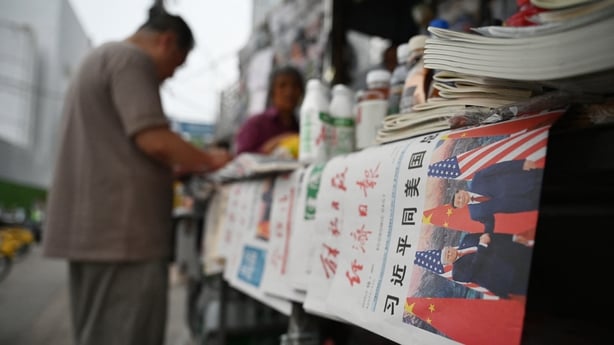
Throughout the visit Mr Trump gushed.
China was "incredible" and "beautiful," he told reporters, dodging shouted questions from the travelling press corps about Taiwan.
His compliments to his host were close to what the younger generation might describe as "glazing".
"You're a great leader, I say it to everybody, you’re a great leader," he said when the men were face to face across the table, flanked by their most senior cabinet ministers, all of them men.
"Sometimes people don't like me saying it," he added.
Could one of these people be his Secretary of State, Marco Rubio, considered something of a classic "China hawk" in Washington circles?
Mr Rubio is still under sanctions from the Chinese state over his criticism, while a senator, of China’s treatment of the Uyghur minority and thereby banned from entering the country.
But China changed the Chinese characters in the transliteration of Mr Rubio's name when he became Secretary of State - an apparent diplomatic fudge that meant he could join the summit.
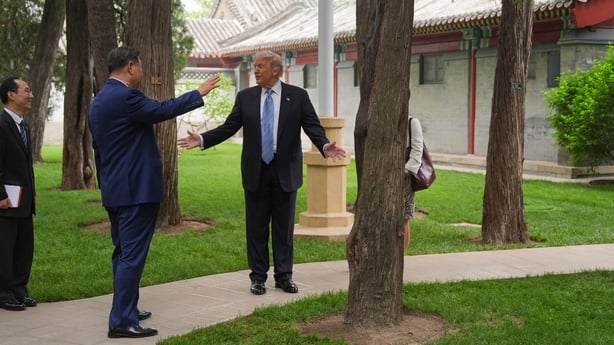
Mr Trump seemed especially chuffed to be invited to walk around the gardens of Zhongnanhai, the secretive Communist Party headquarters in central Beijing. He asked if other presidents and prime ministers got the same privilege.
"Rarely," his host replied and then proceeded to mention Vladimir Putin of Russia as an example of a previous guest.
The garden of strongmen, it seems.
Mr Xi, like most senior Chinese Communist Party officials, is far more inscrutable than his visitor.
But he certainly looked relaxed and exuded plenty of confidence.
And he also wasted no time getting to the point, delivering a stern warning to the US president in their first meeting.
If the situation regarding Taiwan were to be "mishandled," he said, according to the Chinese readout, their two countries could "clash or even enter into conflict, pushing the entire China-US relationship into a highly dangerous situation".
Beijing claims the self-ruling island as its own territory and has not ruled out seizing it by force.
Taiwanese public opinion polls consistently show a desire to maintain the status quo - neither joining China's one party-state system nor declaring independence.
Polling also shows most of Taiwan’s 23 million citizens want the right to decide their own future.
The US has historically armed Taiwan but stuck to an official policy of "strategic ambiguity" over whether the US would come to its defence in the event of a Chinese invasion.
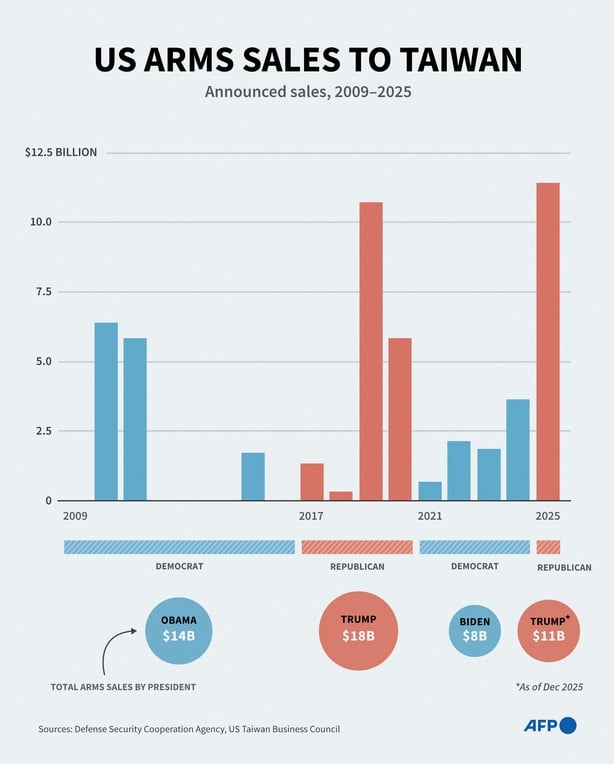
A $14 billion arms package for Taiwan has been approved by Congress, but it appears to be being slow walked by the White House following objections from Beijing.
In Mr Xi's comments, the subtext seemed to be: You, Mr Trump, can avoid the Thucydides Trap if you just back off over Taiwan.
For the Chinese side, it was clear that Taiwan remains the "reddest of red lines," said Wen-Ti Sung, non-resident fellow at the Atlantic Council’s Global China Hub, based in Taipei.
For China, "Taiwan is the identity-defining issue in US-China relations," he told RTÉ News.
"Get Taiwan right and we are friends; get Taiwan wrong and we might become foes before you know it," he said.
As RTÉ News reported last week, some observers wondered if the US President could be persuaded to change US posture on Taiwan, in exchange for China's help ending the war with Iran or as part of a larger superpower deal.
No change was announced but it could still happen.
And even if it doesn't, Mr Xi still scored a victory this week. Why?
Because he got the US president to discuss arms sales to Taiwan with him, face-to-face on Chinese soil - a topic that’s been out of bounds for decades, following US assurances to Taipei.
The two men discussed arms sales "in great detail," Mr Trump told reporters on board Air Force One on the way home on Friday.
"What am I going to do?" he said, "Say, "I don't want to talk to you about it" because I have an agreement signed in 1982?"
"No, we discussed arms sales," he said.
For now, that will be good enough for China because it could open the door for more concessions.
"When dealing with a transactional administration, anytime an item moves from sacrosanct to negotiable is a win for China," said Mr Sung of the Atlantic Council.
While Taiwan remained uppermost in Mr Xi’s mind, for Mr Trump it was trade.
He brought a bevy of "brilliant" billionaires with him to underline the point.
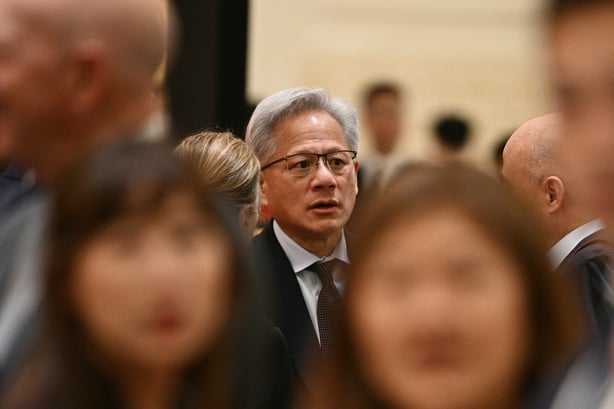
Seventeen executives, including Nvidia CEO Jensen Huang, Apple CEO Tim Cook and Tesla CEO Elon Musk accompanied the president.
And what they want is greater access to the enormous Chinese market.
"I will be asking President Xi, a Leader of extraordinary distinctions, to 'open up' China so that these brilliant people can work their magic," Mr Trump posted on social media ahead of the summit.
"China’s door to the outside world will only open wider," Mr Xi told business leaders, according to China state media.
But it will remain on China's terms, no doubt.
Foreign enterprises are legally required to enter into joint ventures with Chinese companies and often transfer their intellection property, in order to secure a foothold in the Chinese market.
And Beijing is clear on its goal of self-reliance, cutting dependency on the US and other countries.
Nvidia, for example, had been pushing to sell advanced chips to China for artificial intelligence, something initially curbed by US export controls but now stalled by China's desire to rely on homegrown tech.
Beyond Mr Trump's announcement that China had agreed to buy Boeing aircraft and American soybeans, little detail on other major deals emerged.
Meanwhile, between Taiwan and trade, there was little room for human rights, once a mainstay of democratic US's engagement with authoritarian China.
Previous US presidents would often address thorny topics like Tibet, Xinjiang and individual freedoms on their visits to China, albeit in more muted tones.
In a townhall with Shanghai students in 2009, then US president Barack Obama talked about freedom of expression, worship, access to information and political participation as "universal rights" for citizens of all nations.
A couple of years later, China's leader Hu Jintao acknowledged the "universality of human rights" on a visit to the US.
Fast forward to today and the near erasure of that topic from the discourse between the United States and China perhaps represents the biggest win for Beijing this week.
"The US, along with other nations, has long prioritised economic interests over human rights," said Christine Ryan, of Columbia University Law School's Human Rights Institute.
"But now that prioritisation is magnified," she said.
"It’s a huge loss when the US - a major superpower - drops human rights entirely from its foreign policy," she said.