
Parliamentary elections in Central and Eastern Europe are often described as being the most important vote for a country since 1989, the year Communist rule collapsed across the region, enabling the first free elections to take place since World War II.
In most cases, the label of "most important election since '89" tends to get misplaced because the next election cycle receives the exact same description.
But tomorrow's Hungarian parliamentary election merits that title.
At stake is the country's future direction and place within the European Union.
Voters face a choice of sticking with Prime Minister Viktor Orbán’s populist, Eurosceptic and increasingly pro-Moscow government or giving the centre-right, pro-EU Tisza party a chance in government.
Tisza’s leader Péter Magyar, a 44-year-old lawyer and former Fidesz insider, has campaigned on a message of keeping Hungary's interests within the West and rooting out, what he calls, corruption in public institutions.
He has pledged to restore good ties with the European Union and unlock some €18bn in cohesion and recovery funds, frozen over the Fidesz government’s non-compliance with the rule-of-law.
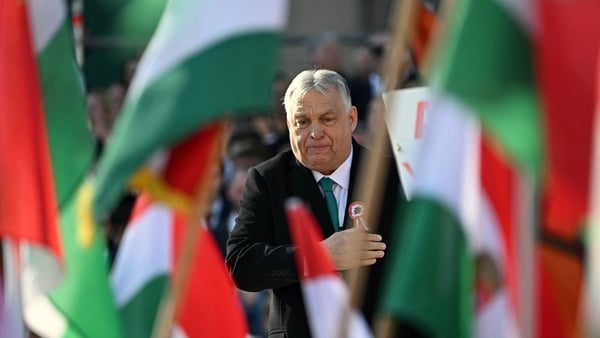
Mr Orbán’s party has been in government since 2010 and during that time it has won four parliamentary elections, each by a two-thirds majority.
That super-majority in the Hungarian parliament enabled Fidesz to rapidly change the country's constitution in 2011, reducing the independence of the judiciary and state media.
By most estimates, pro-Fidesz companies now control about 80% of private media outlets too.
Perpetually at odds with the EU over migrant quotas and the bloc’s rule-of-law norms, Fidesz has pushed Hungary to become something of an outsider within the bloc, while still wielding great leverage with vetoes at EU Council level.
Those strained relations have worsened further still since the start of Russia’s full-scale invasion of Ukraine, with the Orbán government deciding to maintain economic and political ties with Russia, and veto EU funding for Ukraine at critical moments for Kyiv.
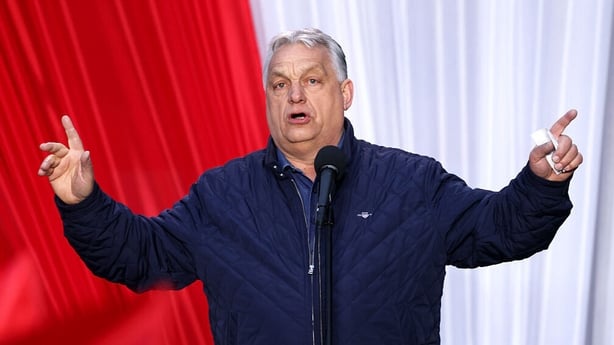
Mr Orbán has tried to present himself and his government as a neutral broker on the war in Ukraine.
But it has become increasingly difficult over the past two years to view his government’s stance on the war as anything other than pro-Russian and anti-Ukrainian.
Hungary's prime minister has met Russian President Vladimir Putin on three occasions since 2023, while only visiting Kyiv once to meet Ukraine’s President Volodymyr Zelensky.
His foreign minister Péter Szijjártó has made at least 15 visits to Russia since the start of Moscow’s full-scale invasion to oversee energy deals between the two countries.
The publication by a Hungarian media outlet two weeks ago of a leaked phone call between Mr Szijjártó and Russian foreign minister Sergey Lavrov, recorded in August 2024, showed the pally nature of the Fidesz-Kremlin relationship.
In the phone call, Mr Lavrov asks Mr Szjiarrto to try to de-list the sister of a Russian oligarch from an EU sanctions list, and Hungary’s top diplomat says he will do his best.
Now, Mr Orbán’s self-described system of "illiberal democracy" is facing is greatest electoral challenge in 16 years from Tisza.
In the space of two years, Mr Magyar has led the party from obscurity to become a national movement within reach of defeating Fidesz at the polls.
An aggregate poll from Politico puts Tisza 10 percentage points ahead of the ruling party.
One Hungarian pollster, Median, yesterday estimated that Tisza could be on course to win 138 out of the 199 seats in parliament which would equate to a super-majority, providing the party with greater powers to roll back many of Fidesz's constitutional changes.
However, because of the way Hungary's electoral boundaries are structured (reforms were implemented by Fidesz in 2011), a slimmer margin of victory for Tisza might not guarantee the party a majority.
In that scenario, it is not inconceivable that Fidesz could try to cobble together a coalition with the far-right and Eurosceptic Mi Hazánk party, which is polling at around 5%.
Under Mr Magyar’s leadership, Tisza has managed to do what Hungarian opposition parties have failed to do for the past four elections: enlarge the party’s support base beyond the big cities.
He has broad appeal among both conservative and centre-left voters.
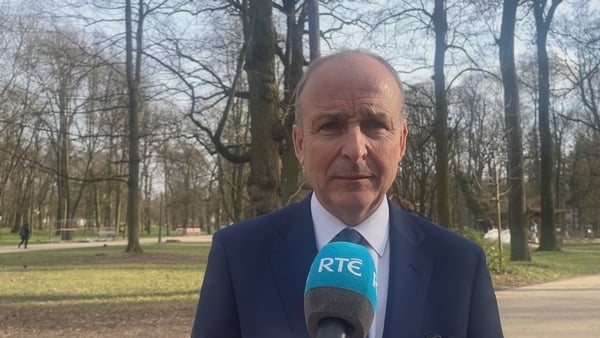
"There is not a big ideological proximity for former Fidesz voters to vote for Tisza. It’s also a right-wing party," Daniel Mickecz, a Hungarian political scientist told RTÉ News.
Both parties, he said, have similar agendas when it comes to migration and ideology.
"The Tisza party is also seen by liberal or left-wing voters as an instrument to change the government. So, they actually have high hopes in Peter Magyar and see the party as something like an effective tool to win an election," said Mr Mickecz from Eötvös Loránd University in Budapest.
Momentum appears to be on Tisza’s side in this election.
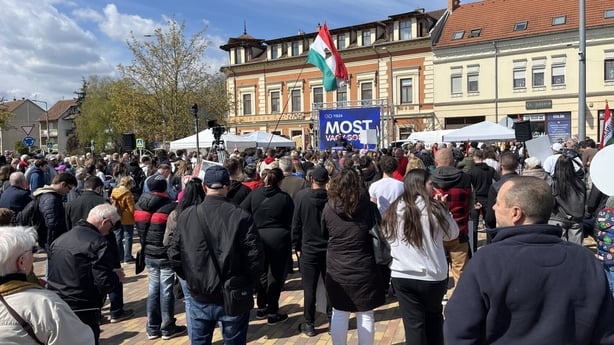
The party has held rallies in towns and cities across Hungary.
Yesterday, RTÉ News attended one such rally in the small commuter town of Aszód, one hour’s drive east of Budapest.
About 40 local volunteers, all kitted out in Tisza-branded jackets, prepared the stage and handed out fliers to hundreds of locals who had come to hear what Mr Magyar and the party’s local candidate had to say.
The atmosphere was upbeat and positive and when Mr Magyar arrived, he was greeted more like a pop star, with locals trying to shake his hand and take a selfie with him.
Waving the Hungarian flag whenever he arrives at a rally, Mr Magyar has tapped into a sense of patriotism that appeals to many older Hungarian voters, while also offering a message of change for younger people.
"The most important question in this election is whether Hungary will remain free and part of the European Union," Mr Magyar told the crowd.
"We cannot be a puppet or colony of Russia," he said, to which a spontaneous chant of "Russians go home" erupted.
Invoking recent Hungarian history, he reminded the crowd that this year is the 70th anniversary of the 1956 Hungarian Uprising against Soviet forces.
"We have a chance again to make Hungary a sovereign, European and human country,"Mr Magyar said.
It is a popular message, greeted by another loud cheer.
Like all opposition parties hoping to get into power, Tisza is promising a lot, including a new tax on the super-rich, insulation subsidies for households, and higher family support payments.
Some in the crowd, like 24-year-old Anna Kalman had travelled home from the Netherlands to vote.
"I’m just genuinely very excited and this is genuinely my opportunity to have a future here," she said.
Another 24-year-old, Máté Csizmada, an IT student, said it felt like "our problems and voices are actually heard".
The rally in Aszód was just one of seven campaign rallies that Mr Magyar spoke at yesterday.
In contrast, Fidesz is not holding similar rallies in small towns lest Tisza supporters turn up and lambast their candidates with a chant of "Russians go home".
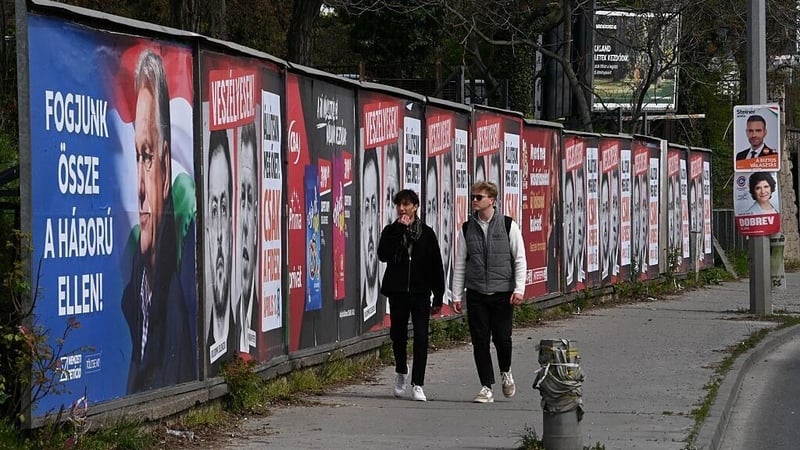
The ruling party has put the war in Ukraine at the centre of its campaign, plastering images of Ukrainian President Volodymyr Zelensky on its election posters.
One features both Mr Zelensky and Mr Magyar and reads: "They are dangerous! Let’s stop them."
Fidesz claims that a Tisza-led government could drag Hungary into the war in Ukraine.
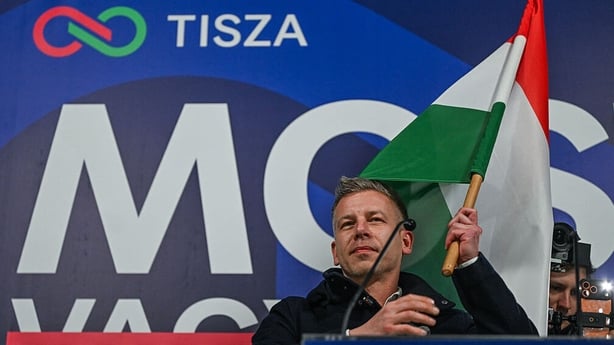
Mr Magyar has said that a Tisza government would continue a Hungarian policy of not sending arms and military aid to Ukraine, but has condemned Russia as the aggressor for its full-scale invasion.
Campaign posters criticising well-known personalities is a tried and tested tactic used by Fidesz in previous elections.
But high support for Tisza in polls suggests it is not working as well on the electorate this time round.
"Fidesz’s main strategy is to polarize the electorate so they want to be actually on the side of the majority.
"People care more about domestic issues like the cost of living, the healthcare system, the education system, public transportation," said Mr Mikecz, the political scientist from Eötvös Loránd University.
"This kind of strategy to polarise the electorate with the help of such an issue [the war in Ukraine], didn't work as much as Fidesz hoped".
An election defeat for Mr Orbán would be uniquely mourned by both the Trump administration and the Kremlin.
Mr Orbán is one of the few European leaders who can pick up the phone and speak with the leaders of the United States and Russia.
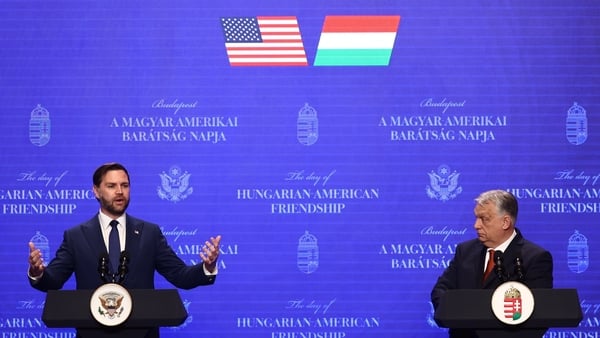
US Vice President JD Vance visited Budapest earlier this week to endorse Mr Orbán, a politician with whom the MAGA movement in the US admires and shares a lot of common ground.
But it is unclear if his visit has had any impact on voting intentions.
Tonight, Fidesz will hold a big rally in Budapest's Castle district as one final effort to rally its core voters. If the can mobilise enough of those core voters in rural constituencies on vote day, the result will be tighter than polls suggest.
Mr Magyar ended his rally in Aszód by reciting the words of 19th century Hungarian revolutionary poem.
The crowd joined in spontaneously before an old Hungarian folk song kicked in on.
Mr Magyar has managed to tap into a sense of voter frustration over a stagnant economy and poor relations with the EU, wrapping it up with a touch of nostalgia and patriotism.
Tomorrow will determine if his vision for Hungary's future is what a majority of voters want, or whether Mr Orbán's messaging will hold out.