
Once again, Europe is paying a price for the actions of the Trump administration.
The US-Israeli attack on Iran presents a cascade of political and economic problems: sky-rocketing oil and gas prices, Russia earning millions from higher fossil fuel revenues (just as the White House has lifted sanctions on the Kremlin's oil exports), a shortage of air-defences for Ukraine, potential terror attacks on European soil and the prospect of a refugee crisis on Europe’s borders should Iran slide into worse repression or even civil war.
Iran’s ability to hit oil infrastructure in the Gulf appears undiminished.
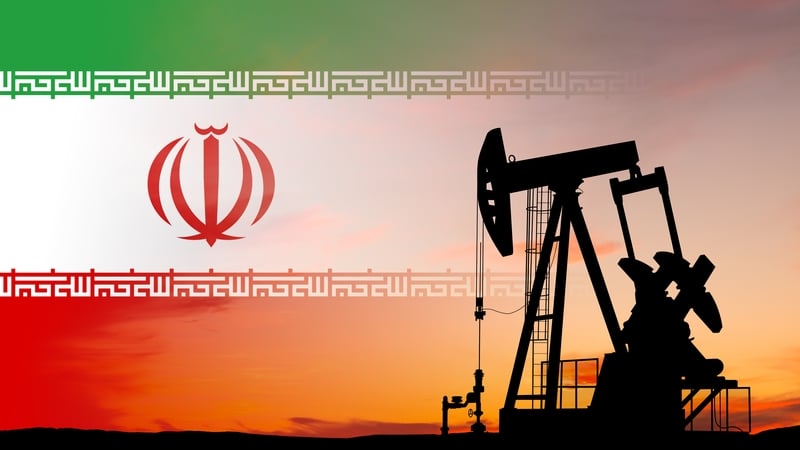
The newly appointed Supreme Leader Mojtaba Khamenei has declared the Strait of Hormuz, through which 20% of the world’s oil transits, will remain closed to shipping.
Despite reported talks between Tehran and French and Italian officials to allow safe passage to tankers, there is no sign of the waterway being reopened.
This week, five oil vessels in the region were struck by missiles.
"As oil prices rise, inflation's impact widens, dealing a significant blow to real disposable income and, consequently, consumer spending," said an Oxford Economics worst case scenario - based on Brent crude averaging $140 per barrel for several months.
"The surge in oil prices will elevate transportation costs and push up prices of food and other goods, heightening the risk of enduring second round inflation effects that could affect medium-term inflation expectations," it added.
EU leaders gathering for a summit in Brussels next Thursday already had high energy prices on the agenda even before the US and Israel attacked Iran on 28 February.
Voters are looking for answers, yet leaders have no way of knowing - let alone influencing - how long the war will last.
Household electricity prices had already risen sharply following Russia’s invasion of Ukraine and have remained elevated, with retail electricity prices today some 36% above their 2014-2020 average.
"The Iran war has infused a lot of uncertainty into energy markets and the world economy," warned Thijs van de Graaf, associate professor in international politics at Ghent University, in an interview with the Brussels Institute for Geopolitics.
He added: "A scenario in which a prolonged and severely escalating conflict sparks a global energy crunch can at this stage not be ruled out."
One EU diplomat lamented: "The causes of this are out of our control, yet we have to deal with the effects as they impact our businesses, our citizens - from home heating to petrol for the car."
Some member states were quick to pounce on potential price gouging.
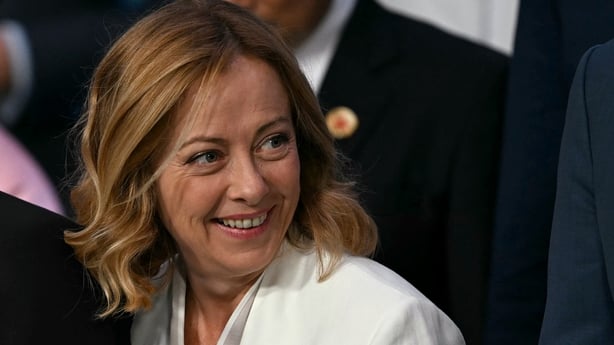
France carried out 500 checks at forecourts and Italian Prime Minister Giorgia Meloni warned against speculators "exploiting the crisis at the expense of families and businesses".
Inevitably, memories have been cast back to the punitive energy crisis triggered by Russia’s full-scale invasion of Ukraine in 2022.
Overnight, Europe was forced into abandoning the paradigm of cheap Russian oil and gas and replacing it with something else.
As a result, oil went above $120 a barrel and gas prices soared well above €300 per megawatt hour.
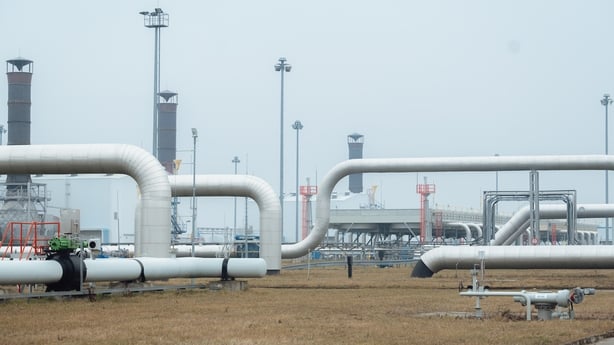
However, the EU’s response meant that dependence on Russian gas fell from 45% to 12%. Gas demand was reduced and Russian piped gas was replaced by US seaborne Liquified Natural Gas (LNG), which today provides one quarter of Europe’s needs.
Norway and Qatar make up most of the rest.
"We should not overestimate the similarities with 2022," said an EU diplomat.
The official said: "Then it was a supply issue, whereas now price is the issue.
"The supply issue is more towards Asia, where much of this stuff through the Strait of Hormuz is going.
"But because there's a supply issue there, it still drives up prices."
There is evidence the EU has learned lessons from 2022.
But the role gas plays in setting electricity prices for industry and consumers means that the shocking volatility in prices triggered by the Iran war is now a red hot political challenge.
Gas is often needed as the final link in the energy chain.
When solar energy slumps in the late afternoon, for example, gas is purchased to make up the shortfall in the production of electricity.
Overall, gas prices in Europe are up 75% compared to the start of the year, with natural gas production in Qatar grinding to a halt, wholesale prices have been fluctuating wildly.
According to Montel Analytics, on 4 March prices in Denmark swung from €26 per megawatt hour at 2pm to almost €430 by 5.45pm.
Yet, on Thursday wind and solar energy meant that Danish consumers enjoyed free electricity for three hours.
What can be done?
The European Commission will present a range of proposals to EU leaders on Thursday, looking at all components which make up the cost of producing electricity.
Generating power - converting gas into electricity - makes up more than 56% of the cost, grid charges represent 18%, taxes and levies 15%, while the cost of producing carbon under the Emissions Trading System (ETS) is around 11%.
Yet, there are wide variations across member states on how electricity is priced and taxed, how the grid is managed and how effective interconnectors are.
"Some countries have zero taxes on electricity, some have huge levels of tax," said a senior EU official.
The official said: "In some countries, grid fees are very high. In other countries they’re quite low.
In some countries, the carbon price actually is a real factor. In others it’s not."
This results in a wide fluctuation in energy prices, a factor seen as a considerable drag on the competitiveness of the EU’s single market.
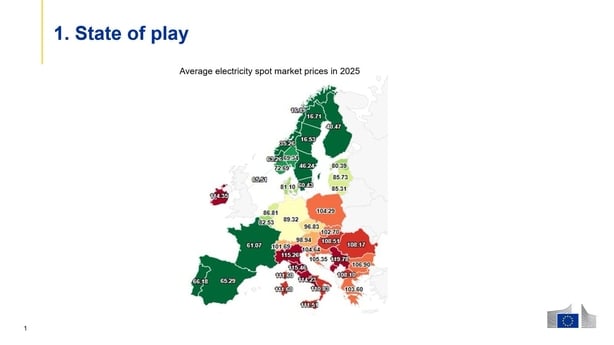
According to the European Commission, average spot market prices per megawatt hour in 2025 in France, Spain and Portugal were €61.07, €65.29 and €66.18 respectively.
Meanwhile in parts of Sweden and Norway they were as low as €16.10 and €16.70.
By contrast, the average spot market price for electricity in Ireland was €114.35, while in northern Italy it was over €115.
The higher priced countries are those which rely on gas.
Spain and Portugal have made renewables a big part of their energy mix, France relies heavily on nuclear energy, as do Sweden and Finland, where biomass - thanks to heavy forestation - provides an extra competitive edge.
Ireland’s disadvantage is down to the fact the economy boomed in an era, the 1990s, when gas-powered energy was cheap - nuclear power stations built in the 20th century were not an option.
For now, Ireland has an over reliance on gas and the electricity it produces gets very expensive because of the Iran war.
There is some relief on the horizon: the Celtic Interconnector between Ireland and France is due to come on stream in 2028, when there will be the benefit of cheaper French nuclear energy, while offshore wind energy should become available from the early 2030s.
Solar energy is also on the increase, meaning renewables account for some 40% of Ireland’s energy mix.
Retro-itting homes and getting the transport sector to switch to electric vehicles has not been so easy.
But the challenges remain.
Ireland’s relatively sparse population density means a bigger and more expensive grid.
When power comes from a big gas-fired station, there is a straightforward grid link - for example Moneypoint to Dublin- but if Ireland is moving to more renewables, then more variable grid lines will be needed.
The €350 million North-South Interconnector has been beset by local opposition to overhead cables, a problem faced to a similar extent in Germany, where there has been fierce opposition to cables linking wind energy hubs in the north to big population centres in the south which provide the demand.
Improving the efficiency of grid infrastructure has been a slow burn issue at EU level, as well as improving cross-border interconnection.
Both suffer from political resistance at national level.
Ireland was extremely fortunate in getting access to French energy through the interconnector.
Spain has tried in vain to get the same access, with France understandably reluctant to give away a competitive advantage to its Iberian neighbour.
The EU’s 2025 Grids Package is designed to accelerate electricity network expansion, modernise infrastructure and integrate renewable energy, while the Citizens Energy Package aims to combat energy poverty at a time when a growing number of Europeans have been struggling to pay bills.
Among the recommendations are the ability for homes with smart meters to use energy when electricity is plentiful, or cheaper, making it easier and quicker for consumers to switch provider, and for households to be rewarded when they shift consumption from peak time to cheaper periods.
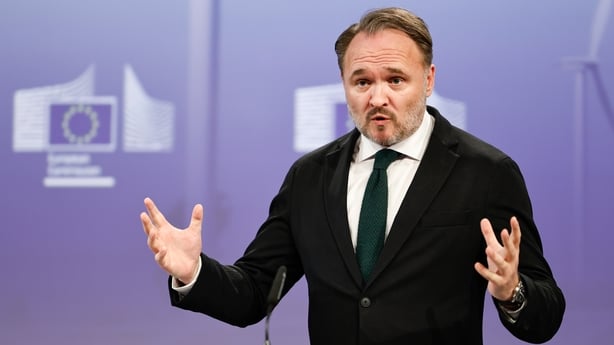
On Tuesday, the EU Energy Commissioner Dan Jørgensen called on governments to lower taxes and levies on electricity.
At a news conference in Strasbourg, he said: "If you are at all able to lower taxes on energy, especially on electricity, there is a huge potential.
"On average, the potential for energy bills in Europe would be a saving of €200 per year."
Leaders are unlikely to get into such minutiae on Thursday.
Bigger picture issues include a possible price cap on gas and changes to the Emissions Trading System (ETS).
In Strasbourg, European Commission President Ursula von der Leyen said it was crucial to lower the cost of gas in the immediate term, possibly through subsidies or a price cap, which is popular with some member states.
A contentious price cap was introduced following the Russian invasion of Ukraine, but the political compromise was that it was set so high - €180 per megawatt hour - that it was never triggered.
Most industry analysts, and one of Europe’s main suppliers Norway, oppose the idea.
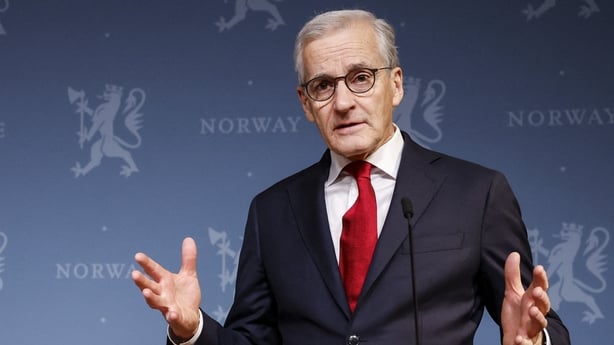
Norwegian Prime Minister Jonas Gahr Store told an event on Wednesday: "We notice that there are again discussions of a potential price cap on European gas.
"That would be unwise.
"We explained that in 2022 and we are ready to explain it again."
Ireland gets its gas from the UK, which in turn gets it from the North Sea, Norway, and Qatar via LNG.
The UK is highly unlikely to go for a price cap on gas, so Ireland is a somewhat neutral observer on the debate - especially with the Irish presidency of the EU coming up.
Meanwhile Italy is leading the charge to strip the ETS - which accounts for 11% of the cost of electricity - from power generation.
The Italian prime minister complained that because expensive gas often determines the final price of electricity - even if it has been mostly generated from renewables - it has rendered much of Italian industry uncompetitive.
In Strasbourg, Ms von der Leyen appeared unconvinced.
"Without ETS we would now consume 100 [billion cubic metres] more gas. Again, making us more vulnerable and more dependent," she said.
"So, we need ETS, but we need to modernise it," she added.
As the war enters its third week, the dangers facing the European economy remain elevated.
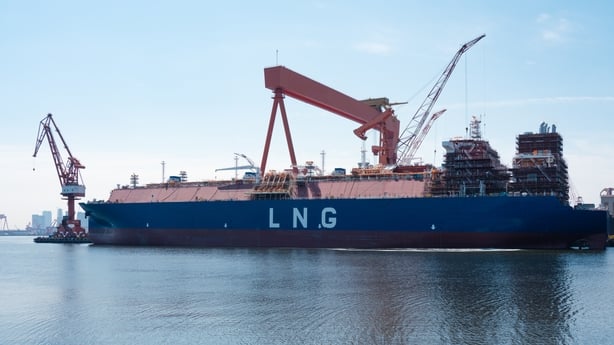
Despite a very high spike in the cost of gas following the Russian invasion, Europe was able to outbid competitors to get its hands on LNG exports.
EU officials point out that with the US and Qatar increasing their liquefaction capacity - to convert gas into shippable LNG - prices should start falling in the coming years anyway.
Yet, the Financial Times reported that shipments of scarce LNG, which had been en route to Europe, were diverted to Asia in early March because exporters were guaranteed a higher price.
While some contracts penalise LNG sellers if they shift products to higher paying customers, there is evidence that some producers are willing to break contracts for financial gain.
On paper, there should be a greater abundance of LNG in the coming years.
However, is Europe’s over reliance on Russia being replaced by over reliance on the United States?
"US energy exports are framed not only as commercial flows, but as tools of economic strength and geopolitical influence, intended to deepen ties with allies and constrain adversaries," concluded a paper by the Bruegel think-tank this week.
It said: "The EU can limit this risk by reducing gas and oil demand and maintaining high storage levels, especially during periods of political or trade tension.
"Lower EU gas demand reduces exposure to price volatility and allows the EU to be more selective in its choice of suppliers."
For now, it is impossible to predict how long the war will continue.
The Iranian regime knows its ability to cripple Gulf energy exports through drone attacks or mining the Strait of Hormuz has given it enviable leverage, even if Israel and the US continue to degrade its ability to launch ballistic missiles.
For the Islamic system in Tehran, the war is existential and surviving is winning.
Europe can only look on and hope that the lessons learned from 2022 will help cushion industry from the worst impacts.
However, if the Strait of Hormuz remains gridlocked for a prolonged period - uncharted waters are ahead.
Last summer, solar became the largest source of energy in the EU for the first time, but because it cannot yet be stored, big EU economies like Germany still rely on gas as does Ireland.
"There’s no quick fix here," said one EU source.
"You can only tweak things until we have the long term break from imported fossil fuels," the official added.